
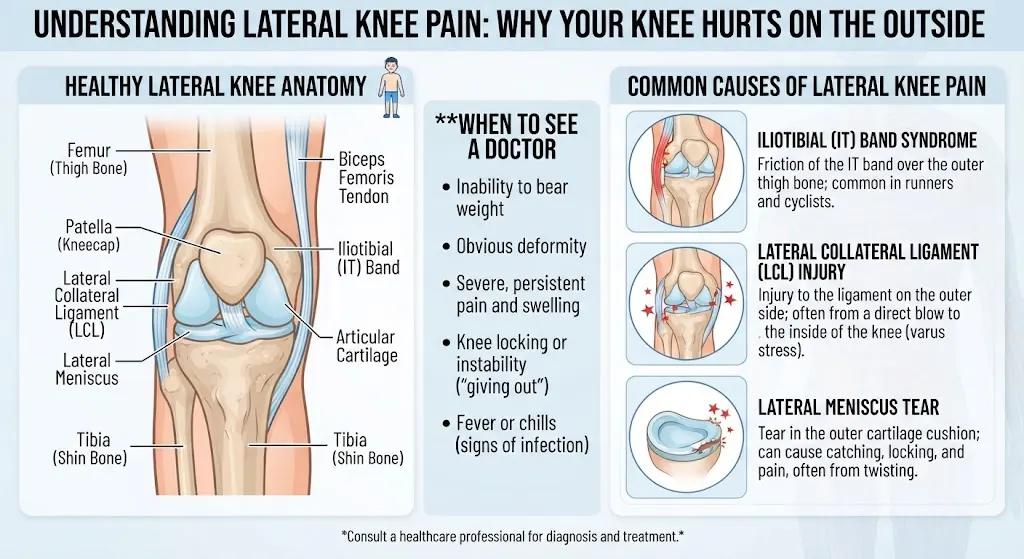
The location of the pain can offer clues, but it does not identify the cause by itself. Outer knee pain may involve tendons, ligaments, cartilage, or the tissues surrounding the joint. Swelling, instability, and difficulty straightening the knee can help determine how urgently it needs evaluation.
Understanding why your knee hurts on the outside can help you choose safer activities, recognize possible causes, and know when to seek medical care. Here are the most common explanations and practical steps that may help.
What Causes Pain on the Outside of the Knee?
The outer knee, also called the lateral knee, contains several structures that can become irritated or injured. The most likely cause depends on where the pain occurs, how it started, and which movements make it worse.
| Possible cause | Typical symptoms | Common triggers |
|---|---|---|
| Iliotibial (IT) band syndrome | Aching or sharp pain along the outer knee | Running, cycling, repetitive bending |
| Lateral meniscus tear | Pain along the joint line, sometimes with catching or swelling | Twisting, pivoting, deep squatting |
| Lateral collateral ligament (LCL) injury | Outer knee tenderness or instability | Impact to the inner knee or sudden direction changes |
| Knee osteoarthritis | Stiffness, aching, and reduced movement | Walking, prolonged activity, getting up after sitting |
| Tendon or muscle irritation | Localized tenderness or pain with resisted movement | Overuse or increased training intensity |
Other conditions can also cause outer knee pain. A clinician may consider these possibilities alongside the broader range of common causes of knee pain.
1. Iliotibial Band Syndrome
The iliotibial band is a strong strip of connective tissue running along the outside of your thigh to the knee. Repeated knee bending can irritate tissues around this area, particularly during running or cycling.
Pain often develops gradually and becomes more noticeable during exercise. Increasing mileage too quickly, changing running surfaces, or altering training routines may contribute.
2. Lateral Meniscus Tear
The meniscus is cartilage that helps cushion the knee. A tear in its outer portion can cause pain along the outside joint line, particularly when twisting, squatting, or turning on a planted foot.
Some people experience swelling, catching, or difficulty fully straightening the knee. Learn about meniscus tear symptoms and treatment options to understand how these injuries are evaluated.
3. Lateral Collateral Ligament Injury
The LCL helps stabilize the outer side of the knee. It can stretch or tear after a collision, awkward landing, or force that pushes the knee sideways.
Pain may occur with swelling or a feeling that the knee is giving way. Other ligament injuries can produce similar symptoms, so an examination is important after a significant injury. The guide to different types of knee ligament injuries explains these differences.
4. Knee Osteoarthritis
Osteoarthritis can affect one or more areas of the knee, including the outer compartment. Symptoms may include aching, stiffness after rest, reduced flexibility, and discomfort during weight-bearing activities.
Pain can develop gradually and fluctuate from day to day. Read about knee arthritis symptoms and treatment for more information.
How Can You Tell Which Knee Problem You Might Have?
The pattern of your symptoms can help narrow down the possibilities, although it cannot confirm a diagnosis.
| Symptom pattern | Possible explanation | What to consider |
|---|---|---|
| Pain during repeated running | IT band irritation | Reduce aggravating training |
| Pain after twisting the knee | Meniscus or ligament injury | Arrange an assessment if persistent or severe |
| Pain with swelling and instability | Ligament or internal joint injury | Seek prompt medical evaluation |
| Stiffness after resting | Osteoarthritis or another joint condition | Monitor mobility and symptom duration |
| Pain with a sudden pop and difficulty bearing weight | Significant injury, including a fracture or ligament tear | Seek urgent evaluation |
For example, outer knee pain accompanied by locking may warrant assessment for a meniscus injury. A knee that repeatedly gives way may indicate instability. However, overlapping symptoms mean that these patterns should not be used for self-diagnosis.
A comparison of meniscus tear versus knee arthritis may help explain why symptoms sometimes overlap.
How Can You Relieve Outer Knee Pain at Home?
Mild pain without significant swelling, instability, or a major injury may improve with temporary activity changes.
-
Reduce painful activities: Pause running, deep squats, jumping, and twisting if they worsen symptoms.
-
Apply ice: Use a cold pack wrapped in a towel for 15–20 minutes at a time, especially after activity.
-
Keep moving gently: Short, comfortable walks or gentle knee movements may help prevent stiffness if you can bear weight normally.
-
Return gradually: Resume exercise in stages rather than immediately returning to your previous intensity.
Avoid forcing stretches or continuing an exercise that produces sharp pain, locking, or instability. For broader guidance, see low-impact exercises for painful joints.
If pain began during running, reducing training volume and reviewing recent changes in distance or intensity may help. The advice on why your knee hurts after running may be useful.
Which Exercises Should You Avoid?
Avoid movements that consistently reproduce your pain until the cause is clearer. Deep squats, rapid pivots, high-impact jumps, and aggressive stretching may aggravate some injuries.
Gentle strengthening can be helpful during recovery, but the appropriate exercises depend on the underlying condition. A physical therapist can tailor a program that improves strength and control without overloading the affected tissues. You can also review exercises for painful knees for related movement considerations.
When Should You See a Doctor for Outer Knee Pain?
Symptoms You Can Usually Monitor
Brief, mild discomfort after unfamiliar activity may be monitored if it improves with rest and normal movement remains comfortable. Stop activities that trigger the pain and watch for improvement over the following days.
Symptoms That Need Medical Evaluation
Arrange an appointment if pain persists, repeatedly returns, limits walking, or is accompanied by recurring swelling, catching, or reduced movement. Assessment is also appropriate if symptoms are getting worse despite activity modification.
Warning Signs Requiring Urgent Care
Seek urgent medical evaluation if you experience:
-
Severe pain after an injury or inability to bear weight.
-
A visibly deformed knee or rapid, substantial swelling.
-
A knee that locks and cannot fully straighten.
-
A hot, red, swollen knee accompanied by fever.
-
New calf swelling or pain, particularly with warmth or redness.
Chest pain or shortness of breath alongside leg swelling requires emergency care because it can indicate a blood clot that has traveled to the lungs.
How Is Outer Knee Pain Diagnosed?
A clinician will ask when the pain started, whether an injury occurred, and which movements make it worse. The examination may assess tenderness, swelling, range of motion, strength, and ligament stability.
Imaging is not always necessary. X-rays may help assess fractures or arthritis, while MRI can be useful when a meniscus, ligament, or other internal knee injury is suspected. The choice depends on the examination and clinical findings.
For more information about evaluating an injury, see sharp knee pain after an injury: ACL or meniscus tear?.
Frequently Asked Questions
1. Why does my knee hurt on the outside but not swell?
Mild tendon irritation or IT band syndrome can cause pain without noticeable swelling. The absence of swelling does not rule out a meniscus injury or another knee problem.
2. Can walking make outer knee pain worse?
Yes. Repeated weight-bearing can aggravate certain injuries, particularly if pain increases with each step. Reduce walking distance if symptoms worsen, and seek assessment if you cannot walk normally.
3. Why does the outside of my knee hurt when I bend it?
Bending loads several knee structures, including the meniscus, tendons, and joint surfaces. Pain during bending may result from irritation or injury, especially when accompanied by catching or restricted movement.
4. Can running cause pain on the outside of the knee?
Yes. IT band syndrome is a common possibility in runners, particularly after a sudden increase in training. Other causes, including meniscus problems, are possible.
5. How long does outer knee pain take to heal?
Recovery ranges from several days for minor irritation to weeks or months for more significant injuries. The timeline depends on the cause, severity, and whether aggravating activities are modified.
6. Should I use heat or ice for outer knee pain?
Ice may help ease discomfort after recent irritation or an injury. Gentle heat may feel soothing for stiffness without substantial swelling, but neither treatment addresses every underlying cause.
7. Can a meniscus tear cause pain only on the outside?
Yes. A tear involving the lateral meniscus can cause localized outer joint-line pain. Some tears also cause swelling, catching, or locking, while others produce fewer obvious symptoms.
8. Is outer knee pain a sign of arthritis?
It can be, particularly when pain develops gradually with stiffness and activity-related discomfort. However, tendon irritation, ligament injuries, and meniscus problems can cause similar symptoms.
9. Should I keep exercising if my outer knee hurts?
Avoid exercises that worsen pain, especially running, jumping, and twisting. Gentle, comfortable movement may be appropriate, but persistent symptoms or instability warrant professional guidance.
10. Can outer knee pain go away on its own?
Mild overuse-related discomfort may improve with activity modification and gradual return to exercise. Persistent, worsening, or injury-related pain should be evaluated rather than assumed to resolve without treatment.
Conclusion
Outer knee pain can result from overuse, cartilage injuries, ligament damage, or arthritis. Pay attention to the location of the pain, associated symptoms, and how your knee responds to activity. Reduce aggravating movements, return to exercise gradually, and seek medical evaluation when symptoms persist or warning signs develop.
If you are unsure what is causing your pain, noting when it started and which movements trigger it can help a clinician determine the next steps.
Disclaimer: This article is provided for educational and informational purposes only.
This article is for education purpose only and is not a diagnosis or a substitute for medical advice.