
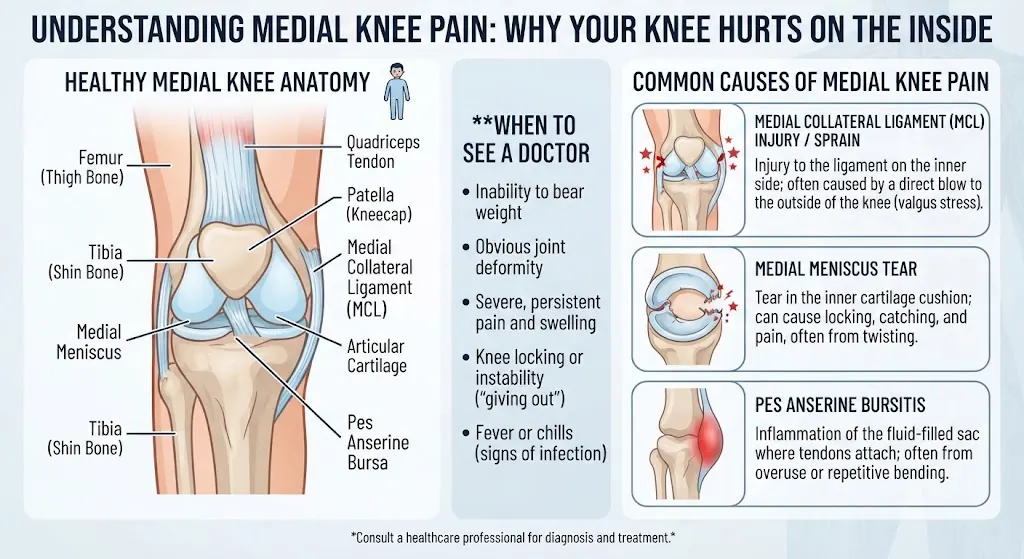
Pain on the inside of the knee does not always mean you have a torn ligament or meniscus. It may result from overuse, irritation of nearby tendons, age-related joint changes, or an injury. Swelling, instability, difficulty straightening the knee, and the way the pain started can help determine whether you need medical evaluation.
Understanding why your knee hurts on the inside can help you choose appropriate next steps. This guide explains common causes, how symptoms differ, what you can safely do at home, how long recovery may take, and which warning signs should not be ignored.
What Causes Pain on the Inside of the Knee?
The most common explanations include irritation of the medial meniscus, injury to the medial collateral ligament (MCL), knee osteoarthritis, and inflammation of the pes anserine tendons or bursa. The right explanation depends on the location, onset, severity, and associated symptoms.
If you experience common causes of knee pain, consider how the discomfort behaves during movement rather than relying on its location alone.
1. Medial meniscus tear
The medial meniscus is a C-shaped piece of cartilage that cushions the inner side of the knee. A tear can occur when the knee twists under load, particularly during sports, or develop gradually as the tissue becomes less resilient with age.
Typical symptoms include pain along the inner joint line, swelling, catching, and discomfort when turning or squatting. Some people can still walk with a tear, and swelling may be absent.
Pain that appears after a twisting injury may warrant an assessment for a meniscus tear. A knee that becomes physically locked and cannot fully straighten needs prompt medical evaluation.
2. Medial collateral ligament (MCL) injury
The MCL runs along the inner knee and helps prevent excessive sideways movement. It may stretch or tear when a force pushes the knee inward, such as during a collision or awkward landing.
Pain and tenderness directly along the ligament, swelling, and a feeling that the knee is unstable can occur. More substantial injuries may make walking difficult.
An MCL injury differs from a meniscus tear, although both can happen during the same incident. Clinicians may assess the mechanism of injury and knee stability to distinguish them.
3. Knee osteoarthritis
Osteoarthritis involves changes to joint cartilage and other joint tissues. Inner knee pain may develop gradually, particularly during walking, standing, or stair climbing, and may accompany stiffness after resting.
People with osteoarthritis can experience intermittent swelling, reduced movement, and stiffness after waking. Age, previous knee injuries, and other individual factors can influence risk.
For a broader comparison, see meniscus tear vs. knee arthritis.
4. Pes anserine bursitis or tendon irritation
The pes anserine tendons and nearby bursa sit below the inner knee joint, toward the upper shin. Irritation in this area can cause localized tenderness, especially when climbing stairs, exercising, or bending the knee repeatedly.
Pain from this condition is usually lower than pain directly at the joint line. Repetitive activity, changes in training, and altered knee mechanics may contribute.
5. Other possible causes
Pain may also arise from cartilage damage, other ligament injuries, or referred pain from nearby structures. Less commonly, infection, inflammatory arthritis, or a blood clot can cause symptoms that require urgent assessment, especially when accompanied by fever, marked warmth, or significant leg swelling.
How Can You Tell Which Condition Is Causing Inner Knee Pain?
The pattern of pain can help narrow down possible causes, but no single symptom confirms a diagnosis. The following comparison summarizes common differences.
| Possible cause | Typical pain location | Clues that may accompany it |
|---|---|---|
| Medial meniscus tear | Along the inner joint line | Twisting pain, catching, swelling |
| MCL injury | Along the inner ligament | Pain after impact, tenderness, instability |
| Knee osteoarthritis | Inner joint, sometimes more widespread | Stiffness, activity-related pain |
| Pes anserine irritation | Below the inner joint line | Local tenderness, pain on stairs |
| Other joint or soft-tissue problems | Varies | Symptoms depend on the affected structure |
These patterns overlap. A physical examination is often needed to determine which structure is involved, and imaging may be appropriate depending on the findings.
What does inner knee pain during specific movements mean?
-
When twisting: A meniscus injury is one possibility, especially after a sudden turn. Avoid repeatedly twisting the knee to test it.
-
When climbing stairs: Osteoarthritis, meniscus irritation, and pes anserine problems can all cause discomfort.
-
When bending or squatting: Joint compression and increased load can aggravate several knee conditions. See why your knee hurts when you squat.
-
When straightening the leg: Swelling, joint irritation, or a mechanical problem may restrict movement. Read about knee pain when straightening the leg.
-
When walking: The cause may range from temporary overuse to a meniscus or ligament injury. Pain that progressively limits walking deserves assessment.
Pain location alone is not enough to determine whether an injury is minor or serious.
What Should You Do for Inner Knee Pain at Home?
For mild pain without a major injury or warning signs, temporarily reducing aggravating activities and managing swelling may help. The goal is to protect the knee without unnecessarily avoiding all movement.
1. Modify activities
For several days, reduce movements that clearly worsen your symptoms, particularly deep squats, pivoting, running, and repeated stair climbing. You can try shorter walks on level ground if you can walk comfortably without limping or increasing the pain.
If walking makes the symptoms worse, reduce the distance rather than pushing through. Guidance on walking with a torn meniscus can help explain why activity tolerance matters when a meniscus injury is suspected.
2. Use cold therapy for recent pain or swelling
Apply a cold pack wrapped in a thin towel for about 15–20 minutes at a time. Check your skin regularly and avoid applying ice directly to the skin, especially if you have reduced sensation or circulation.
Cold therapy may provide temporary relief, but it does not repair a torn ligament or meniscus. Elevating the leg when resting may also help manage swelling.
3. Keep gentle movement within a comfortable range
If there is no significant injury, severe swelling, or mechanical locking, gentle knee bending and straightening may help prevent stiffness. Stop if movement causes sharp pain, instability, or increasing swelling.
Low-impact activity may be useful as symptoms improve. Explore low-impact exercises for painful joints, but choose activities according to your symptoms and any advice from your clinician.
4. Consider medication carefully
Some people can use over-the-counter pain relievers, such as acetaminophen or an anti-inflammatory medicine, but these are not appropriate for everyone. Anti-inflammatory medicines such as ibuprofen can increase the risk of stomach bleeding, kidney problems, and cardiovascular complications, and may interact with other medications.
Ask a pharmacist or clinician which option is appropriate if you have chronic medical conditions, take blood thinners, are pregnant, or use other regular medicines. Do not exceed the product label’s recommended dose.
5. Avoid forcing recovery
Do not repeatedly test the knee with painful twisting movements, push through significant pain, or return immediately to intense workouts. A supportive brace or knee sleeve may help some people, but the appropriate type depends on the injury; a brace cannot substitute for assessment when the knee feels unstable.
When Should You See a Doctor for Inner Knee Pain?
The urgency depends on how the pain started and whether other symptoms are present.
| Symptom pattern | Recommended action |
|---|---|
| Mild soreness after activity that steadily improves, with normal walking | Monitor symptoms and modify activity |
| Pain lasting several days without improvement, recurring pain, or persistent swelling | Arrange a medical appointment |
| Pain after a twisting injury, repeated catching, or a feeling that the knee gives way | Seek prompt clinical assessment |
| A knee that is locked and cannot straighten, or inability to bear weight after an injury | Seek urgent medical evaluation |
| A hot, red, markedly swollen knee with fever or feeling seriously unwell | Seek emergency assessment |
| New calf swelling with warmth or pain, particularly on one side | Seek urgent assessment for a possible blood clot; chest pain or shortness of breath requires emergency care |
Severe pain after an accident, an obvious deformity, or a cold, pale, or numb foot also warrants emergency evaluation. Do not attempt to force a locked or visibly deformed knee back into position.
How Is Inner Knee Pain Diagnosed?
A clinician usually begins by asking when the pain started, whether an injury occurred, and which movements make it worse. They may check swelling, tenderness, range of motion, walking ability, and ligament stability.
Depending on the examination, imaging may help identify the cause. X-rays can show bone changes and signs of osteoarthritis, but they do not directly show most meniscus or ligament tears. MRI can provide detailed images of these soft tissues when the results are likely to affect treatment decisions.
The American Academy of Orthopaedic Surgeons’ 2024 guideline identifies MRI as the preferred imaging test for suspected acute meniscus tears. It also supports combining relevant physical examination findings rather than relying on one test alone.
For a closer look at symptoms and assessment, see early signs of a meniscus injury for general guidance, and discuss whether imaging is appropriate with your clinician.
What does the research say about knee injuries?
Research helps explain why inner knee pain deserves a careful assessment rather than an automatic assumption that the meniscus is torn.
| Research finding | What it means for patients |
|---|---|
| An AAOS guideline summary reports meniscus tears in about 12% of adults.
OrthoInfo +1
|
Meniscus abnormalities are relatively common, but symptoms and examination findings matter when deciding whether a tear explains your pain. |
| The CDC reports that about 33 million U.S. adults have osteoarthritis.
CDC
|
Osteoarthritis is a common potential cause of knee pain, particularly in middle-aged and older adults. |
| The 2024 AAOS guideline recommends preserving as much functional meniscus tissue as possible when surgery is indicated.
AAOS
|
Surgery decisions should consider the tear pattern, symptoms, healing potential, and long-term joint health. |
These figures describe populations, not an individual’s likelihood of having a particular condition. A scan finding alone does not establish that an abnormality is causing pain.
How Long Does Inner Knee Pain Take to Heal?
Recovery depends on the underlying problem, its severity, your activity demands, and whether treatment is needed. Mild irritation may settle over days to a few weeks, while ligament injuries, persistent meniscus symptoms, and osteoarthritis may require longer-term management.
| Possible cause | General recovery expectations |
|---|---|
| Mild overuse or soft-tissue irritation | Often improves over several days to a few weeks with appropriate activity changes |
| Mild MCL sprain | May improve over several weeks; more severe injuries take longer |
| Meniscus tear treated without surgery | Symptoms may improve over weeks, but the tear may not structurally heal |
| Meniscus repair surgery | Rehabilitation often takes several months, depending on the repair and recovery plan |
| Knee osteoarthritis | Often requires ongoing symptom management rather than a fixed healing timeline |
These are broad expectations, not guaranteed deadlines. Persistent pain, increasing swelling, or difficulty returning to normal activities should prompt reassessment.
If a meniscus tear is suspected, learn about whether a meniscus tear can heal on its own. Some tears have healing potential, while others may continue to cause symptoms.
Frequently Asked Questions
1. Why does my knee hurt on the inside but have no swelling?
Mild soft-tissue irritation, early osteoarthritis, and some meniscus injuries can cause pain without visible swelling. The absence of swelling does not rule out an injury, especially if pain persists or movement becomes difficult.
2. Can walking make inner knee pain worse?
Yes. Walking increases the load on the knee, which may aggravate an irritated joint or injured tissue. Shorter walks on level ground may be more comfortable, but stop and seek assessment if you cannot bear weight normally.
3. Is inner knee pain a sign of a torn meniscus?
It can be, particularly when pain begins after twisting and is accompanied by catching or swelling. However, ligament injuries, arthritis, and tendon irritation can produce similar symptoms.
4. Why does the inside of my knee hurt when I bend it?
Bending increases pressure within the knee and can aggravate several conditions, including meniscus irritation and osteoarthritis. If bending causes locking or you cannot fully straighten the leg afterward, arrange prompt medical evaluation.
5. Why does my inner knee hurt when I climb stairs?
Stair climbing increases the forces passing through the knee. Osteoarthritis, meniscus problems, and irritation of the tendons below the inner knee can all cause discomfort during this activity.
6. Should I use ice or heat for inner knee pain?
Cold therapy is often useful for recent pain or swelling, particularly after an injury. Gentle heat may help some people with stiffness, but avoid heating a newly injured, hot, or markedly swollen knee without medical guidance.
7. Do I need an MRI for pain on the inside of my knee?
Not always. A clinician may diagnose some problems through your history and physical examination, while MRI may be appropriate when a meniscus or other soft-tissue injury is suspected and the result could change treatment.
8. Can inner knee pain go away without treatment?
Mild overuse symptoms may settle with reduced aggravating activity and gradual return to movement. Persistent structural injuries or osteoarthritis may need targeted treatment, so improvement should not be assumed if symptoms continue.
9. What exercises should I avoid when my inner knee hurts?
Temporarily avoid movements that trigger sharp pain, including deep squats, loaded twisting, and intense pivoting. Guidance on exercises to avoid with a meniscus injury may be useful if that injury is suspected, but an individualized plan is preferable.
10. When is inner knee pain an emergency?
Seek emergency care for a hot, red, markedly swollen knee accompanied by fever or severe illness, a major injury with deformity, or a cold or numb foot. Sudden calf swelling also needs urgent assessment, and chest pain or shortness of breath requires emergency care.
Conclusion
Pain on the inside of the knee can come from a meniscus tear, MCL injury, osteoarthritis, or irritation of nearby tendons and bursae. The way the pain started, the movements that aggravate it, and accompanying symptoms help guide the evaluation.
For mild symptoms, temporarily modifying activity, using cold therapy when appropriate, and maintaining comfortable movement may help. Persistent pain, instability, locking, or significant swelling warrants medical assessment, while emergency warning signs require immediate care.
Disclaimer: This article is provided for educational and informational purposes only.
This article is for education purpose only and is not a diagnosis or a substitute for medical advice.