
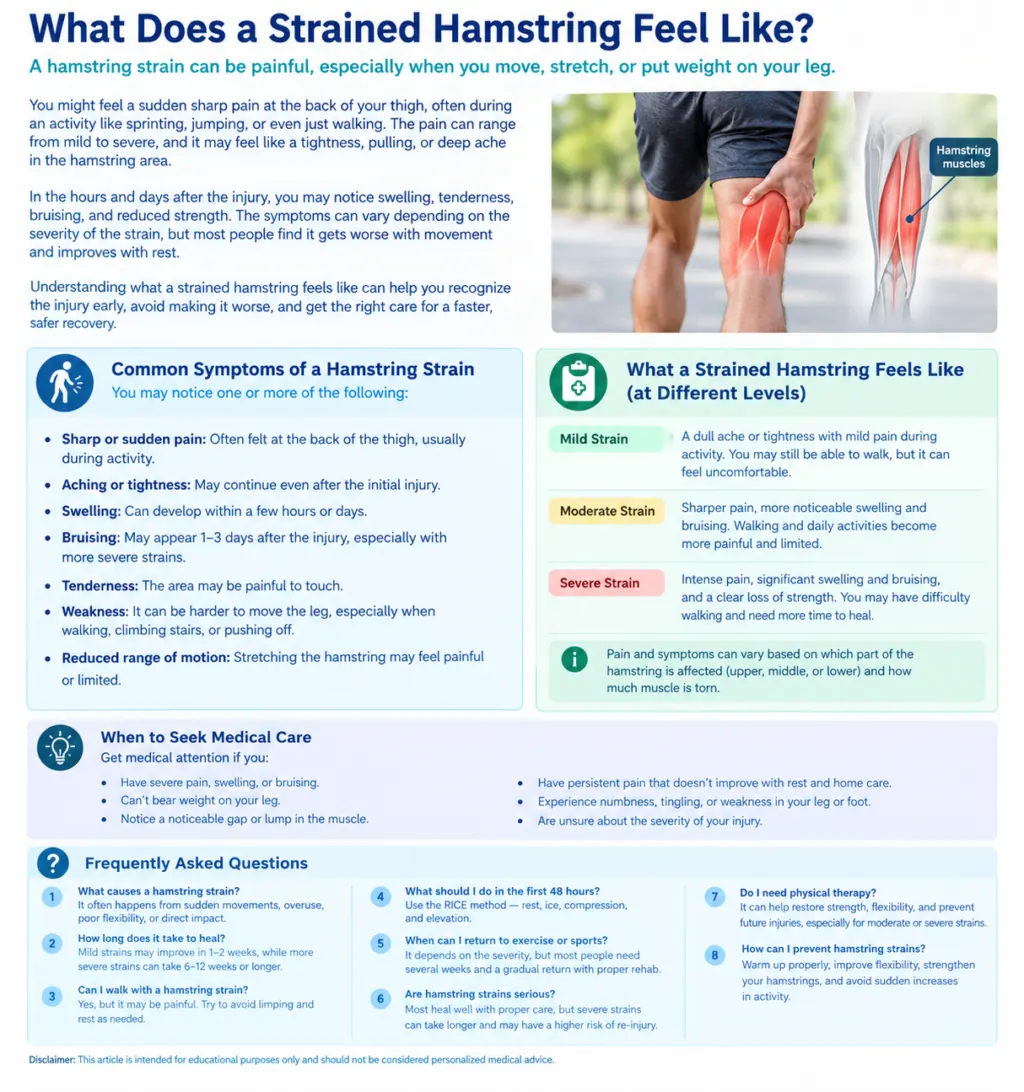
Not every hamstring strain causes severe pain or immediate swelling. A mild injury may feel like persistent tightness or soreness that becomes more noticeable after activity, while a more significant tear can cause bruising, weakness, and difficulty bearing weight. Recognizing these differences can help you decide whether home care is reasonable or a medical assessment is needed.
A hamstring strain occurs when one or more muscles or tendons at the back of the thigh are overstretched or torn. This guide explains what a strained hamstring feels like, how symptoms vary by severity, what can make the injury worse, and how to approach recovery safely.
What Does a Hamstring Strain Feel Like?
The most common sensation is pain or tightness along the back of the thigh. Symptoms may start suddenly during exercise or develop gradually after repeated strenuous activity.
Common signs include:
- Sharp or pulling pain: Often felt during sprinting, jumping, kicking, or sudden acceleration.
- Tightness in the back of the thigh: The muscle may feel stiff when walking, straightening the knee, or bending at the hip.
- Tenderness: Pressing the affected area may cause discomfort.
- Muscle weakness: The injured leg may feel less powerful when pushing off, climbing stairs, or bending the knee.
- Swelling or bruising: These can develop over several hours or days, particularly with a more substantial tear.
- Pain when stretching: Straightening the knee while bending forward may increase discomfort.
Some people feel a sudden snap or popping sensation when the injury occurs. This can indicate a more serious muscle or tendon injury, especially when followed by significant weakness or difficulty walking.
How Do Hamstring Strain Symptoms Vary by Severity?
Hamstring strains range from mild overstretching to more extensive tearing. Symptoms alone cannot reliably determine the exact grade, but the following comparison can help explain typical differences.
| Severity | What it may feel like | Common functional changes |
|---|---|---|
| Mild strain | Tightness, tenderness, or mild pain | Walking is usually possible, although faster movement may hurt |
| Moderate strain | More noticeable pain, weakness, and possible bruising | Walking, bending the knee, or climbing stairs may be difficult |
| Severe tear | Intense pain, marked weakness, swelling, or a popping sensation | Walking may be very difficult; a tendon injury may cause substantial loss of function |
A severe injury may involve a tendon pulling away from the bone rather than only muscle fibers tearing. This is one reason significant weakness, extensive bruising, or pain close to the buttock should be evaluated promptly.
Where Do You Feel Hamstring Strain Pain?
The location can vary depending on which part of the hamstring is injured.
- Upper back of the thigh: Pain near the buttock may involve the upper hamstring muscle or tendon, particularly after forceful stretching or sprinting.
- Middle of the back of the thigh: This is a common location for a muscle strain.
- Lower back of the thigh near the knee: Pain may occur closer to the hamstring tendons behind the knee.
Pain in these areas does not automatically confirm a hamstring strain. Other conditions, including tendon irritation, referred pain from the lower back, or an injury involving the knee, can produce similar symptoms. For broader context, see how hip flexor strain symptoms feel and develop.
What Causes a Strained Hamstring?
Hamstring strains commonly occur when the muscle lengthens under load or contracts forcefully. Activities involving rapid acceleration, sprinting, jumping, and sudden changes in direction can place substantial stress on the muscle.
Risk may increase when you:
- Increase exercise intensity or distance too quickly.
- Return to sport before recovering from an earlier strain.
- Have limited strength or conditioning for the activity.
- Exercise while fatigued.
- Perform demanding movements without an appropriate warm-up.
A warm-up can prepare the body for activity, but it cannot eliminate injury risk. Learn how warming up differs from stretching before exercise.
What Should You Do if You Think You Have a Hamstring Strain?
For a suspected hamstring strain, stop the activity that triggered the pain. Continuing to sprint, stretch aggressively, or exercise through sharp pain can aggravate the injury.
During the first day or two, consider these measures:
-
Protect the leg: Avoid movements that increase pain, particularly sprinting, jumping, and forceful bending at the hip.
-
Apply a cold pack: Wrap it in a towel and apply for 15–20 minutes at a time. Never place ice directly on the skin.
-
Use comfortable compression: A light thigh wrap may help with swelling, but remove it if you notice numbness, tingling, or increased pain.
-
Elevate the leg when practical: This may help if swelling develops.
-
Keep movement gentle: Short, comfortable walks may be reasonable for a mild strain, but do not force walking if you are limping significantly.
Avoid deep massage, forceful stretching, and intense strengthening during the early painful stage. For general guidance on how long a pulled muscle takes to heal, remember that recovery depends on the injury’s severity and location.
How Long Does a Strained Hamstring Take to Heal?
Recovery can take days to several months, depending on whether the injury involves mild muscle damage, a larger tear, or tendon involvement. Pain improving does not necessarily mean the muscle is ready for sprinting or competitive sport.
| Injury pattern | General recovery expectation | Important consideration |
|---|---|---|
| Mild strain | Often a few weeks | Return gradually as strength and movement improve |
| Moderate strain | Several weeks or longer | Weakness and pain may persist after everyday walking improves |
| Severe tear or tendon injury | Several months in some cases | Specialist assessment and structured rehabilitation may be necessary |
These are broad estimates, not guaranteed timelines. If you are not improving, or symptoms are substantial from the beginning, a clinician can assess whether additional treatment is needed.
When Can You Stretch or Exercise Again?
Start with comfortable daily movement rather than immediately returning to a full workout. Once pain settles, a clinician or physical therapist may recommend progressive mobility and strengthening exercises.
A sensible progression often includes:
-
Comfortable walking without a pronounced limp.
-
Gentle knee bending and straightening within a comfortable range.
-
Gradual strengthening exercises guided by symptoms and recovery.
-
Faster walking, jogging, and sport-specific movements only when strength and control have returned.
Do not use stretching as a test of whether the injury has healed. Strong stretching can increase pain in a recovering muscle. General guidance on low-impact exercises for people with joint pain may help you consider alternatives while avoiding activities that strain the thigh.
Before returning to sport, you should generally be able to walk, move the leg, and perform progressively demanding exercises without significant pain or weakness. A physical therapist can help determine when running and cutting movements are appropriate. Guidance on preventing injuries during workouts illustrates the broader value of gradual progression, although shoulder-specific advice does not apply directly to hamstring rehabilitation.
When Should You Seek Medical Care?
Symptoms that may be monitored
Mild soreness or tightness that improves with rest and gentle activity may be monitored briefly if you can walk normally and have no concerning symptoms.
Symptoms needing medical evaluation
Arrange an assessment if you have persistent pain, noticeable bruising, significant weakness, a recurring injury, or symptoms that are not improving. Pain near the sitting bone, especially after a sudden injury, may warrant evaluation for a tendon injury.
Symptoms requiring urgent care
Seek urgent medical attention if you cannot bear weight, have severe or rapidly worsening pain, develop substantial swelling, or experience a sudden pop followed by major weakness. A cold, pale, or numb foot after an injury also needs urgent assessment.
A clinician may examine the thigh, strength, movement, and tenderness. Imaging is not always necessary, but ultrasound or MRI may be considered if a major tear or tendon injury is suspected. If pain is concentrated around the knee rather than the thigh, other causes may need consideration, including knee ligament injuries or meniscus tear symptoms.
Frequently Asked Questions
1. Can you have a strained hamstring without bruising?
Yes. Mild strains may cause tenderness or tightness without visible bruising. Bruising can develop later and is more common with more substantial tissue damage.
2. Does a strained hamstring hurt when walking?
It can. Mild strains may allow normal walking, while more severe injuries can cause limping or make weight-bearing difficult.
3. Can you still run with a hamstring strain?
It is best to avoid running while it causes pain, weakness, or altered movement. Returning too early can aggravate the injury or contribute to recurrence.
4. Should you stretch a pulled hamstring?
Avoid forceful stretching during the painful early stage. Gentle mobility may be introduced as symptoms settle, ideally with professional guidance if pain or weakness persists.
5. Is heat or ice better for a hamstring strain?
Cold packs may help reduce pain during the first day or two. Heat may feel soothing later for some people, but neither treatment repairs a torn muscle on its own.
6. Can a hamstring strain cause pain behind the knee?
Yes. The hamstring muscles and tendons extend toward the back of the knee. However, sharp pain behind the knee can have other causes, so persistent or severe symptoms should be assessed.
7. How can you tell a strain from ordinary muscle soreness?
A strain often causes localized pain, tenderness, or weakness and may begin suddenly during activity. Ordinary post-exercise soreness commonly develops later and tends to affect the muscles more diffusely.
8. Can a hamstring strain heal on its own?
Many mild strains improve with appropriate activity modification and gradual rehabilitation. More severe tears or tendon injuries may need specialist treatment.
9. Why does my hamstring still hurt after resting?
Rest may reduce irritation, but injured tissue still needs time and appropriate rehabilitation to regain strength. Persistent pain can also mean the injury is more substantial than initially suspected.
10. How can you reduce the chance of straining your hamstring again?
Build strength gradually, warm up before vigorous activity, and increase running speed and training volume progressively. Avoid returning to full-intensity sport until strength, mobility, and movement control have recovered.
The Bottom Line
A strained hamstring typically feels like pain, pulling, or tightness in the back of the thigh, sometimes with weakness, swelling, or bruising. Stop painful activity, protect the leg, and return to exercise gradually. Seek medical assessment for significant weakness, substantial bruising, difficulty walking, or symptoms that fail to improve.
Disclaimer: This article is provided for educational and informational purposes only.
This article is for education purpose only and is not a diagnosis or a substitute for medical advice.