
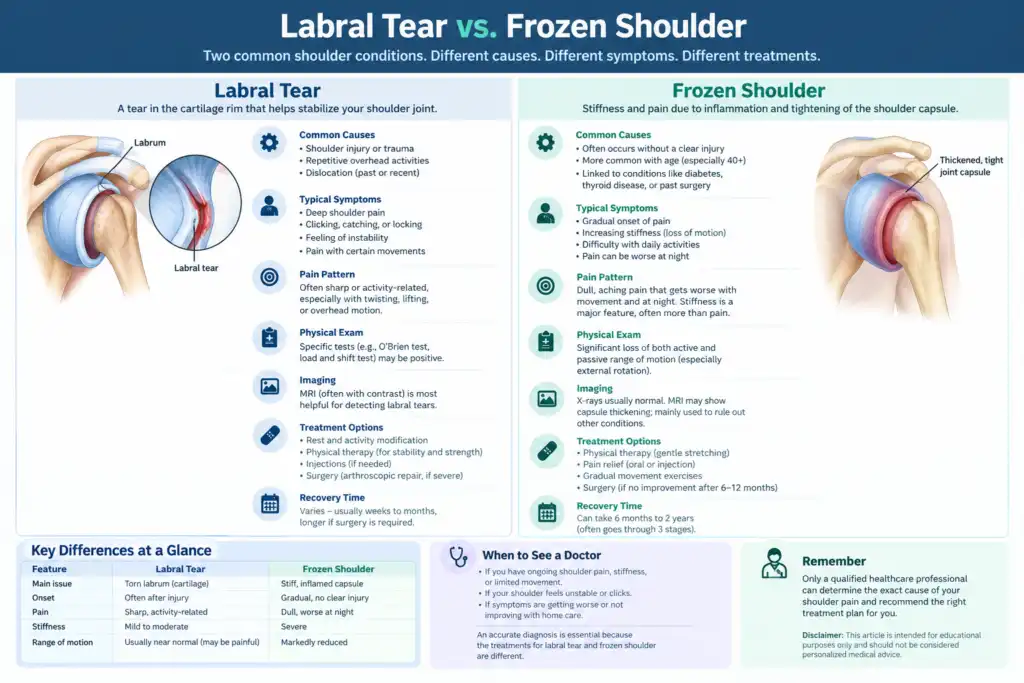
A labral tear and frozen shoulder can both cause shoulder pain, stiffness, and difficulty using the arm, but they are different problems. For example, you may notice catching or clicking when reaching overhead with a labral tear, while frozen shoulder often makes everyday movements such as reaching behind your back progressively harder. Understanding the pattern of symptoms can help you know what questions to discuss with a clinician.
One common misconception is that severe shoulder stiffness automatically means a labral tear, or that every painful shoulder with limited movement is frozen shoulder. The two conditions can overlap in symptoms, and shoulder pain alone cannot reliably distinguish them. However, the way the shoulder moves, how symptoms began, and whether the joint feels mechanically unstable can provide useful clues.
This guide explains the key differences between a labral tear and frozen shoulder, including symptoms, causes, movement limitations, diagnosis, treatment, recovery, and when medical evaluation is appropriate. If you are trying to understand your symptoms before an appointment, start by comparing the characteristic patterns below.
Labral Tear vs Frozen Shoulder: What Is the Difference?
A shoulder labral tear involves damage to the labrum, a ring of cartilage that helps deepen and stabilize the shoulder socket. Frozen shoulder, medically called adhesive capsulitis, involves tightening and inflammation of the capsule surrounding the shoulder joint.
The most useful distinction is often mechanical symptoms versus progressive stiffness.
| Feature | Labral tear | Frozen shoulder |
|---|---|---|
| Main problem | Labral damage and possible instability | Tight, painful shoulder capsule |
| Typical symptoms | Catching, clicking, pain, instability | Pain and marked stiffness |
| Range of motion | May be relatively preserved | Often restricted in multiple directions |
| Common trigger | Injury, repetitive overhead activity, or degeneration | Often develops gradually; sometimes after injury or immobilization |
| Feeling of instability | Can occur | Not usually the main symptom |
| Night pain | Can occur | Common, particularly during painful stages |
If you are unsure whether your symptoms fit a labral problem, reviewing the early signs of a shoulder labral tear can help you recognize the broader symptom pattern.
Labral Tear Symptoms vs Frozen Shoulder Symptoms
A labral tear may cause deep shoulder pain, clicking, catching, a sensation that the shoulder is slipping, or discomfort during overhead and throwing movements. Some people have relatively normal motion but experience pain or instability during specific activities.
Frozen shoulder tends to produce more obvious loss of movement. Reaching overhead, putting on a shirt, fastening clothing behind the back, or reaching for something on a high shelf can become increasingly difficult.
| Symptom or movement | More suggestive of labral tear | More suggestive of frozen shoulder |
|---|---|---|
| Clicking or catching | Commonly reported | Less characteristic |
| Feeling shoulder may slip | Possible | Unusual |
| Progressive stiffness | Less typical | Very characteristic |
| Difficulty reaching behind back | Possible | Common |
| Pain at night | Possible | Common |
| Major restriction in several directions | Less typical | Characteristic |
| Pain after a specific shoulder injury | Possible | Possible |
Because symptoms overlap, it is also useful to understand what a labral tear is and its symptoms before assuming that stiffness has a particular cause.
What Causes a Labral Tear?
Labral tears can occur after a fall, forceful shoulder movement, dislocation, repetitive overhead activity, or sports involving throwing. Age-related changes can also affect the labrum without one obvious injury.
There are several forms of labral injury, so the location and type of tear matter. You can review the different types of shoulder labral tears to understand why symptoms can vary from one person to another.
Frozen shoulder has a different mechanism. The capsule around the shoulder becomes painful and progressively contracted, restricting normal joint movement. It may occur after shoulder injury or surgery, prolonged immobilization, or alongside certain medical conditions, although sometimes no clear cause is identified.
Which Condition Causes More Stiffness?
Frozen shoulder is generally associated with a more pronounced and consistent loss of shoulder motion.
A person with a labral tear may be able to move the shoulder through a relatively broad range but experience pain, clicking, catching, or instability during particular movements. With frozen shoulder, both active movement and passive movement can become restricted.
This distinction is important during a physical examination because a clinician can assess whether the shoulder remains stiff even when the arm is moved with assistance.
How Are Labral Tears and Frozen Shoulder Diagnosed?
Diagnosis starts with your medical history and a physical examination. A clinician may ask when symptoms started, whether there was an injury, which movements cause pain, and whether you notice clicking, catching, weakness, or instability.
Imaging may be used when a labral injury is suspected. An MRI for a shoulder labral tear can provide information about soft tissues, although the findings must be interpreted alongside symptoms and examination results.
In some cases, an MRI arthrogram for a shoulder labral tear may be considered because contrast placed into the joint can make certain labral abnormalities easier to evaluate.
Frozen shoulder is often diagnosed primarily from the characteristic history and physical examination, particularly the pattern of restricted movement.
Labral Tear vs Frozen Shoulder Treatment
Treatment depends on the cause, severity, duration of symptoms, functional limitations, and whether other shoulder problems are present.
| Treatment approach | Labral tear | Frozen shoulder |
|---|---|---|
| Activity modification | Often useful | May reduce irritation |
| Physical therapy | Commonly used | Core part of treatment |
| Pain medication | May be recommended | May be recommended |
| Mobility exercises | Depends on tear and symptoms | Usually important |
| Surgery | Sometimes considered | Usually not the first treatment |
| Recovery | Varies by tear and treatment | Often progresses through stages |
For a labral injury, treatment may include rehabilitation before surgery is considered. More information is available in this guide to shoulder labral tear treatment and physical therapy versus surgery.
If the diagnosis is a SLAP tear specifically, SLAP tear physical therapy and recovery provides more condition-specific rehabilitation information.
Can Exercise Help?
Exercise can be helpful, but the appropriate exercises depend on the diagnosis.
For a labral tear, rehabilitation generally focuses on restoring useful shoulder motion, strength, and control without repeatedly provoking symptoms. The best exercises for labral tear recovery should be adapted to the individual injury.
Some movements may aggravate a labral injury, particularly when they repeatedly reproduce pain, catching, or instability. Learn which exercises to avoid with a shoulder labral tear may need modification.
For frozen shoulder, gentle mobility is generally more important because persistent stiffness is a central feature. However, forcing the shoulder aggressively can increase pain rather than improve function.
When Should You See a Clinician?
Persistent shoulder pain or progressive loss of movement deserves medical evaluation, particularly when symptoms interfere with sleep, work, dressing, exercise, or daily activities.
Seek more prompt evaluation if you develop significant weakness, recurrent instability, a visible deformity, sudden inability to move the arm, persistent numbness, or severe pain following an injury.
If you already know you have a labral tear, understanding signs that a labral tear may be getting worse can help you recognize changes that warrant reassessment.
Symptoms that can usually be monitored
Mild, stable discomfort that improves with activity modification can sometimes be monitored while arranging routine care.
Symptoms needing medical evaluation
See a clinician when pain persists, stiffness progressively worsens, shoulder function declines, or symptoms repeatedly interfere with sleep or daily activities.
Symptoms requiring urgent attention
Sudden severe pain with deformity, an apparent dislocation, major loss of function, or new significant neurological symptoms should receive prompt medical attention.
What If a Labral Tear Is Left Untreated?
Not every labral tear requires surgery. Some people manage symptoms successfully with activity modification and rehabilitation, depending on the type of tear and their functional demands.
The question can a shoulder labral tear heal without surgery is therefore more complicated than a simple yes-or-no answer. Structural healing and improvement in pain and function are not always the same thing.
Likewise, daily adjustments can matter. How to live with a labral tear and manage daily activities covers practical strategies for managing symptoms.
Frequently Asked Questions
1. How can I tell a labral tear from frozen shoulder?
A labral tear may cause clicking, catching, deep pain, or instability, while frozen shoulder is more strongly associated with progressive restriction of shoulder movement. A physical examination is often needed to distinguish them reliably.
2. Can a labral tear cause shoulder stiffness?
Yes. Pain and protective muscle guarding can reduce movement after a labral injury. However, substantial restriction in several directions is more characteristic of frozen shoulder.
3. Does frozen shoulder cause clicking?
Clicking can occur for different reasons, but prominent catching or mechanical symptoms are not the defining features of frozen shoulder. Repeated painful catching should be discussed with a clinician.
4. Which condition causes more night pain?
Both can cause nighttime discomfort. Frozen shoulder commonly produces significant night pain, while a labral tear can also become painful when the shoulder is compressed or positioned in certain ways during sleep.
5. Can a labral tear turn into frozen shoulder?
A labral tear does not inherently turn into frozen shoulder. However, prolonged pain or immobilization after a shoulder injury can contribute to stiffness, and persistent restriction should be evaluated.
6. Is physical therapy used for both conditions?
Yes, but the goals can differ. Labral rehabilitation may emphasize shoulder control and stability, while frozen shoulder treatment commonly emphasizes gradually restoring mobility and function.
7. Can an MRI diagnose frozen shoulder?
Frozen shoulder is usually diagnosed clinically rather than solely from an MRI. Imaging may be used when a clinician needs to exclude other causes of pain or stiffness.
8. Does every labral tear need surgery?
No. Treatment depends on symptoms, tear type, activity demands, instability, and response to conservative care. Surgery may be considered when appropriate nonoperative treatment does not provide adequate improvement.
9. How long does a labral tear take to recover?
Recovery varies considerably depending on the tear, treatment approach, activity level, and whether surgery is performed. If surgery is required, shoulder labral tear surgery recovery time can involve a substantially longer rehabilitation period.
10. Can a shoulder brace help a labral tear?
A brace may provide support for selected situations, particularly when instability is an issue, but it does not repair the labrum. More information about shoulder support for a labral tear can help you discuss whether support is appropriate.
Conclusion
Labral tears and frozen shoulder can both make the shoulder painful and difficult to use, but their typical patterns differ. Labral tears are more associated with mechanical symptoms, injury-related pain, and possible instability, while frozen shoulder is characterized by progressive pain and restricted movement.
Because symptoms can overlap, persistent pain, stiffness, weakness, or instability should be assessed rather than self-diagnosed. The right treatment depends on the underlying problem, and rehabilitation should be matched to the specific condition.
Disclaimer: This article is provided for educational and informational purposes only. It is not a substitute for professional medical advice, diagnosis, or treatment.
This article is for education purpose only and is not a diagnosis or a substitute for medical advice.