
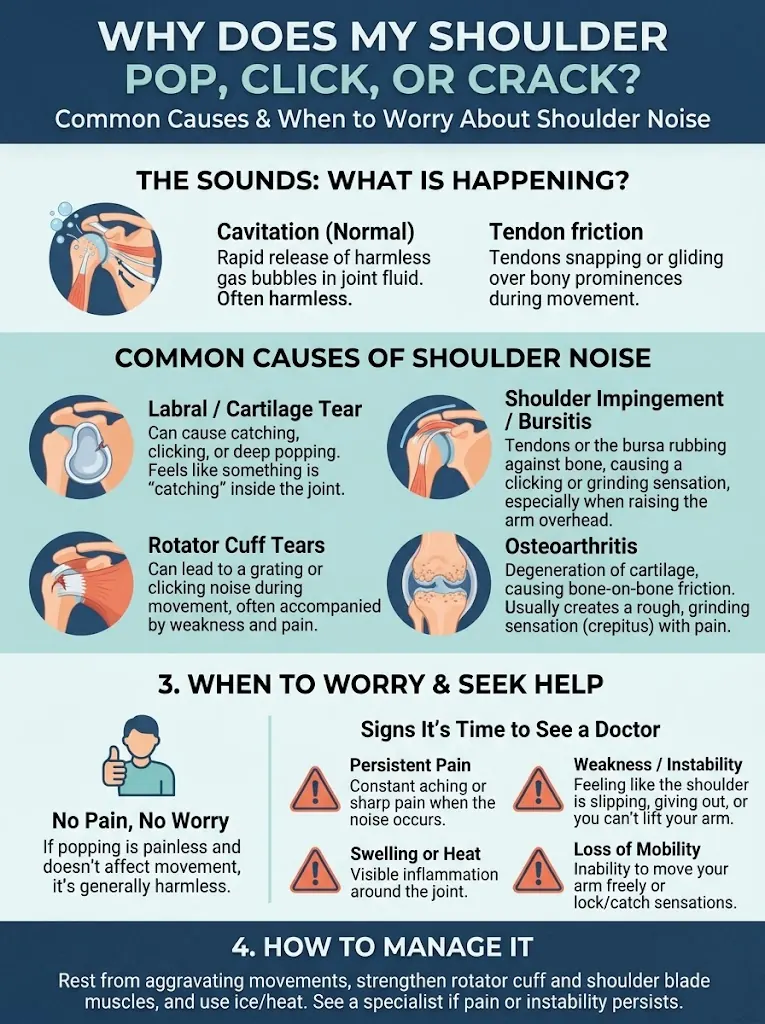
Hearing your shoulder pop, click, or crack when you raise your arm, rotate it, or reach behind your back can be surprising. Sometimes the sound occurs without pain or movement problems. In other cases, shoulder popping comes with discomfort, weakness, catching, or a feeling that the joint might slip out of place.
Shoulder noises are not always a sign of injury. Tendons moving over bone, changes in joint pressure, and normal movement of the shoulder blade can all produce sounds. However, new popping after an injury or clicking accompanied by pain, swelling, or instability deserves closer attention.
Understanding why your shoulder pops, clicks, or cracks can help you recognize common causes, identify warning signs, and decide whether to modify your activities or seek medical care. The sound alone usually cannot identify the underlying problem.
Why Does My Shoulder Pop, Click, or Crack?
Shoulder popping can happen when tendons, ligaments, bones, or joint surfaces move during arm movement. The shoulder has a wide range of motion, and its stability depends on coordinated movement between the upper-arm bone, shoulder blade, and surrounding muscles.
Common explanations include:
- Tendon movement: Rotator cuff or biceps tendons may move across nearby structures and produce a snapping sensation.
- Joint cavitation: Changes in pressure within a joint can create a popping sound, similar to knuckle cracking.
- Shoulder blade movement: The shoulder blade glides across the rib cage, sometimes creating clicking or grinding sounds.
- Previous injury or tissue changes: Damage to cartilage, tendons, or the shoulder labrum may cause painful clicking, catching, or instability.
The pattern matters more than the sound alone. Occasional painless clicking is generally less concerning than a new sound that repeatedly occurs with pain or reduced function.
What Causes Shoulder Popping and Clicking?
| Possible cause | Common symptoms | When to consider evaluation |
|---|---|---|
| Normal joint or tendon movement | Occasional popping without pain | If the sound becomes persistent or movement changes |
| Rotator cuff irritation or tear | Pain when lifting the arm, weakness, discomfort at night | If weakness or pain persists, particularly after an injury |
| Shoulder impingement | Pain during overhead movement or reaching | If pain limits daily activities |
| Labral tear | Deep clicking, catching, pain, or instability | If symptoms follow trauma or interfere with sports and daily tasks |
| Shoulder instability | Slipping, shifting, or a sense the joint may come out | Prompt assessment if instability is new or recurrent |
| Shoulder blade movement problems | Grinding or clicking near the shoulder blade | If accompanied by pain, weakness, or restricted movement |
1. Rotator cuff problems
The rotator cuff is a group of muscles and tendons that helps stabilize the shoulder and control arm movement. Irritation or a tear can cause pain, weakness, and sometimes clicking during lifting or rotation. Explore the signs, treatment options, and recovery from a rotator cuff tear if these symptoms occur together.
2. Shoulder impingement
Shoulder impingement describes pain associated with movement of the shoulder structures, often during overhead activity. Clicking may occur alongside discomfort when reaching up, dressing, or lifting objects. Learn about shoulder impingement symptoms and treatment to understand how this condition differs from other causes of shoulder pain.
3. Labral tears
The labrum is a ring of cartilage that deepens the shoulder socket and helps stabilize the joint. A tear may cause deep clicking, catching, pain, or instability, particularly after a fall, sudden pull, or repetitive overhead activity. However, clicking alone does not confirm a labral tear.
4. Tendon irritation and bursitis
Inflammation or irritation involving shoulder tendons or the nearby bursa may cause painful movement and occasional popping. Symptoms can become more noticeable after repetitive lifting or exercise. See the guide to shoulder tendonitis symptoms and treatment for more information about tendon-related pain.
Is Shoulder Popping Without Pain Normal?
Occasional shoulder popping without pain, weakness, swelling, or restricted movement is often not a cause for concern. If the sound has been present for a long time and your shoulder functions normally, monitoring it may be reasonable.
Do not assume every painless sound is harmless, though. Repeated catching, a sense of instability, or a new clicking pattern after an injury can warrant an assessment even if pain is mild.
When Should You Worry About Shoulder Clicking?
Pay attention to accompanying symptoms rather than relying on the sound alone.
| Symptom pattern | Recommended response |
|---|---|
| Occasional painless popping with normal movement | Monitor and avoid repeatedly forcing the joint to make the sound |
| Persistent clicking with pain or stiffness | Arrange a routine medical evaluation |
| Clicking with weakness or recurrent slipping | Seek assessment for possible tendon or stability problems |
| Sudden popping after a fall with severe pain, deformity, or inability to move the arm | Seek urgent medical care |
| Shoulder pain with chest pressure, shortness of breath, sweating, or nausea | Call 911 for emergency assessment |
A visibly deformed shoulder or suspected dislocation should not be forced back into place. Keep the arm supported and seek urgent care.
How Can You Reduce Shoulder Popping at Home?
If the popping is mild and there are no warning signs, simple adjustments may help reduce irritation.
- Temporarily modify aggravating movements. Reduce heavy overhead lifting, repetitive reaching, or exercises that trigger pain.
- Avoid forcing clicks. Repeatedly rotating or jerking the shoulder to produce a pop may aggravate symptoms.
- Use cold therapy for discomfort. Apply a cold pack wrapped in a towel for 15–20 minutes at a time if the shoulder is sore after activity.
- Maintain comfortable movement. Gentle, pain-free movement can help prevent stiffness. Stop if an exercise causes sharp pain, catching, or instability.
- Build strength gradually. A clinician or physical therapist can recommend exercises based on the cause of symptoms.
For general guidance, see these shoulder pain relief strategies you can try at home. If poor movement habits contribute to discomfort, posture correction exercises for shoulder and neck pain may also be relevant, provided the movements are comfortable.
How Do Doctors Evaluate Shoulder Popping?
A clinician will usually ask when the sound began, which movements trigger it, whether there was an injury, and whether pain or weakness occurs. The physical examination may assess shoulder strength, range of motion, tenderness, and stability.
Imaging is not always necessary for painless clicking. X-rays can help assess bones and joint alignment, while MRI or ultrasound may be considered when the examination suggests a soft-tissue injury. A normal X-ray does not rule out every tendon or labral problem.
Frequently Asked Questions
1. Why does my shoulder pop when I rotate my arm?
Tendons moving over nearby structures, joint pressure changes, or shoulder blade movement may produce popping during rotation. If the sound is painful or follows an injury, arrange an assessment.
2. Why does my shoulder click when I raise my arm?
Clicking during arm elevation may come from tendon movement or altered shoulder mechanics. Pain, weakness, or difficulty lifting the arm makes a clinical evaluation more important.
3. Can a rotator cuff tear cause shoulder clicking?
A rotator cuff tear can cause pain and weakness, and some people also experience clicking. The sound is not specific enough to diagnose a tear without an appropriate assessment.
4. Can a shoulder labral tear cause popping?
Yes, a labral tear can cause deep clicking, catching, or instability. These symptoms can also occur with other conditions, so popping alone cannot establish the diagnosis.
5. Should I stop exercising if my shoulder pops?
Not necessarily if the popping is painless and your movement remains normal. Modify or stop exercises that cause pain, catching, weakness, or a slipping sensation.
6. Can poor posture make shoulder clicking worse?
Posture and shoulder blade movement can influence how the shoulder moves, but posture is not the cause of every clicking sound. Exercises should be chosen according to your symptoms and physical ability.
7. Why does my shoulder pop after a workout?
Repetitive lifting or unfamiliar exercise may irritate tendons and surrounding tissues. Reduce the movements that trigger symptoms and seek evaluation if pain, swelling, or weakness persists.
8. Can shoulder popping go away on its own?
Some mild popping associated with temporary irritation may become less noticeable when aggravating activities are modified. Persistent or worsening symptoms need assessment rather than assuming the cause will resolve.
9. Do I need an MRI for a clicking shoulder?
Not always. Imaging decisions depend on your history, examination, injury mechanism, and symptoms; many cases of painless clicking do not require an MRI.
10. When is shoulder popping an emergency?
Seek urgent care for sudden popping after trauma with severe pain, deformity, or inability to move the arm. Call 911 if shoulder discomfort occurs with chest pressure, breathing difficulty, sweating, or nausea.
Conclusion
Shoulder popping, clicking, or cracking can result from normal joint movement, tendon motion, or an underlying shoulder condition. Painless sounds with normal function are often less concerning, while pain, weakness, catching, instability, or symptoms after an injury deserve attention. Modify aggravating activities and arrange an evaluation when symptoms persist or worsen.
Disclaimer: This article is provided for educational and informational purposes only.
This article is for education purpose only and is not a diagnosis or a substitute for medical advice.