
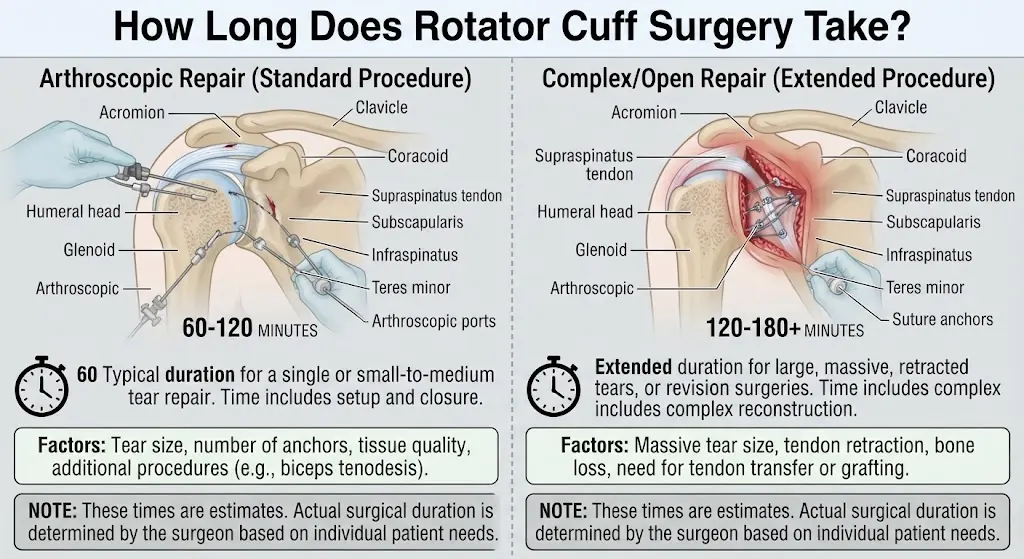
The procedure’s duration depends on the size of the tear, the number of tendons involved, the surgical technique, and whether additional shoulder problems need treatment. A straightforward repair may be relatively quick, while a large or complicated tear can require more time.
Understanding the difference between operating time and total recovery time can help you plan transportation, time off work, and support at home. Here is what to expect before, during, and after rotator cuff surgery.
How Long Does Rotator Cuff Surgery Usually Take?
Most rotator cuff repairs take approximately 1–2 hours of operating time. This is an estimate, not a fixed limit; your surgeon can give you a more personalized expectation based on your imaging and planned procedure.
| Stage | Typical time |
|---|---|
| Rotator cuff repair | About 1–2 hours |
| Anesthesia and preparation | Additional time before surgery |
| Recovery-room monitoring | Often 1–2 hours or longer |
| Total facility visit | Several hours; sometimes most of the day |
These are general planning estimates, not guarantees. Preparation, anesthesia, recovery monitoring, and discharge requirements mean you will usually spend considerably longer at the facility than the operation itself.
For background on the injury being treated, see rotator cuff tear symptoms and treatment options.
What Affects How Long the Surgery Takes?
Several factors can change the procedure’s length.
-
Tear size: Small tears may be easier to repair than large tears involving more tendon tissue.
-
Number of tendons affected: Repairs involving multiple tendons may take longer.
-
Tendon condition: Chronic tears may involve retraction, scarring, or muscle changes that complicate repair.
-
Additional procedures: Bone-spur removal or treatment of other shoulder problems may add time when indicated.
-
Surgical approach: Arthroscopic surgery uses small incisions and a camera; some cases require a different or more extensive approach.
Your surgeon may review an MRI or ultrasound to understand the tear before estimating the operation. An X-ray can show bone changes but does not directly display the rotator cuff tendons; learn about X-ray versus MRI for shoulder pain.
What Happens During Rotator Cuff Surgery?
During arthroscopic repair, the surgeon inserts a small camera and instruments through small incisions. The torn tendon is positioned and secured to the upper arm bone using anchors and sutures when repair is appropriate.
The procedure is commonly performed with general anesthesia, sometimes alongside a regional nerve block to help control pain. Your anesthesia team will explain the plan and discuss relevant risks based on your health.
| Procedure type | What it involves | Possible effect on timing |
|---|---|---|
| Arthroscopic repair | Camera and small instruments | Often used for routine repairs |
| Open or mini-open repair | Larger incision or a combination of approaches | May require additional time |
| Repair with additional treatment | Addresses other identified shoulder problems | Depends on what is needed |
Not every rotator cuff tear requires surgery. The decision depends on symptoms, function, tear characteristics, activity needs, and response to nonsurgical treatment.
Do You Go Home the Same Day?
Many people go home the same day after rotator cuff surgery if their pain is controlled, vital signs are stable, and they meet discharge criteria. You will generally need an adult to take you home, and you should not drive yourself.
An overnight stay may be needed depending on your medical condition, the procedure, pain control, or the facility’s arrangements. Before surgery, confirm your discharge plan and whether someone needs to stay with you.
How Long Does Recovery Take After Rotator Cuff Surgery?
Recovery takes much longer than the operation. Although some daily activities gradually become easier within weeks, tendon healing and rehabilitation commonly extend over several months. The timeline varies with tear size, repair strength, general health, and adherence to the rehabilitation plan.
| Recovery phase | What may happen |
|---|---|
| First several weeks | Sling use and protection of the repair |
| Following weeks | Gradual, guided range-of-motion work |
| Around 3–6 months | Progressive strengthening when cleared |
| Beyond 6 months | Continued improvement in strength and function for some people |
These phases overlap and are not a personal rehabilitation prescription. Follow your surgeon’s instructions, because moving or strengthening the shoulder too soon can jeopardize healing.
For more detailed planning, review rotator cuff surgery recovery time, how long you may need a sling after surgery, and how to sleep after rotator cuff surgery.
What Can Help You Prepare?
Before your operation, ask your surgical team:
-
How long is my planned procedure likely to take?
-
Will I go home the same day?
-
Which medications should I take or pause?
-
How long will I need help with dressing, meals, and other daily tasks?
-
When can I return to driving, work, and exercise?
Recovery planning guides can also help you understand when you can drive after rotator cuff surgery, when you can return to work, and when exercise can resume.
Frequently Asked Questions
1. Is rotator cuff surgery a major operation?
It is a significant orthopedic procedure, even when performed arthroscopically. It requires anesthesia, protection of the repair, and structured rehabilitation.
2. Does arthroscopic rotator cuff surgery take less time?
It can be efficient for many repairs, but duration depends on the tear and any additional procedures. Arthroscopy does not guarantee a shorter operation in every case.
3. Will I be awake during rotator cuff surgery?
Most patients receive general anesthesia, sometimes with a nerve block. Your anesthesiologist will explain the recommended approach.
4. Is rotator cuff surgery painful?
Pain and soreness are expected after surgery, especially as the initial nerve block wears off. Your care team will provide instructions for pain control and warning signs.
5. Can I walk after rotator cuff surgery?
Many patients can walk soon after anesthesia effects wear off, but they must protect the operated arm and follow discharge instructions. Balance, dizziness, and medication effects may temporarily limit activity.
6. How long will I wear a sling?
Many people use a sling for several weeks, depending on the repair and surgeon’s protocol. Do not stop using it without clearance.
7. When can I drive again?
You should not drive while taking impairing medication, wearing a restrictive sling, or unable to control the vehicle safely. Ask your surgeon when driving is appropriate for your situation.
8. When can I return to work?
Desk work may be possible earlier than heavy labor, but timing depends on pain, arm restrictions, and job demands. Work involving lifting or overhead activity may require a longer absence.
9. Can a rotator cuff tear heal without surgery?
Some people improve with physical therapy, activity changes, and clinician-guided pain management, particularly with certain degenerative tears. See whether a rotator cuff tear can heal without surgery.
10. What symptoms after surgery need urgent attention?
Contact your surgical team promptly for increasing redness, drainage, fever, worsening uncontrolled pain, or new numbness or weakness. Seek emergency care for chest pain, trouble breathing, or sudden severe symptoms.
Conclusion
Rotator cuff surgery commonly takes around one to two hours, but preparation and recovery-room monitoring make the total facility visit much longer. Healing takes months, so plan for help at home, follow your sling and rehabilitation instructions, and ask your surgeon for a timeline tailored to your tear and procedure.
Disclaimer: This article is provided for educational and informational purposes only.
This article is for education purpose only and is not a diagnosis or a substitute for medical advice.