
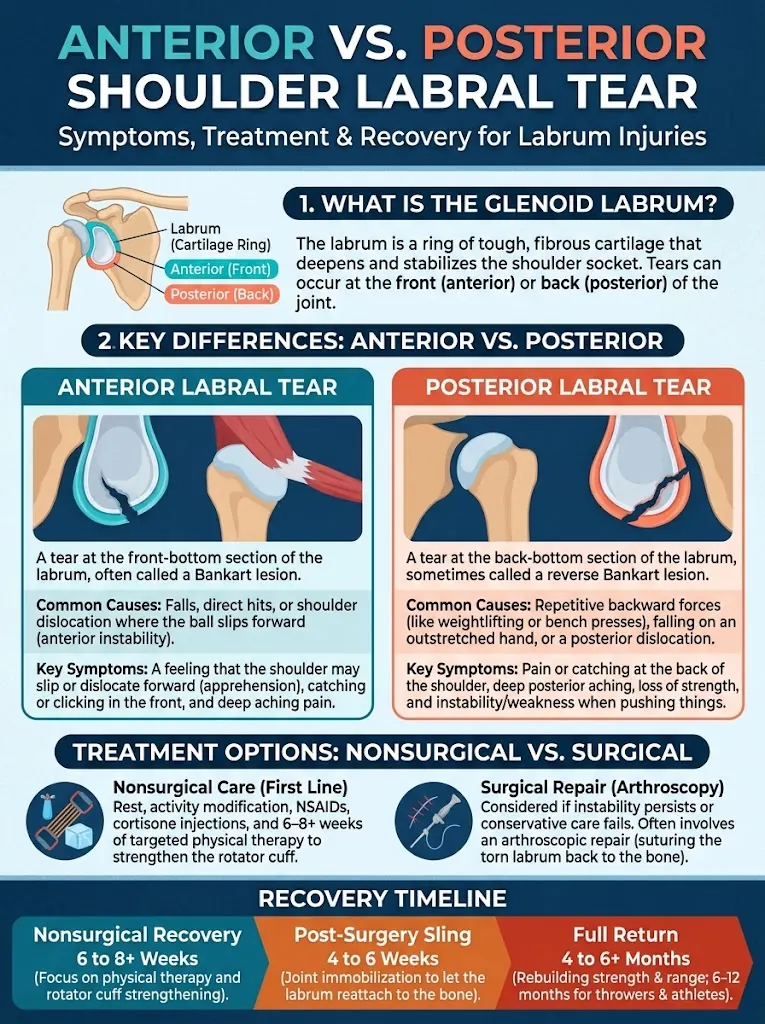
Shoulder pain that feels deep inside the joint, clicking during movement, or a sense that the shoulder might slip out of place can make everyday activities difficult. Reaching overhead, lifting weights, throwing a ball, or sleeping on the affected side may become uncomfortable, especially when the shoulder labrum is injured.
Not all shoulder labral tears are the same. The location of the tear can influence the symptoms, the way the injury occurs, and the treatment a clinician recommends. However, pain location alone cannot reliably distinguish an anterior tear from a posterior tear, and some labral tears cause few noticeable symptoms.
Understanding anterior vs. posterior shoulder labral tears can help you recognize possible symptoms, understand diagnostic tests, compare treatment options, and know when to seek medical evaluation. Recovery depends on the tear’s location and severity, shoulder stability, activity demands, and response to treatment.
What Is the Difference Between an Anterior and Posterior Shoulder Labral Tear?
The labrum is a ring of strong fibrocartilage around the shoulder socket. It helps deepen the socket and supports shoulder stability by providing attachment points for ligaments and other structures.
An anterior labral tear affects the front portion of the labrum, while a posterior labral tear affects the back portion. Both injuries can occur after trauma, repetitive loading, or shoulder instability, but they are associated with different injury patterns.
| Feature | Anterior labral tear | Posterior labral tear |
|---|---|---|
| Location | Front of the shoulder socket | Back of the shoulder socket |
| Common injury mechanism | Shoulder dislocation, forced movement, or trauma | Compression, repetitive loading, or force applied to the back of the shoulder |
| Possible symptoms | Deep pain, instability, or a feeling that the shoulder may slip forward | Deep pain, clicking, weakness, or discomfort during pushing movements |
| Associated condition | May occur with a Bankart lesion after shoulder dislocation | May occur with posterior shoulder instability |
| Treatment | Rehabilitation, activity modification, or surgery in selected cases | Rehabilitation, activity modification, or surgery in selected cases |
These patterns are not definitive. Anterior and posterior tears can overlap in their symptoms, and other shoulder conditions can cause similar pain.
For a broader overview of injury locations, see the different types of shoulder labral tears and how they differ.
What Are the Symptoms of an Anterior Labral Tear?
An anterior labral tear may cause deep shoulder pain, particularly after a dislocation or an injury that forces the arm into an awkward position. Some people also experience a feeling of looseness or apprehension when moving the arm into certain positions.
Possible symptoms include:
- Pain deep inside the shoulder, especially during movement.
- A feeling that the shoulder may slip out of place.
- Clicking, catching, or popping during arm movement.
- Reduced confidence when reaching overhead or rotating the arm.
- Weakness or difficulty returning to sports and lifting activities.
A Bankart lesion is a specific type of anterior-inferior labral injury commonly associated with shoulder dislocation. It can affect shoulder stability, particularly when supporting structures are also damaged. Learn more about shoulder dislocation symptoms and recovery.
What Are the Symptoms of a Posterior Labral Tear?
A posterior labral tear may produce deep shoulder pain during pushing, pressing, or movements that load the arm across the body. Some people notice clicking, reduced strength, or a sensation that the shoulder shifts backward.
Common symptoms may include:
- Pain during push-ups, bench presses, or other pushing exercises.
- Discomfort when the arm is positioned across the body.
- Clicking or catching inside the shoulder.
- A feeling of instability during certain movements.
- Reduced performance during sports or strength training.
Posterior labral injuries can occur in athletes who repeatedly load the shoulder, but they are not limited to athletes. Symptoms may also follow a fall, direct impact, or other traumatic event.
If the shoulder feels unstable or repeatedly slips, understanding shoulder instability and its possible causes can help you recognize why an examination may be important.
How Are Anterior and Posterior Labral Tears Diagnosed?
Diagnosis usually involves a review of your injury history, physical examination, and, when appropriate, imaging. A clinician may ask how the injury happened, which movements cause pain, whether the shoulder has dislocated, and whether you experience clicking or instability.
No single physical test can reliably identify every labral tear. The examiner may assess shoulder motion, strength, stability, and pain with specific movements.
| Test or assessment | What it can help identify | Important limitation |
|---|---|---|
| Medical history and physical examination | Injury mechanism, movement-related pain, weakness, and instability | Symptoms and examination findings can overlap with other conditions |
| X-ray | Bone injury, alignment, or changes associated with dislocation | Does not directly show the labrum |
| MRI | Labral abnormalities and other soft-tissue injuries | Some findings may be present without causing symptoms |
| MRI arthrogram | May improve visualization of certain labral injuries using contrast injected into the joint | It is invasive and is not necessary for every patient |
A clinician may recommend MRI for a shoulder labral tear or an MRI arthrogram to investigate a suspected labral injury when the findings could influence treatment.
What Is the Best Treatment for an Anterior or Posterior Labral Tear?
Treatment depends on the tear’s location, severity, associated instability, activity level, and symptoms. Surgery is not automatically necessary for every labral tear. Many people begin with nonsurgical treatment, particularly when the shoulder is stable and symptoms can be managed.
Nonsurgical treatment
A clinician may recommend:
- Activity modification: Temporarily reduce painful lifting, pushing, throwing, or overhead movements.
- Physical therapy: Progressively improve shoulder control, strength, mobility, and coordination.
- Pain management: Ice or suitable medication may help, depending on individual health risks and clinician advice.
- Gradual return to activity: Increase exercise demands according to symptoms and rehabilitation progress.
Avoid repeatedly testing the shoulder with heavy weights or movements that trigger instability. Exercises should match the injury and stage of recovery rather than follow a generic routine.
For more detail, compare physical therapy and surgery for shoulder labral tears, or review exercises that may be appropriate during labral tear rehabilitation.
When might surgery be recommended?
Surgery may be considered when the shoulder remains unstable, symptoms significantly limit activity despite appropriate rehabilitation, or the injury requires repair based on its characteristics and the person’s needs.
The procedure depends on the injury. Some tears can be repaired with sutures and anchors, while other cases may require a different approach. A surgeon considers the labrum, surrounding ligaments, bone, and other shoulder structures before recommending an operation.
Recovery after surgery usually involves a period of protection followed by progressive rehabilitation. See how long recovery from shoulder labral tear surgery takes for a closer look at the recovery process.
How Long Does Recovery Take?
Recovery varies considerably. Mild symptoms may improve with activity changes and rehabilitation over weeks to months, while significant instability or surgical repair can require a longer recovery period.
| Recovery stage | Typical focus | What to keep in mind |
|---|---|---|
| Early management | Control symptoms and avoid aggravating movements | Follow any clinician-provided restrictions |
| Rehabilitation | Restore controlled movement and shoulder strength | Progress gradually; pain or instability may require adjustment |
| Functional recovery | Resume work, sports, and lifting in stages | Readiness depends on strength, control, and the activity involved |
| Long-term management | Maintain strength and reduce reinjury risk | Continue appropriate exercises and technique adjustments |
There is no universal timeline for returning to work, driving, or sports. These activities require adequate control and the ability to respond safely; postoperative restrictions take priority when surgery has been performed. The stages of SLAP tear healing and rehabilitation offer additional context for a different, superior labral injury.
Warning Signs: When Should You Seek Medical Care?
Symptoms that may be monitored: Mild discomfort that steadily improves with activity modification and does not involve weakness or instability may be monitored while arranging appropriate care if it persists.
Arrange a medical evaluation: Seek assessment for ongoing pain, repeated clicking with pain, reduced strength, restricted movement, or a shoulder that repeatedly feels unstable.
Seek urgent care: Get prompt medical attention after a significant injury if you cannot move the arm, have severe pain, visible deformity, or new numbness or weakness. A shoulder that appears dislocated needs urgent assessment; do not attempt to force it back into place yourself.
Frequently Asked Questions
1. Is an anterior labral tear worse than a posterior tear?
Neither location is automatically worse. Severity depends on the extent of damage, shoulder stability, associated injuries, and functional limitations.
2. Can you have both anterior and posterior labral tears?
Yes. A tear can extend around more than one part of the labrum, particularly after significant trauma. Imaging and clinical findings help determine its extent.
3. Does a posterior labral tear hurt in the back of the shoulder?
It can, but pain location varies. Some people feel deep joint pain or discomfort during pushing movements rather than pain directly over the back of the shoulder.
4. Can an anterior labral tear cause shoulder dislocations?
An anterior labral injury can contribute to instability after a dislocation. However, dislocations can also damage other supporting structures, so assessment is important.
5. Can a shoulder labral tear heal without surgery?
Symptoms and shoulder function can improve without surgery, but the labrum may not return to its original structure. Whether conservative treatment is appropriate depends on stability, tear characteristics, and activity demands.
6. Do all labral tears show up on an MRI?
No. Some tears can be difficult to detect, and imaging findings do not always explain a person’s symptoms. A clinician interprets imaging alongside the history and examination.
7. Should you exercise with a labral tear?
Gentle, appropriately selected rehabilitation may help, but movements that cause sharp pain or instability should be avoided until assessed. Follow an individualized plan rather than continuing heavy pressing or overhead exercise through symptoms.
8. How long does a shoulder labral tear take to heal?
Recovery may take weeks to months, depending on the injury and treatment. Surgical repair generally requires a more structured rehabilitation period than symptom management without surgery.
9. Can a labral tear get worse if left untreated?
Symptoms may persist or worsen if an activity repeatedly aggravates the injury or if the shoulder remains unstable. Not every tear progresses, but recurring instability or functional loss deserves medical evaluation.
10. When is surgery necessary for a shoulder labral tear?
Surgery may be considered for persistent disabling symptoms, recurrent instability, or injuries unlikely to respond adequately to nonsurgical care. The decision should be based on symptoms, examination, imaging, and individual goals—not an MRI finding alone.
Conclusion
Anterior and posterior shoulder labral tears differ mainly in location and may be associated with different injury patterns, but their symptoms can overlap. A clinical examination and appropriate imaging help clarify the injury and guide treatment. Start by avoiding aggravating activities and seeking an assessment if pain, weakness, or instability persists; follow a gradual, individualized rehabilitation plan for the safest return to daily activities and sport.
Disclaimer: This article is provided for educational and informational purposes only.
This article is for education purpose only and is not a diagnosis or a substitute for medical advice.