
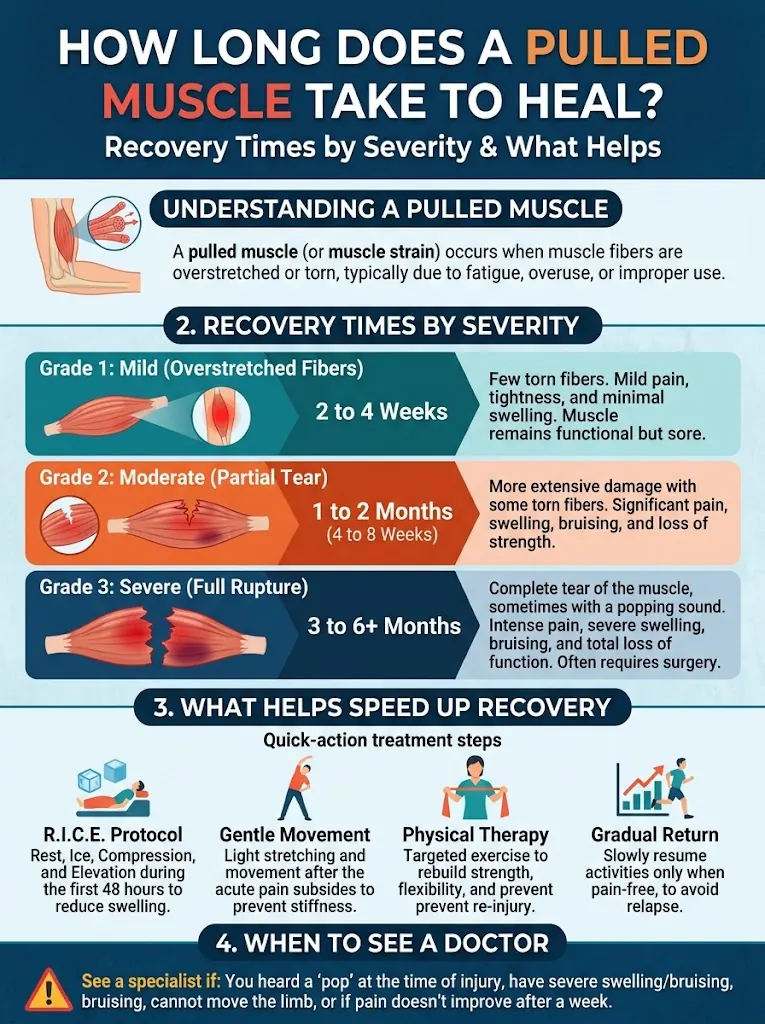
A pulled muscle can cause sudden sharp pain, tenderness, swelling, or stiffness that makes everyday activities difficult. You might notice discomfort when walking, bending, lifting, exercising, or even getting out of bed. The time it takes to recover depends on which muscle is injured and how severely the muscle fibers are strained.
Most mild muscle strains improve within a few days to a couple of weeks, while moderate or severe injuries can take several weeks or months to heal. However, pain levels alone do not always reveal how serious an injury is, and returning to strenuous activity too soon can delay recovery.
Understanding how long a pulled muscle takes to heal can help you set realistic expectations, choose appropriate home care, and recognize when medical evaluation is necessary. This guide explains recovery times by severity, factors that affect healing, safe recovery steps, and warning signs that should not be ignored.
How Long Does a Pulled Muscle Take to Heal?
A pulled muscle, also called a muscle strain, occurs when muscle fibers are overstretched or torn. Recovery can range from several days for a minor strain to several months for a major tear.
Pulled muscle recovery time by severity
| Strain severity | Typical recovery time | Common features |
|---|---|---|
| Grade 1: Mild | A few days to 2 weeks | Mild tenderness, limited fiber damage, little strength loss |
| Grade 2: Moderate | Several weeks to 6–8 weeks or longer | More pain, swelling or bruising, reduced strength and movement |
| Grade 3: Severe | Several months in some cases | Major or complete muscle tear, substantial weakness, possible need for surgery |
These time frames are estimates, not guarantees. A small strain in one muscle may heal faster than an injury in a muscle heavily used for walking, lifting, or sports. Severe strains may require imaging, supervised rehabilitation, or surgical assessment.
What Affects Muscle Strain Recovery Time?
Several factors influence how quickly a pulled muscle heals.
- Injury severity: Greater fiber damage generally means a longer recovery.
- Muscle location: Hamstring, calf, back, and hip muscles may be repeatedly stressed during normal movement.
- Activity level: Continuing heavy lifting, sprinting, or painful movements can aggravate the injury.
- Previous injuries: Repeated strains may require a more careful rehabilitation plan.
- Overall health: Age, nutrition, medical conditions, and some medications can influence recovery.
For example, a mild strain after exercise may improve quickly, while a significant injury that causes difficulty walking deserves closer assessment. If you are unsure whether the injury is a strain or another condition, review the common causes of muscle and joint pain.
What Does a Pulled Muscle Feel Like?
Symptoms depend on the injured muscle and the amount of tissue damage. Common signs include:
- Sudden pain during exercise or lifting
- Tenderness when pressing on the affected area
- Stiffness or pain when stretching or contracting the muscle
- Swelling or bruising
- Reduced strength or range of motion
A severe strain may cause a popping sensation, marked weakness, or difficulty using the affected limb. However, similar symptoms can occur with tendon injuries, fractures, or other conditions. For example, what a strained hamstring feels like can help explain symptoms specific to the back of the thigh.
How Can You Help a Pulled Muscle Heal Faster?
You cannot force muscle tissue to heal instantly, but sensible care can help control symptoms and support recovery.
During the first 24–72 hours
- Protect the injured area: Temporarily stop activities that trigger pain, particularly heavy lifting, sprinting, or forceful stretching.
- Apply cold if helpful: Wrap an ice pack in a towel and apply it for 15–20 minutes at a time. Avoid placing ice directly on your skin.
- Use comfortable movement: Gentle movement within a tolerable range may help prevent unnecessary stiffness. Do not push through sharp or increasing pain.
- Consider compression: A light wrap may help with swelling in an appropriate area, but it should not cause numbness, tingling, or color changes.
Avoid aggressive massage and intense stretching during the early painful phase. Complete bed rest is not usually necessary for a mild strain, but the appropriate activity level depends on severity.
After the initial pain settles
Gradually restore normal movement, then build strength and endurance. Increase activity only when symptoms remain manageable during exercise and afterward. A low-impact exercise approach for people with joint pain may offer useful general ideas, although a muscle strain may require a more specific rehabilitation plan.
| Recovery stage | Main goal | Practical approach |
|---|---|---|
| Early phase | Control pain and protect tissue | Relative rest, comfortable movement, cold packs if helpful |
| Mobility phase | Restore comfortable movement | Gentle, pain-limited range-of-motion exercises |
| Strength phase | Rebuild muscle capacity | Gradual resistance exercises, preferably guided when needed |
| Return to activity | Restore normal function | Increase duration and intensity progressively |
This progression is a general framework, not a fixed schedule. A clinician or physical therapist can adjust it for the injured muscle and severity.
When Can You Return to Exercise or Work?
Return when the injured muscle can handle the required activity without significant pain, compensatory movement, or worsening symptoms afterward. Normal walking and everyday movement are useful early milestones, but they do not automatically mean you are ready for sprinting, heavy lifting, or competitive sports.
For physically demanding jobs, temporary changes to lifting, climbing, or repetitive movements may be necessary. Athletes may need to demonstrate near-normal strength, flexibility, and sport-specific movement before returning fully. If symptoms flare during activity, reduce the intensity rather than repeatedly testing the injury.
When Should You Seek Medical Care?
Many mild strains improve with home care, but some injuries need prompt evaluation.
| Level of concern | Signs to watch for | Recommended action |
|---|---|---|
| Usually monitor | Mild soreness that steadily improves, without major weakness or swelling | Continue sensible self-care and gradual movement |
| Arrange medical evaluation | Persistent pain, significant bruising, ongoing weakness, or symptoms that are not improving | Contact a healthcare professional |
| Urgent assessment | Severe pain, a visible deformity, inability to use the limb, or rapidly increasing swelling | Seek urgent medical care |
Seek emergency care if muscle pain occurs with dark, cola-colored urine or markedly reduced urination after intense exercise, as these can be signs of serious muscle breakdown. A swollen, warm, painful calf—especially with one-sided swelling—also needs prompt evaluation because a blood clot can sometimes cause similar symptoms. Chest pain or shortness of breath with leg swelling requires emergency attention.
Frequently Asked Questions
1. Can a pulled muscle heal in 3 days?
A very mild strain may feel substantially better within three days, but symptom improvement does not necessarily mean the tissue has fully recovered. Avoid returning to strenuous activity solely because the pain has decreased.
2. Is it better to rest or walk with a pulled muscle?
Relative rest is usually more helpful than either pushing through pain or remaining completely inactive. Gentle walking may be reasonable if it does not increase symptoms or cause limping.
3. Should I use heat or ice for a pulled muscle?
Cold packs may help relieve pain during the early phase. Heat may feel soothing later when stiffness is the main concern, but avoid treatments that worsen swelling or discomfort.
4. Can stretching make a muscle strain worse?
Yes. Forceful stretching, particularly soon after injury, can aggravate damaged fibers. Resume gentle stretching only when it is comfortable and appropriate for the injury.
5. Why does my pulled muscle still hurt after two weeks?
Moderate strains can take longer than two weeks to improve, especially if the muscle is repeatedly stressed. Persistent or worsening pain, weakness, or bruising warrants medical assessment.
6. Does bruising mean a pulled muscle is severe?
Bruising can occur when small blood vessels are damaged, but its presence alone cannot determine the injury’s grade. Extensive bruising or significant weakness should be evaluated.
7. Can I work out with a pulled muscle?
Avoid exercises that load or stretch the injured muscle enough to cause pain. You may be able to train unaffected body areas, provided doing so does not strain the injured tissue.
8. Do pulled muscles need physical therapy?
Not every mild strain requires formal physical therapy. Rehabilitation may be beneficial for moderate or severe injuries, repeated strains, persistent weakness, or difficulty returning to normal activities.
9. Can a pulled muscle heal without medication?
Yes. Many mild strains improve with activity modification and time. Pain medication is optional for some people, but consult a healthcare professional or pharmacist if you have medical conditions, take other medications, or are unsure what is safe.
10. How do I know if a pulled muscle is healing?
Pain and tenderness should gradually decrease, movement should become easier, and strength should improve. Repeated flare-ups, worsening weakness, or no meaningful progress are reasons to seek evaluation.
Conclusion
A pulled muscle may heal within days if mild, while moderate or severe strains can take weeks or months. Protect the injured area initially, restore movement gradually, and return to demanding activities only when strength and function have recovered. Seek medical evaluation for significant weakness, persistent symptoms, or warning signs that suggest a more serious injury.
Disclaimer: This article is provided for educational and informational purposes only.
This article is for education purpose only and is not a diagnosis or a substitute for medical advice.