
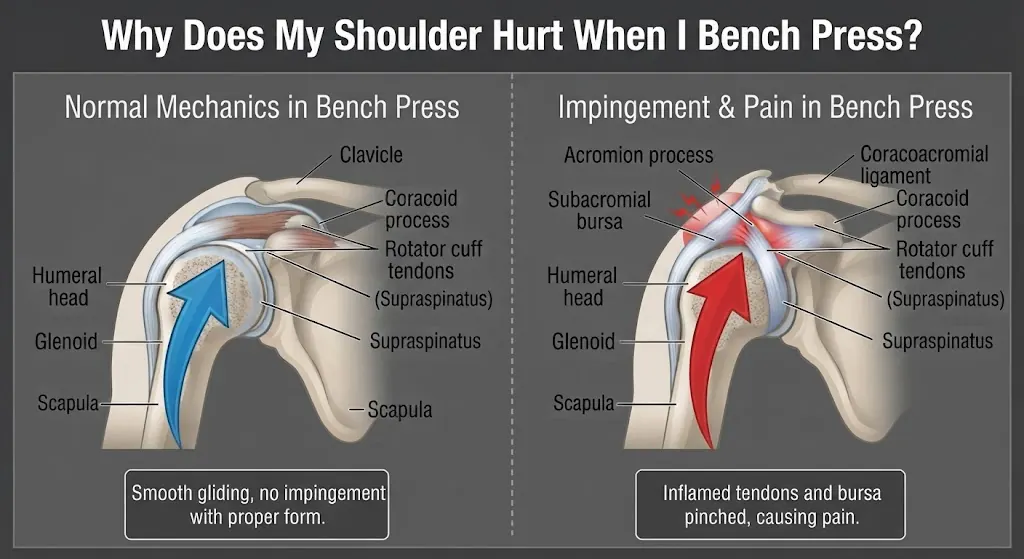
Pain does not automatically mean you have a torn tendon or another serious injury. However, continuing to bench press through worsening pain can aggravate irritated tissues and make training more difficult.
Understanding why your shoulder hurts when you bench press can help you identify possible causes, adjust your technique, and decide when to rest or seek medical evaluation.
What causes shoulder pain during the bench press?
The bench press places substantial demands on the shoulder joint, rotator cuff, and surrounding muscles. Pain may develop from repetitive loading, a sudden increase in weight, limited recovery, or an existing shoulder condition.
| Possible cause | Common symptoms | Potential contributing factor |
|---|---|---|
| Rotator cuff irritation | Pain during pressing or lowering the bar | Repeated loading or excessive training volume |
| Shoulder impingement-related pain | Pinching at the front or side of the shoulder | Painful arm positioning or irritated tissues |
| Biceps tendon irritation | Ache near the front of the shoulder | Repetitive pressing and shoulder loading |
| AC joint irritation | Pain on top of the shoulder | Deep lowering or a previous joint injury |
| Labral injury | Deep pain, catching, or instability | Trauma or repetitive high-load movements |
These conditions can cause similar symptoms, so pain location alone cannot establish a diagnosis. For more detail, see shoulder tendonitis symptoms and treatment, shoulder impingement symptoms, and rotator cuff tear symptoms and recovery.
Can bench pressing cause a rotator cuff or labral tear?
A rotator cuff or labral injury can occur during weight training, particularly after a sudden overload or traumatic movement. However, ordinary bench-press discomfort is not proof of a tear. New weakness, persistent pain, or a feeling that the shoulder is unstable deserves medical assessment.
You can compare the typical features of a labral tear versus a rotator cuff tear to understand why symptoms sometimes overlap.
Which bench-press mistakes can aggravate shoulder pain?
Technique is only one possible factor, but changing how you press may reduce discomfort.
-
Lowering the bar too far: A deep bottom position can increase shoulder demands, particularly if your mobility or current tolerance is limited.
-
Flaring your elbows excessively: This may place the shoulder in a position that feels uncomfortable under load.
-
Using too much weight: Heavy loads can exceed your current strength or tissue tolerance.
-
Increasing volume too quickly: Adding sets, repetitions, or training days without adequate recovery may aggravate symptoms.
-
Ignoring persistent pain: Repeatedly training through sharp or worsening discomfort can prolong irritation.
A comfortable elbow angle and controlled bar path may help, but no single technique suits everyone. Review how to prevent shoulder injuries during workouts and how shoulder pain can occur when lifting your arm for related movement concerns.
What should you do if bench pressing hurts your shoulder?
Stop the painful variation rather than trying to push through it. You may not need to stop all exercise, but your next steps should depend on symptom severity.
| Strategy | How to apply it | Important caution |
|---|---|---|
| Reduce loading | Temporarily stop heavy or painful pressing | Do not keep testing painful weights |
| Use a cold pack | Apply for 15–20 minutes with a cloth barrier if helpful | Never place ice directly on the skin |
| Maintain comfortable movement | Move the shoulder gently within a pain-free range | Avoid forceful stretching |
| Modify training | Choose only exercises that do not reproduce symptoms | Stop if pain increases during or afterward |
| Return gradually | Increase resistance and volume in small steps after improvement | Do not progress if weakness or pain persists |
For additional options, explore these ways to relieve shoulder pain at home. If you need exercises, a physical therapist can help select suitable shoulder pain relief and strengthening exercises.
Avoid using pain medicine simply to mask symptoms so you can continue lifting. Over-the-counter medicines may not be suitable for everyone, particularly people with kidney disease, stomach ulcers, cardiovascular conditions, certain medication regimens, or pregnancy.
How long does bench-press shoulder pain take to improve?
Mild irritation may settle over several days after reducing the activity that triggers it. More persistent tendon problems or structural injuries may take weeks or longer, depending on the cause and treatment.
Arrange a medical assessment if pain is not improving after one to two weeks, keeps returning whenever you lift, disrupts sleep, or limits everyday movement. Seek earlier evaluation if you develop significant weakness or pain after a sudden injury.
When is shoulder pain a warning sign?
| Symptom pattern | What to do |
|---|---|
| Mild discomfort that settles with rest and normal movement remains possible | Modify training and monitor symptoms |
| Persistent pain, night pain, reduced range of motion, or recurring weakness | Arrange a clinical assessment |
| Sudden severe pain, major weakness after injury, deformity, or inability to move the arm | Seek urgent medical care |
| Shoulder discomfort with chest pressure, shortness of breath, sweating, faintness, or nausea | Call 911 in the United States |
Shoulder pain may occasionally originate from the neck or another area. If you also notice shoulder pain that travels down your arm, mention it to your clinician. Symptoms that may indicate a heart problem require emergency attention, even if the discomfort seems related to exercise.
A clinician can review your training history, examine shoulder movement and strength, and decide whether imaging is needed. An X-ray evaluates bones, while ultrasound or MRI may help assess soft tissues when appropriate.
Frequently Asked Questions
1. Why does the front of my shoulder hurt during bench presses?
Pain at the front of the shoulder may involve the biceps tendon, rotator cuff, or nearby joint structures. The location alone cannot identify the cause.
2. Should I stop bench pressing if my shoulder hurts?
Stop the variation that causes pain, especially if discomfort increases with each repetition. Return to pressing gradually once movement is comfortable and symptoms have improved.
3. Can poor bench-press form cause shoulder pain?
Yes, technique and excessive loading can contribute to discomfort. However, pain can also occur with an injury or shoulder condition even when your form appears sound.
4. Are dumbbell bench presses better for painful shoulders?
Dumbbells allow each arm to move more independently and may make a comfortable range easier to find. They are not automatically safer, so avoid them if they reproduce your symptoms.
5. Should I switch to a close-grip bench press?
A closer grip changes the movement and muscle demands, but it does not guarantee less shoulder pain. Try a modification only if it is comfortable and does not worsen symptoms afterward.
6. Can a rotator cuff tear hurt only when lifting weights?
Yes, some rotator cuff problems are more noticeable during loaded movements. Persistent weakness or pain during ordinary activities warrants evaluation.
7. Should I stretch before bench pressing?
A gradual warm-up with light, comfortable movements is a sensible approach. Avoid aggressive stretches that reproduce shoulder pain.
8. Can I train chest while my shoulder recovers?
Possibly, if alternative exercises do not cause pain during or after training. Avoid painful pressing movements and seek professional guidance if symptoms continue.
9. Why does my shoulder hurt after bench pressing rather than during it?
Symptoms may appear later as irritated tissues respond to training. Repeated post-workout pain can indicate that your current load or exercise volume needs adjustment.
10. When should I see a doctor for bench-press shoulder pain?
Seek evaluation for persistent or recurring pain, significant weakness, restricted movement, or symptoms following a sudden injury. Severe pain, deformity, or emergency symptoms such as chest pressure and shortness of breath require immediate attention.
Conclusion
Shoulder pain during bench pressing may result from excessive loading, tendon irritation, technique, or an underlying injury. Temporarily modify painful movements, maintain comfortable mobility, and return to lifting gradually. If symptoms persist, recur, or include weakness, seek medical evaluation instead of continuing to train through pain.
Disclaimer: This article is provided for educational and informational purposes only.
This article is for education purpose only and is not a diagnosis or a substitute for medical advice.