
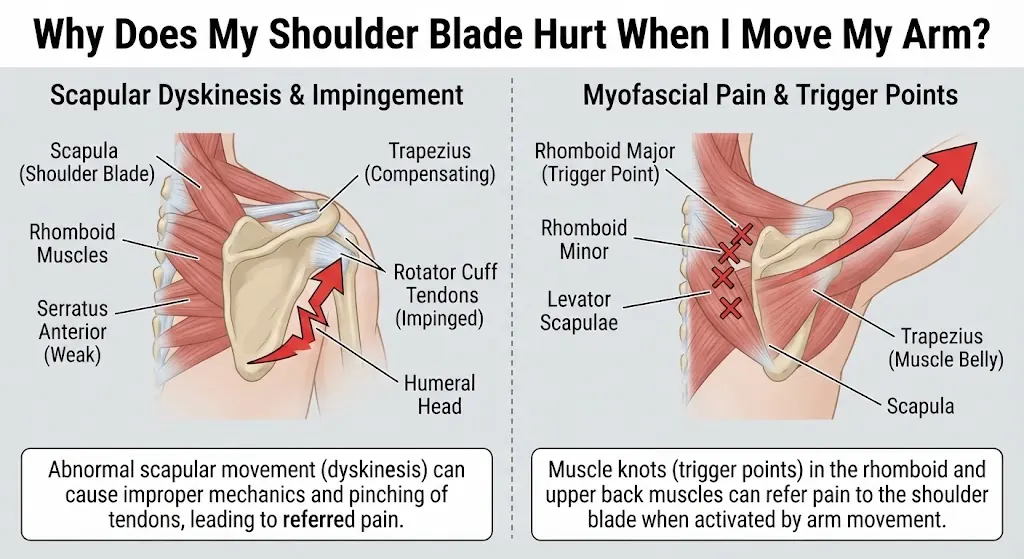
This pain does not always mean something is wrong with the shoulder blade itself. Muscles, tendons, the shoulder joint, and nerves in the neck can all contribute to discomfort in this area. Pain after an injury deserves particular attention, especially if you also have weakness or difficulty lifting your arm.
Understanding why your shoulder blade hurts when you move your arm can help you choose safe steps for relief and recognize when medical evaluation is needed. The location of the pain, the movement that triggers it, and any accompanying symptoms can offer useful clues, although they cannot confirm a diagnosis on their own.
What Causes Shoulder Blade Pain When Moving Your Arm?
Several conditions can cause pain around the shoulder blade during arm movement. Common possibilities include muscle strain, irritation of shoulder tendons, and problems involving the neck.
Muscle strain or overuse
The trapezius, rhomboids, and other muscles around the shoulder blade help control shoulder and arm movement. Repetitive lifting, unfamiliar workouts, prolonged desk work, or sudden reaching can overload these muscles.
Muscle-related pain often feels sore, tight, or tender when you press the area or move your arm. A recent increase in activity may also help explain how long a pulled muscle takes to heal.
Rotator cuff irritation or shoulder impingement
The rotator cuff muscles and tendons help stabilize and move the shoulder. Tendon irritation or shoulder impingement may cause pain when you raise your arm, reach overhead, or lift objects away from your body. Discomfort can spread toward the shoulder blade because the shoulder and upper-back muscles work together.
Learn more about shoulder tendonitis symptoms and treatment and how shoulder impingement causes pain with movement.
Neck-related nerve irritation
Nerves that supply the shoulder and arm originate in the neck. A compressed or irritated nerve may cause pain near the shoulder blade, sometimes accompanied by tingling, numbness, or weakness extending down the arm.
Pain that changes when you turn your head or move your neck may be related to the cervical spine. Read about symptoms of a pinched nerve in the neck and cervical radiculopathy and its causes.
Other possible causes
Pain may also arise from the shoulder joint, inflammation around a bursa, or stiffness and altered movement patterns. After a fall or forceful pull, an injury may involve the shoulder joint or surrounding structures.
The following guides explain shoulder bursitis symptoms and relief and signs of a rotator cuff tear.
What Does the Pain Pattern Tell You?
The movement that triggers discomfort can help guide an assessment, but symptoms overlap between conditions.
| Pain pattern | Possible explanation | What to notice |
|---|---|---|
| Pain when raising the arm overhead | Rotator cuff irritation or impingement | Painful arc or difficulty lifting |
| Soreness after exercise or lifting | Muscle strain or overuse | Tenderness and recent activity changes |
| Pain with neck movement | Neck joint or nerve irritation | Tingling, numbness, or pain traveling down the arm |
| Pain with clicking or catching | Shoulder joint or tendon problem | Whether movement is restricted or the joint feels unstable |
| Sudden pain after a fall | Possible shoulder or bone injury | Swelling, deformity, or inability to move the arm |
Pain between the shoulder blades can also have causes beyond the shoulder itself. See common causes of pain between the shoulder blades if discomfort is centered in the upper back.
How Can You Relieve Shoulder Blade Pain at Home?
For mild pain that began after activity and has no warning signs, simple measures may help. Avoid movements that sharply increase pain, but do not keep your shoulder completely immobile unless a clinician advises it.
-
Modify activities: Temporarily reduce heavy lifting, repeated overhead reaching, and painful exercises.
-
Use a cold or warm pack: Apply a wrapped cold pack for 15–20 minutes after a recent strain or activity-related flare. Gentle heat may feel better for muscle tightness. Protect your skin and stop if either worsens discomfort.
-
Keep moving gently: Try comfortable shoulder and neck movements within a pain-free or mildly uncomfortable range. Stop if symptoms spread, numbness develops, or weakness increases.
-
Review your posture: Change position regularly during desk work and keep frequently used items within easy reach. Posture correction exercises for shoulder and neck pain may be useful when poor positioning contributes to symptoms.
Over-the-counter pain medicines may help some people, but anti-inflammatory drugs such as ibuprofen are not suitable for everyone, including some people with kidney disease, stomach ulcers, cardiovascular conditions, or those taking blood thinners. Ask a pharmacist or clinician if you are unsure what is safe for you.
For additional guidance, see home remedies for shoulder pain relief and exercises commonly used for shoulder pain. Do not force stretches or start strengthening exercises through sharp pain.
When Should You See a Doctor?
Seek medical evaluation if the pain is severe, keeps returning, interferes with sleep or daily activities, or does not begin improving after several days of reducing aggravating activities. Arrange an assessment sooner if you have persistent weakness, reduced shoulder movement, numbness, or pain following an injury.
Get urgent medical care for sudden severe pain after trauma, a visibly deformed shoulder, or an inability to move the arm. Seek emergency care if shoulder blade pain occurs with chest pressure, shortness of breath, sweating, faintness, or pain spreading to the jaw or arm, as these can be signs of a heart attack. Sudden weakness, difficulty walking, or other new neurological symptoms also require urgent assessment.
How Is the Cause Diagnosed?
A clinician will usually ask when the pain began, which movements trigger it, whether an injury occurred, and whether symptoms travel into the neck or arm. They may examine shoulder strength, range of motion, neck movement, and sensation.
Imaging is not always necessary for uncomplicated pain. X-rays can help identify certain bone or joint problems, while MRI or ultrasound may be considered when a tendon injury or another soft-tissue problem is suspected. The choice depends on the examination and clinical history.
Frequently Asked Questions
1. Why does my shoulder blade hurt when I raise my arm?
Raising your arm engages the rotator cuff, shoulder blade muscles, and shoulder joint. Pain may result from muscle overuse, tendon irritation, or impingement, but an examination is needed to distinguish among them.
2. Can a pulled muscle cause shoulder blade pain?
Yes. Overstretched or overworked muscles around the shoulder blade can become sore and painful during reaching, lifting, or twisting. Symptoms often follow unfamiliar activity, although other causes can feel similar.
3. Can a pinched nerve cause pain near the shoulder blade?
Yes. Nerve irritation in the neck can cause pain around the shoulder blade and sometimes produce tingling, numbness, or weakness in the arm. New or worsening weakness needs prompt medical evaluation.
4. Should I keep exercising if my shoulder blade hurts?
Avoid exercises that trigger sharp pain or worsen symptoms. Gentle, comfortable movement may be appropriate for mild pain, but persistent symptoms or pain after an injury should be assessed before you resume strenuous training.
5. Is heat or ice better for shoulder blade pain?
Either may help, depending on what feels comfortable. Cold may help after a recent strain, while heat can ease muscle tightness; use a protective layer and limit each application to about 15–20 minutes.
6. Can poor posture cause pain around the shoulder blade?
Prolonged positioning may contribute to muscle fatigue and discomfort. Changing positions regularly and adjusting your workstation may help, although posture alone does not explain every case of shoulder blade pain.
7. How long does shoulder blade pain take to improve?
Mild muscle-related pain may begin improving over several days, but recovery varies with the cause and severity. Pain that persists, worsens, or limits normal movement should be evaluated.
8. Does shoulder blade pain always mean a rotator cuff tear?
No. Muscle strain, tendon irritation, neck-related pain, and other conditions can produce similar symptoms. A rotator cuff tear cannot be confirmed by pain location alone.
9. Can shoulder blade pain come from the neck?
Yes. Neck joints, discs, and nerves can refer pain toward the shoulder blade. Neck stiffness or symptoms traveling down the arm may provide additional clues.
10. When is shoulder blade pain an emergency?
Seek emergency care if the pain occurs with chest pressure, breathing difficulty, sweating, faintness, or pain spreading to the jaw or arm. Severe trauma, a deformed shoulder, or sudden neurological symptoms also warrant urgent care.
Conclusion
Shoulder blade pain when moving your arm can come from muscle overuse, shoulder tendon problems, or irritation of nerves in the neck. Temporarily modifying painful activities, using comfortable heat or cold, and maintaining gentle movement may help mild symptoms. Seek medical assessment if pain persists, limits movement, or comes with weakness or numbness, and treat emergency warning signs seriously.
Disclaimer: This article is provided for educational and informational purposes only.
This article is for education purpose only and is not a diagnosis or a substitute for medical advice.