
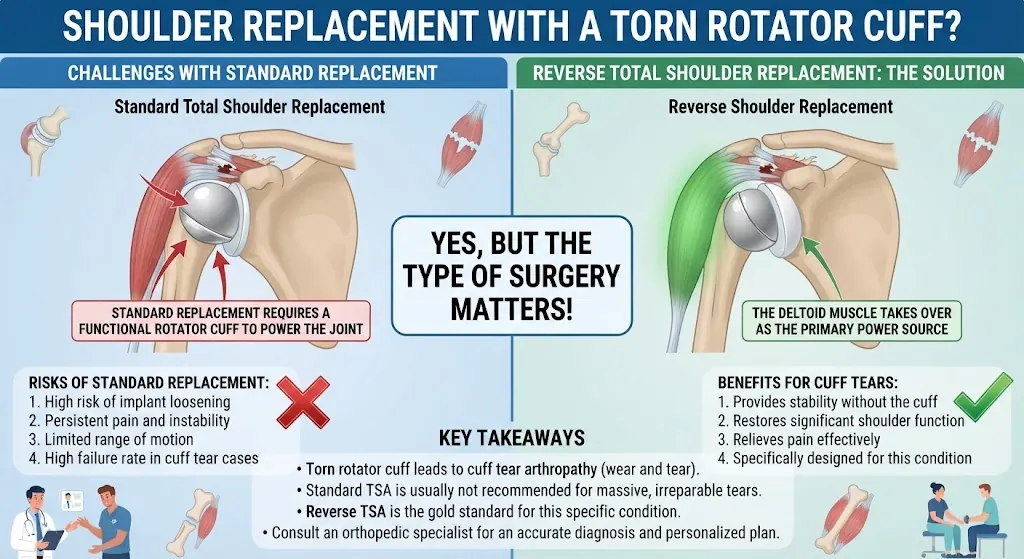
Yes, you can have a shoulder replacement with a torn rotator cuff. The important question is which type of replacement is appropriate. Some people can receive an anatomic shoulder replacement if the rotator cuff is functional or can be successfully repaired, while others may benefit from a reverse shoulder replacement designed to work with a severely damaged rotator cuff.
The decision depends on the size and condition of the tear, the degree of arthritis, bone quality, shoulder strength, and overall health. Understanding these factors can help you discuss the available options with an orthopedic surgeon without assuming that a rotator cuff tear automatically rules out replacement surgery.
Can You Get a Shoulder Replacement if Your Rotator Cuff Is Torn?
Yes. A torn rotator cuff does not automatically prevent shoulder replacement surgery, but it can influence which implant your surgeon recommends.
The rotator cuff is a group of four muscles and their tendons that help stabilize the shoulder joint and control arm movement. When these tendons are badly damaged, the shoulder may struggle to move normally even if the arthritic joint is replaced.
A surgeon will assess whether the tear is repairable, how much muscle weakness or degeneration is present, and whether arthritis has damaged the joint. The evaluation may include a physical examination and imaging such as X-rays, ultrasound, or MRI. For more detail, see rotator cuff tear symptoms, treatment, and recovery.
Which Shoulder Replacement Is Best for a Torn Rotator Cuff?
The two main options are anatomic total shoulder replacement and reverse shoulder replacement. They differ in design and in how they help the shoulder move.
| Feature | Anatomic shoulder replacement | Reverse shoulder replacement |
|---|---|---|
| Joint design | Recreates the natural ball-and-socket arrangement | Reverses the ball and socket positions |
| Rotator cuff requirement | Generally requires a functional rotator cuff | Often used when the rotator cuff is severely damaged or irreparable |
| Common use | Shoulder arthritis with adequate cuff function | Certain cases of cuff-related arthritis, complex fractures, or revision surgery |
| Movement | Relies on the rotator cuff and other shoulder muscles | Changes the joint mechanics so the deltoid muscle can help raise the arm |
| Main consideration | A deficient cuff may compromise stability and function | The deltoid and other relevant structures must be suitable for the procedure |
Neither option is best for everyone. The surgeon considers the tear’s severity, the degree of arthritis, and the muscles and bones available to support the implant.
When Is Anatomic Shoulder Replacement Possible?
Anatomic replacement may be appropriate when the rotator cuff is intact, functioning adequately, or can be repaired in a way that is expected to support the new joint. However, a substantial, irreparable tear can make this approach less suitable because the shoulder may not remain stable or move effectively.
When Is Reverse Shoulder Replacement Recommended?
Reverse shoulder replacement is often considered when a large, irreparable rotator cuff tear causes major weakness, particularly when arthritis is also present. By changing the joint’s mechanics, the procedure allows the deltoid muscle to contribute more to lifting the arm.
Learn more about why a reverse shoulder replacement may be needed. The procedure is not automatically necessary for every rotator cuff tear; the full clinical picture determines whether it is appropriate.
What Factors Determine Whether You Need a Reverse Replacement?
The most important factors are the severity of the rotator cuff tear and the condition of the shoulder joint. A surgeon may consider:
-
Tear size and repairability: A small tear may be repairable, while a large tear with substantial tendon retraction or muscle degeneration may not be.
-
Arthritis severity: Advanced joint damage may make replacement more appropriate than tendon repair alone.
-
Arm strength and function: Significant weakness or inability to raise the arm can affect treatment decisions.
-
Bone quality: The implant must have suitable bone support.
-
Overall health and goals: Medical conditions, daily activities, and recovery expectations also matter.
A rotator cuff tear does not always require surgery. Depending on its severity and your symptoms, non-surgical treatment for a rotator cuff tear may be considered before replacement.
What Happens Before Shoulder Replacement Surgery?
Your surgeon will review your symptoms, examine shoulder movement and strength, and assess imaging. X-rays help show arthritis and bone changes, while MRI or other imaging may help evaluate the rotator cuff when needed.
| Evaluation | Why it matters |
|---|---|
| Physical examination | Assesses strength, movement, and shoulder function |
| X-rays | Show joint damage, bone changes, and arthritis |
| MRI or ultrasound, when appropriate | Helps evaluate tendon damage and muscle condition |
| Medical history | Identifies health issues that may affect surgery or recovery |
| Discussion of goals | Helps match the procedure to your daily needs and expectations |
Ask whether the tear is repairable, which replacement type is being considered, and what level of arm movement you can reasonably expect. Reviewing what to know before shoulder surgery can also help you prepare questions.
What Is Recovery Like After Shoulder Replacement With a Torn Rotator Cuff?
Recovery varies by procedure, overall health, and the condition of the surrounding tissues. Rehabilitation typically progresses from protecting the shoulder to restoring movement and then building strength under professional guidance.
| Recovery stage | General focus |
|---|---|
| Early recovery | Pain control, wound care, and following movement restrictions |
| Initial rehabilitation | Protected movement and exercises approved by the care team |
| Progressive rehabilitation | Gradual improvement in mobility and strength |
| Longer-term recovery | Returning to suitable daily activities and maintaining function |
Your surgeon may recommend a sling for a period after surgery. Follow instructions on how long you may need a sling after shoulder replacement and how to sleep after shoulder replacement. Do not begin strengthening exercises or lift objects before you are cleared.
For a broader overview, see the shoulder replacement recovery timeline. Recovery is gradual, and the timeline should be individualized rather than treated as a fixed deadline.
What Are the Risks and Limitations?
Both anatomic and reverse shoulder replacement carry risks, including infection, stiffness, instability, fractures, nerve injury, and implant loosening. A reverse replacement also has specific risks related to its design, while anatomic replacement may be less successful if the rotator cuff cannot adequately support the joint.
The operation can improve pain and function, but it cannot guarantee normal strength or unrestricted movement. Ask your surgeon about expected benefits, possible complications, and how long a shoulder replacement may last.
Seek prompt medical advice after surgery if you develop fever, wound drainage, increasing redness, or worsening pain. Sudden severe pain, a visible change in shoulder shape, or loss of arm function after a fall requires urgent assessment.
Frequently Asked Questions
1. Can a torn rotator cuff make shoulder replacement impossible?
No. Many people with rotator cuff tears can undergo shoulder replacement, although the tear may affect which implant is suitable.
2. Is reverse shoulder replacement always needed for a torn rotator cuff?
No. Some tears are repairable, and some patients retain enough cuff function for an anatomic replacement. The decision depends on the tendon, joint, and overall shoulder function.
3. Can a rotator cuff tear be repaired during shoulder replacement?
In selected cases, a surgeon may repair a tear, but this is not suitable for every tear or implant design. Ask whether the tendon is repairable and how that affects the surgical plan.
4. Is shoulder replacement better than rotator cuff repair?
These procedures address different problems. Repair may be appropriate for a repairable tear, while replacement may be considered when severe arthritis or irreparable cuff damage causes major symptoms.
5. How painful is shoulder replacement surgery?
Pain is expected after surgery, but medication, ice when approved, and a guided rehabilitation plan can help manage it. Learn more about pain after shoulder replacement surgery.
6. How long does shoulder replacement surgery take?
The duration varies with the procedure and its complexity. Your surgical team can provide an estimate based on your specific case; see how long shoulder replacement surgery takes.
7. Can physical therapy help a torn rotator cuff without surgery?
Yes, physical therapy may improve strength and function for some people, although it does not reconnect a completely torn tendon. Treatment depends on tear severity and symptoms.
8. What happens if a torn rotator cuff is left untreated?
Some tears remain manageable, while others may enlarge or lead to worsening weakness. Read about what can happen when a rotator cuff tear is left untreated.
9. Can you regain full arm movement after reverse shoulder replacement?
Some patients regain substantial functional movement, but full normal movement is not guaranteed. Outcomes depend on the shoulder’s condition, muscle function, and rehabilitation.
10. How do you know whether you need shoulder replacement?
Persistent pain, severe arthritis, reduced function, and the condition of the rotator cuff help guide the decision. An orthopedic evaluation is needed to compare replacement with other treatment options.
Conclusion
You can have a shoulder replacement with a torn rotator cuff. The key is determining whether the tendon can support an anatomic replacement or whether a reverse replacement is more appropriate. An orthopedic surgeon can assess your imaging, strength, joint damage, and goals to help you choose a suitable treatment plan.
Disclaimer: This article is provided for educational and informational purposes only.
This article is for education purpose only and is not a diagnosis or a substitute for medical advice.