
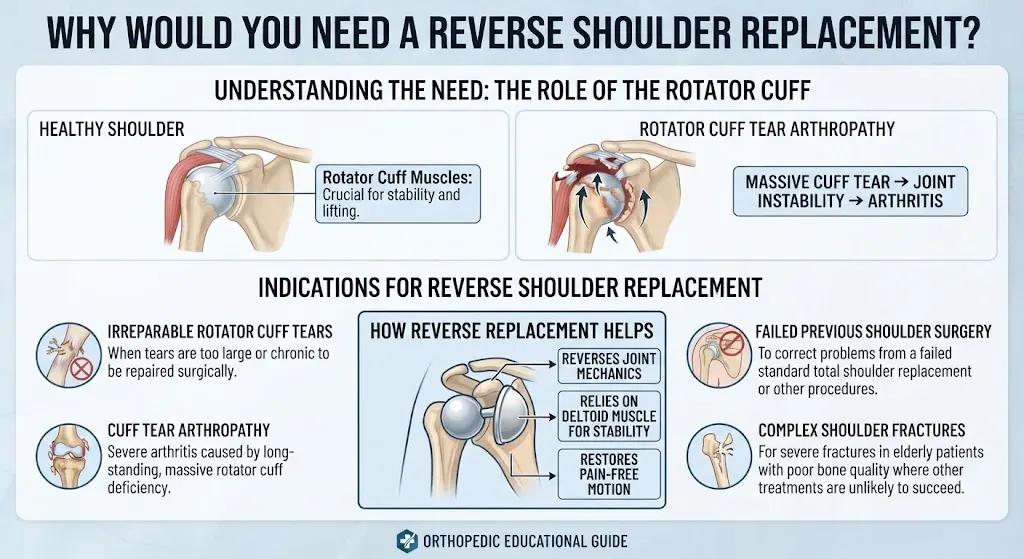
Shoulder pain, weakness, stiffness, and difficulty reaching overhead can make dressing, sleeping, and everyday tasks challenging. However, not everyone with a rotator cuff tear or shoulder arthritis needs replacement surgery. The right treatment depends on the cause of the symptoms, the degree of joint damage, overall health, and how much shoulder function remains.
Understanding why you would need a reverse shoulder replacement can help you discuss treatment options with an orthopedic surgeon. Below, we explain who may benefit, how the procedure differs from conventional replacement, what alternatives exist, and what recovery may involve.
What Is a Reverse Shoulder Replacement?
A reverse shoulder replacement is an operation that changes the normal ball-and-socket arrangement of the shoulder. The surgeon places a ball-shaped component on the shoulder socket and a socket-shaped component on the upper arm bone.
In a conventional, or anatomic, shoulder replacement, the artificial joint follows the shoulder’s natural arrangement. This generally requires a functioning rotator cuff to stabilize the joint and help control arm movement. With a reverse replacement, the deltoid muscle can take on more of the work of lifting the arm when the rotator cuff is severely damaged.
Why Would You Need a Reverse Shoulder Replacement?
Several conditions may make reverse shoulder replacement more appropriate than conventional replacement.
1. A large, irreparable rotator cuff tear
The rotator cuff is a group of muscles and tendons that stabilize the shoulder and support movement. When a tear is extensive, the tendons may be too damaged or retracted to repair successfully. This can cause persistent pain and difficulty raising the arm.
A surgeon may recommend reverse replacement when symptoms are severe and other treatments have not helped enough. Learn about when a rotator cuff tear needs surgery.
2. Shoulder arthritis combined with rotator cuff damage
Shoulder arthritis damages the joint’s smooth cartilage, causing pain and stiffness. When arthritis occurs alongside a major rotator cuff tear, a conventional replacement may not provide adequate stability or function.
Reverse replacement may address both problems by replacing damaged joint surfaces while relying more heavily on the deltoid muscle.
3. A complex shoulder fracture
Some severe fractures near the top of the upper arm bone cannot be repaired reliably, particularly when the bone is broken into several pieces or the rotator cuff is compromised. In selected cases, reverse replacement may offer a treatment option. The decision depends on the fracture pattern, bone quality, age, activity level, and overall health.
4. A previous shoulder replacement has failed
A previous replacement may fail because of loosening, instability, infection, or rotator cuff failure. Some patients may need revision surgery, and a reverse replacement may be considered depending on the reason for failure and the condition of the remaining bone and soft tissues.
Reverse vs. Conventional Shoulder Replacement
| Feature | Reverse replacement | Conventional replacement |
|---|---|---|
| Joint design | Ball and socket positions are reversed | Natural ball-and-socket arrangement is retained |
| Rotator cuff | Can work despite severe cuff damage | Generally requires a functional cuff |
| Common reasons | Irreparable cuff tear, cuff-related arthritis, selected complex fractures | Arthritis with a functioning rotator cuff |
| Main muscle supporting arm elevation | Deltoid plays a major role | Rotator cuff and deltoid work together |
The choice is not based on age or an MRI finding alone. An orthopedic surgeon assesses symptoms, physical examination findings, imaging, bone quality, and functional goals. For a closer look at the decision, see shoulder replacement with a torn rotator cuff.
What Tests Help Determine Whether You Need It?
Evaluation usually includes a medical history and physical examination. The surgeon checks pain, strength, range of motion, shoulder stability, and the ability to lift the arm.
X-rays help show arthritis, bone changes, and joint alignment. MRI or ultrasound may help assess rotator cuff damage, while CT scans can provide more detail about bone loss and help with surgical planning. Imaging findings must be interpreted alongside symptoms and examination results.
What Are the Alternatives to Reverse Shoulder Replacement?
Surgery is not always the first option. Depending on the condition, treatment may include:
-
Physical therapy: Exercises tailored to shoulder strength and mobility.
-
Medication: Pain relievers or anti-inflammatory medicines when medically appropriate.
-
Activity modification: Temporarily reducing movements that aggravate symptoms.
-
Rotator cuff repair: An option when the tendon tear is considered repairable.
-
Other shoulder procedures: Selected patients may benefit from a different operation based on the specific damage.
For guidance on non-surgical versus surgical shoulder pain treatments, discuss the likely benefits and limitations of each option with your clinician.
Recovery After Reverse Shoulder Replacement
Recovery takes time and varies by the reason for surgery, overall health, and rehabilitation progress. A sling is commonly used initially, and physical therapy usually advances in stages according to the surgeon’s instructions.
| Recovery phase | What may happen |
|---|---|
| Early recovery | Pain management, wound care, sling use, and prescribed gentle movement |
| Rehabilitation | Gradual improvement in mobility and controlled strengthening |
| Later recovery | Increasing use of the arm for daily activities, guided by progress and restrictions |
Do not rush lifting, pushing, pulling, or overhead activity. Follow your care team’s guidance on how long you may need a sling after shoulder replacement and the shoulder replacement recovery timeline. Ask when it is safe to drive, return to work, and resume exercise.
What Are the Risks?
Potential complications include infection, blood clots, dislocation, fractures around the implant, nerve injury, implant loosening, and persistent pain or stiffness. Some patients continue to have limited strength or range of motion even after surgery.
Contact your surgical team for worsening pain, increasing redness, drainage, fever, or symptoms that concern you. Seek urgent medical attention for chest pain, sudden shortness of breath, or other signs of a possible emergency.
Frequently Asked Questions
1. Does a torn rotator cuff always require reverse shoulder replacement?
No. Some tears can be managed with physical therapy, activity changes, medication, or repair surgery. Reverse replacement is generally considered when substantial shoulder damage causes persistent symptoms and other options are unlikely to work well.
2. Can you lift your arm after reverse shoulder replacement?
Many patients regain the ability to lift their arm more comfortably, but the amount of improvement varies. Rehabilitation and the condition of the deltoid muscle affect the outcome.
3. Is reverse shoulder replacement a major surgery?
Yes. It involves replacing joint components and requires postoperative care and rehabilitation. Your surgeon can explain your individual risks and expected recovery.
4. How painful is reverse shoulder replacement?
Pain is expected after surgery, especially during early recovery, but medication and a structured rehabilitation plan can help manage it. Pain levels and recovery experiences vary.
5. How long does a reverse shoulder replacement last?
Implant longevity varies with factors such as activity, bone quality, complications, and implant design. Ask your surgeon about expected durability and how long a shoulder replacement may last.
6. Can physical therapy prevent the need for surgery?
Sometimes. Therapy may improve strength and function, but it cannot restore severely damaged cartilage or reliably repair every irreparable tendon tear. Suitability depends on the underlying condition.
7. Can both shoulders be replaced?
Some people undergo replacement in both shoulders, usually as separate operations. Timing depends on recovery, daily support needs, health, and the condition of each shoulder.
8. Is reverse replacement suitable for younger adults?
It can be considered in selected younger adults, but age, activity demands, implant longevity, and alternative treatments matter. The decision requires individualized assessment.
9. What should you avoid after surgery?
Restrictions vary, but lifting heavy objects or pushing through the arm too early may jeopardize recovery. Follow your rehabilitation plan and ask before resuming demanding activities.
10. When should you discuss reverse shoulder replacement with a surgeon?
Consider an orthopedic evaluation if shoulder pain, weakness, or limited movement persist despite appropriate treatment, especially when imaging shows substantial arthritis or rotator cuff damage. A consultation can clarify whether surgery or a less invasive approach is reasonable.
Conclusion
Reverse shoulder replacement may be appropriate when severe rotator cuff damage, arthritis, certain fractures, or a failed previous replacement limits shoulder function. It is not necessary for every tear or painful shoulder. A careful examination, appropriate imaging, and discussion of treatment alternatives can help determine the most suitable approach.
Disclaimer: This article is provided for educational and informational purposes only.
This article is for education purpose only and is not a diagnosis or a substitute for medical advice.