
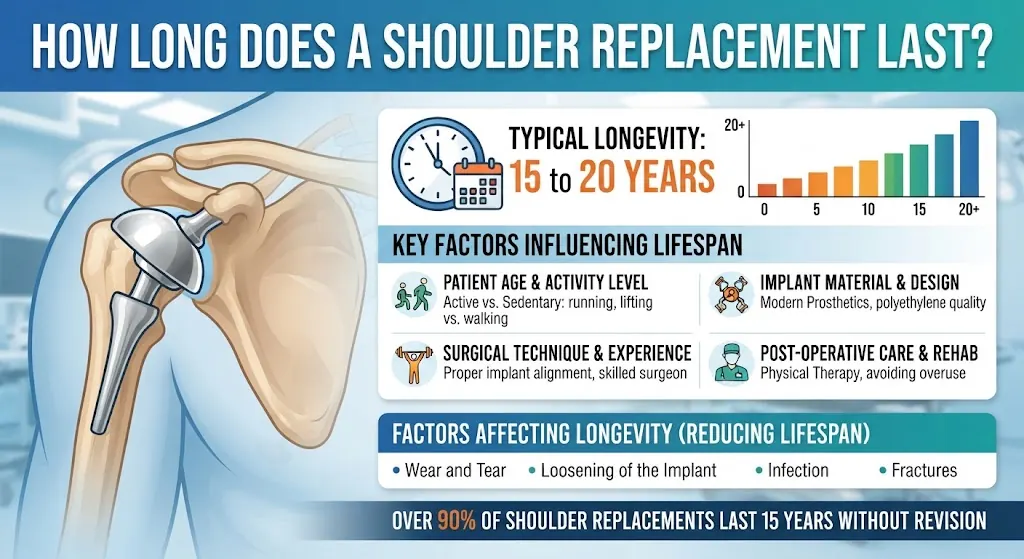
A shoulder replacement is not necessarily a lifetime solution, but it also does not automatically need to be replaced after a fixed number of years. Implant longevity depends on factors such as the type of replacement, bone quality, activity level, surgical technique, and whether complications develop.
Understanding how long a shoulder replacement lasts can help you set realistic expectations, choose appropriate activities, and recognize when follow-up care may be needed. The information below explains typical implant lifespan, differences between replacement types, factors that affect durability, and signs that warrant medical evaluation.
How Long Does a Shoulder Replacement Typically Last?
A shoulder replacement often lasts 15–20 years or longer, although some implants need revision earlier and others continue functioning well beyond 20 years. These are general expectations, not guarantees for an individual patient.
Researchers assess implant longevity by tracking how many replacements remain in place without revision surgery. These studies can differ because they examine different implant designs, patient groups, surgical techniques, and follow-up periods. A replacement that has not needed another operation may still have some pain or stiffness, so implant survival does not always mean perfect comfort or function.
Your surgeon can explain how your age, diagnosis, bone condition, and implant type affect your expected outcome. For additional context, see how long shoulder replacement recovery takes and what recovery involves before judging the long-term result.
What Affects How Long a Shoulder Replacement Lasts?
Several factors influence how long an artificial shoulder joint remains functional.
-
Implant type: Anatomic total shoulder replacement and reverse shoulder replacement use different designs and may have different risks depending on the patient’s condition.
-
Age at surgery: Younger patients may place more years of demand on an implant and may be more likely to undergo revision during their lifetime.
-
Activity level: Repeated heavy lifting, high-impact activity, and excessive loading can increase stress on the joint.
-
Bone and tissue health: Bone quality, rotator cuff function, and surrounding soft tissues affect joint stability and performance.
-
Complications: Infection, implant loosening, instability, fractures, or component wear may shorten implant life.
-
Follow-up care: Monitoring symptoms and attending recommended appointments can help identify problems before they become more difficult to manage.
Shoulder replacements are not all designed for the same circumstances. For example, why a reverse shoulder replacement may be recommended explains why rotator cuff damage can influence the choice of implant.
Anatomic vs. Reverse Shoulder Replacement: Does the Type Matter?
Yes. The implant design and the condition being treated can influence durability, function, and the likelihood of future surgery.
| Feature | Anatomic shoulder replacement | Reverse shoulder replacement |
|---|---|---|
| Joint design | Recreates the shoulder’s natural ball-and-socket arrangement | Reverses the ball and socket positions |
| Common use | Arthritis when the rotator cuff functions adequately | Certain cases of severe rotator cuff damage, complex fractures, or revision surgery |
| Main functional consideration | Depends partly on a functioning rotator cuff | Uses different muscle mechanics to help raise the arm |
| Long-term outlook | Can last many years; outcomes depend on implant and patient factors | Can also last many years; risks vary with the underlying condition and implant |
| Important limitation | Rotator cuff failure can affect function | Instability, fractures, and other complications remain possible |
People with significant rotator cuff damage may be candidates for a reverse design. Learn more about having a shoulder replacement with a torn rotator cuff.
Neither design is automatically more durable for every patient. Your surgeon considers the reason for surgery, the condition of the rotator cuff and bone, and the expected demands on the shoulder.
Can a Shoulder Replacement Wear Out or Fail?
Yes. Artificial components can wear, loosen, become unstable, or develop other problems over time. However, new pain does not necessarily mean the implant has failed.
Possible reasons for new or increasing symptoms include:
-
Component loosening: An implant may lose its secure attachment to the bone.
-
Instability: The joint may partially or completely come out of position.
-
Infection: An infection can develop after surgery, sometimes long after the initial procedure.
-
Fracture: A fall or other injury may damage the bone around the implant.
-
Rotator cuff or soft-tissue problems: Changes in surrounding structures can affect movement and strength.
-
Component wear: Parts may deteriorate over time, depending on their materials and the forces placed on them.
A clinician may assess your symptoms, examine shoulder movement and strength, and order X-rays or other imaging when appropriate. The article on how shoulder imaging compares with an X-ray or MRI can help explain why different tests may be used, although the best test after replacement depends on the clinical situation.
How Can You Help a Shoulder Replacement Last Longer?
You cannot eliminate every risk, but sensible activity choices and follow-up care can help protect your shoulder.
-
Follow rehabilitation instructions. Progress exercises according to your surgeon’s and physical therapist’s guidance rather than increasing resistance too quickly.
-
Avoid excessive loading. Heavy lifting and repetitive overhead work may need modification, especially if they cause pain or strain.
-
Build strength gradually. Exercise can improve function, but the right movements and timing depend on your surgery and recovery.
-
Prevent falls. Use safe footwear, keep walkways clear, and take care on stairs.
-
Attend follow-up appointments. Your care team can assess symptoms, function, and imaging when indicated.
-
Report persistent changes. New pain, weakness, swelling, or reduced movement deserves attention rather than being dismissed as normal aging.
Before returning to weight training, review guidance on lifting weights after shoulder replacement. General workout advice is not a substitute for your individual postoperative restrictions.
What Activities Should You Be Careful With?
There is no single lifelong activity list that applies to everyone with a shoulder replacement. Restrictions depend on the implant, the stability of the joint, recovery progress, and the surgeon’s recommendations.
| Activity | Practical approach |
|---|---|
| Everyday tasks, such as dressing and eating | Resume gradually as permitted during rehabilitation |
| Light exercise | Follow your prescribed program and avoid movements that cause sharp or worsening pain |
| Heavy lifting | Ask your surgeon about appropriate loads and technique |
| Repetitive overhead activity | Build up cautiously and discuss demanding work or sports |
| Contact or high-impact sports | Review injury risks and alternatives with your care team |
| Activities after a fall or sudden injury | Seek assessment if pain, weakness, deformity, or loss of movement develops |
For broader recovery planning, things to know before shoulder surgery can help you prepare for postoperative limitations. When you are cleared to exercise, shoulder-strengthening exercises may offer useful background, but only use movements approved for your replacement.
When Should You Be Concerned About a Shoulder Replacement?
Some stiffness or soreness can occur during recovery, but new symptoms years after surgery should not automatically be attributed to the implant aging.
| Symptom | What to do |
|---|---|
| Mild, stable stiffness without other changes | Discuss it at a routine appointment if it persists or affects daily activities |
| Increasing pain, weakness, or reduced movement | Arrange a medical evaluation |
| New pain after a fall or sudden injury | Seek prompt medical assessment |
| Fever, wound drainage, increasing redness, or warmth | Contact your healthcare team promptly |
| Severe sudden pain, visible deformity, or inability to move the arm after injury | Seek urgent medical care |
A painful shoulder may have causes unrelated to implant failure. For example, rotator cuff tear symptoms and treatment and shoulder tendonitis symptoms describe problems involving surrounding tissues. Do not assume either condition is responsible without an examination.
If symptoms are severe or rapidly worsening, do not delay care while trying home remedies. For less urgent discomfort, your clinician can explain appropriate shoulder pain treatment options based on the cause.
Frequently Asked Questions
1. Can a shoulder replacement last 30 years?
It is possible for some replacements to remain functional for several decades, but this cannot be guaranteed. Long-term durability depends on implant design, patient factors, and complications.
2. Does a shoulder replacement eventually need to be replaced?
Not always. If the implant remains stable and provides acceptable function, revision surgery may never be necessary.
3. Does age affect how long a shoulder replacement lasts?
Age can influence lifetime revision risk. Younger patients generally have more years in which an implant may wear or develop complications, while overall health and activity also matter.
4. Can exercise damage a shoulder replacement?
Appropriately prescribed exercise helps restore strength and movement. Excessive loading or returning to demanding activities too early may increase risk, so follow your rehabilitation plan.
5. Is reverse shoulder replacement less durable than a standard replacement?
There is no universal answer. The two designs are used for different clinical situations, and their long-term outcomes depend on patient characteristics, implant design, and surgical factors.
6. How often should a shoulder replacement be checked?
Follow your surgeon’s recommended schedule. Contact the care team sooner if pain increases, movement declines, or other new symptoms develop.
7. Can a fall damage a shoulder replacement?
Yes. A fall can cause a fracture around the implant, dislocation, or other injury. New severe pain or difficulty moving the arm after a fall needs prompt evaluation.
8. Is pain years after shoulder replacement normal?
Persistent or new pain should not automatically be considered normal. A clinician may need to assess the implant, surrounding tissues, and other possible causes.
9. Does heavy lifting shorten implant life?
Repeated heavy loads may increase stress on the shoulder, but the risk varies. Ask your surgeon which lifting limits and activities are appropriate for your particular replacement.
10. What happens if a shoulder replacement wears out?
Your clinician may recommend monitoring, activity modification, or further tests, depending on the problem. Revision surgery may be considered if the implant fails or causes significant symptoms, but it is not required in every case.
Conclusion
A shoulder replacement commonly lasts 15–20 years or longer, but individual results vary. Implant type, activity demands, surrounding tissue health, and complications all influence durability. Follow your rehabilitation and follow-up plan, choose activities appropriate for your shoulder, and seek medical advice if pain or function worsens.
Disclaimer: This article is provided for educational and informational purposes only.
This article is for education purpose only and is not a diagnosis or a substitute for medical advice.