
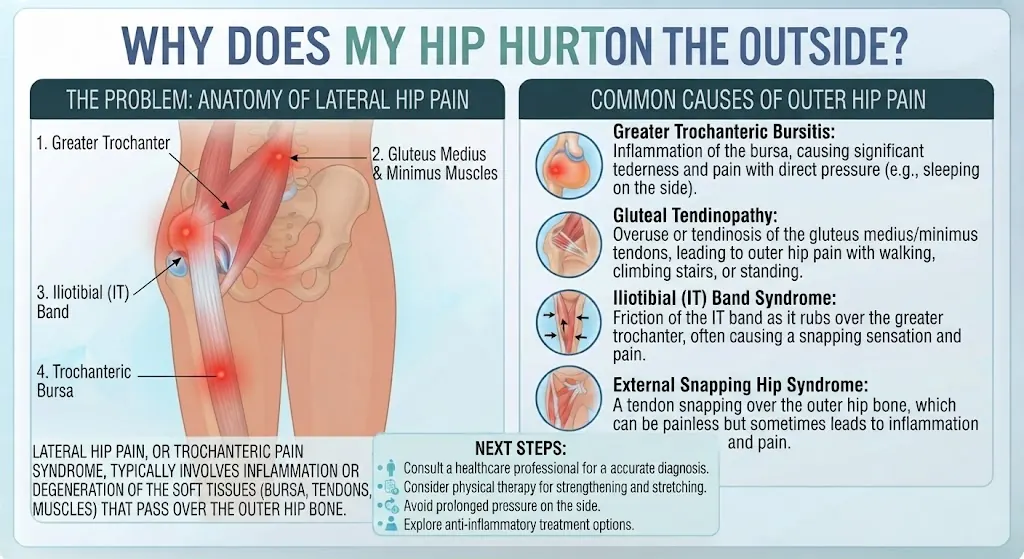
Pain on the outside of the hip does not always mean the hip joint itself is damaged. Muscles, tendons, and small fluid-filled sacs around the hip can also cause discomfort. However, persistent pain, worsening symptoms, or difficulty bearing weight deserves medical attention.
Understanding why your hip hurts on the outside can help you identify possible causes, adjust activities safely, and recognize when professional evaluation is appropriate.
What Causes Pain on the Outside of the Hip?
The most common causes involve the soft tissues surrounding the bony prominence on the outer side of the hip, although joint conditions and referred pain can also contribute.
1. Greater trochanteric pain syndrome
Greater trochanteric pain syndrome (GTPS) is a common cause of outer hip pain. It often involves irritation or injury of the gluteal tendons, sometimes alongside inflammation of the nearby bursa, a small cushioning sac.
Typical symptoms include tenderness over the outside of the hip, pain when lying on that side, and discomfort during stair climbing or prolonged walking. Symptoms may worsen after increasing exercise, standing for long periods, or repeatedly loading the affected leg.
For more detail, see why hip pain develops when sleeping on your side.
2. Gluteal tendon irritation or injury
The gluteus medius and gluteus minimus muscles help stabilize your pelvis while you walk. Their tendons attach near the outer hip and can become overloaded by repetitive activity or sudden changes in exercise.
Pain may increase when standing on one leg, climbing stairs, walking uphill, or getting out of a low chair. Tendon problems can overlap with GTPS, so symptoms alone cannot reliably distinguish them.
3. Hip osteoarthritis
Osteoarthritis affects the cartilage and other structures inside the hip joint. It more commonly causes groin pain, stiffness, and reduced movement, but discomfort can sometimes spread toward the outer hip.
Stiffness after resting, difficulty putting on shoes, and pain with weight-bearing activity may suggest a joint-related cause. Age-related changes can increase the likelihood of osteoarthritis, but age alone does not establish the diagnosis.
4. Other possible causes
Less commonly, outer hip pain may come from a muscle strain, a hip labral problem, a stress fracture, or a nerve problem originating in the lower back. A hip flexor strain more often causes pain toward the front of the hip or groin than directly over its outer side.
Pain that travels down the leg, especially with tingling, numbness, or back pain, may have a different source. Learn about hip pain that spreads down the leg.
What Does Outer Hip Pain Usually Feel Like?
The location and circumstances of your pain can offer clues, but they cannot confirm the cause.
| Symptom pattern | Possible explanation | Helpful next step |
|---|---|---|
| Tenderness over the outer hip | GTPS or gluteal tendon irritation | Reduce aggravating pressure and monitor symptoms |
| Pain when lying on one side | Outer hip tendon or bursa irritation | Avoid direct pressure on the painful side |
| Pain on stairs or hills | Tendon overload or joint problems | Temporarily reduce strenuous climbing |
| Groin pain with stiffness | Possible hip joint involvement | Arrange an evaluation if persistent |
| Pain with back discomfort or tingling | Possible referred or nerve-related pain | Discuss the symptoms with a clinician |
Pain that is concentrated over the outer hip and worsens with direct pressure is often associated with local soft-tissue problems. For comparison, hip pain in the groin may point toward a different pattern of hip involvement.
How Can You Relieve Outer Hip Pain at Home?
For mild pain without warning signs, adjusting activity and reducing pressure on the area may help.
-
Modify painful activities. Temporarily reduce repeated stair climbing, steep hills, running, and movements that clearly worsen your symptoms. Avoid complete inactivity if you can move comfortably.
-
Try cold therapy. Apply a cold pack wrapped in a towel for 15–20 minutes at a time. Stop if your skin becomes numb or irritated.
-
Change your sleeping position. Avoid lying directly on the painful hip. If you sleep on the opposite side, place a pillow between your knees to improve comfort.
-
Return to movement gradually. Gentle walking on level ground may be appropriate if it does not significantly increase pain. Low-impact exercises for joint pain may offer options once symptoms settle.
-
Be cautious with stretching and strengthening. Deep hip stretches, forceful foam rolling, or exercises that compress the outer hip may aggravate some tendon problems. A physical therapist can help select suitable exercises.
Over-the-counter pain relievers may help some people, but they are not appropriate for everyone. Anti-inflammatory medicines such as ibuprofen can cause stomach bleeding, kidney problems, and medication interactions. Ask a healthcare professional or pharmacist which option is safe for you.
When Should You See a Doctor?
Symptoms you can usually monitor
Mild discomfort after an increase in activity may improve with temporary activity modification. Monitor whether pain is easing, whether walking remains comfortable, and whether symptoms interfere with sleep.
Symptoms needing medical evaluation
Arrange an appointment if pain persists for more than a week or two without improvement, repeatedly returns, worsens, disrupts sleep, or limits everyday activities. Seek evaluation sooner if you have significant weakness, a limp, unexplained weight loss, fever, or a history of cancer.
A clinician may examine your hip movement, strength, gait, and tenderness. X-rays can help assess bones and arthritis; ultrasound or MRI may be considered when a tendon injury or another soft-tissue problem is suspected. A normal X-ray does not exclude every cause of hip pain.
Symptoms requiring urgent care
Seek urgent medical attention if you develop sudden severe hip pain, cannot bear weight, or have significant pain after a fall or injury. Fever with a hot, swollen, or very painful hip also requires urgent assessment. A fracture or joint infection needs prompt medical treatment.
Frequently Asked Questions
1. Why does the outside of my hip hurt when I walk?
Walking repeatedly loads the muscles and tendons that stabilize your pelvis. Tendon irritation, GTPS, or hip joint conditions may cause pain, particularly when walking longer distances or uphill.
2. Why does my outer hip hurt when I climb stairs?
Stair climbing requires more work from the hip muscles than level walking. If the outer hip tendons are irritated, repeated steps may increase pain.
3. Why does my hip hurt when I lie on it?
Direct pressure can irritate sensitive tissues around the outer hip. Sleeping on the opposite side with a pillow between your knees may reduce discomfort.
4. Can outer hip pain come from the lower back?
Yes. Nerve irritation or other spinal conditions can refer pain toward the hip. Back pain, tingling, numbness, or symptoms extending down the leg may provide additional clues.
5. Is outer hip pain always bursitis?
No. Gluteal tendon problems are an important cause, and bursitis may occur alongside them. An examination can help identify the most likely source.
6. Should I keep walking if my hip hurts?
Gentle walking may be reasonable if pain remains mild and does not worsen afterward. Reduce the distance or stop if you develop a limp, sharp pain, or increasing discomfort.
7. How long does outer hip pain take to improve?
Mild activity-related pain may improve over days to a few weeks. Tendon problems can take several weeks or longer, particularly when symptoms have been present for months.
8. Can exercises make outer hip pain worse?
Yes. Exercises that overload or compress irritated tendons may aggravate symptoms. Start gradually and seek professional guidance if movement repeatedly increases pain.
9. Can outer hip pain occur without an injury?
Yes. Repetitive loading, changes in exercise, prolonged pressure during sleep, and gradual tendon changes can cause symptoms without a single identifiable injury.
10. When might I need surgery for outer hip pain?
Most cases are initially managed without surgery, depending on the cause. Surgery may be considered for selected structural problems that remain disabling despite appropriate nonsurgical treatment.
Conclusion
Outer hip pain commonly involves the tendons and other soft tissues around the hip, but joint conditions and referred pain are also possible. Reduce activities that aggravate symptoms, avoid direct pressure on the painful side, and return to exercise gradually. Seek medical evaluation for persistent or worsening pain, and obtain urgent care for severe symptoms or difficulty bearing weight.
Disclaimer: This article is provided for educational and informational purposes only.
This article is for education purpose only and is not a diagnosis or a substitute for medical advice.