
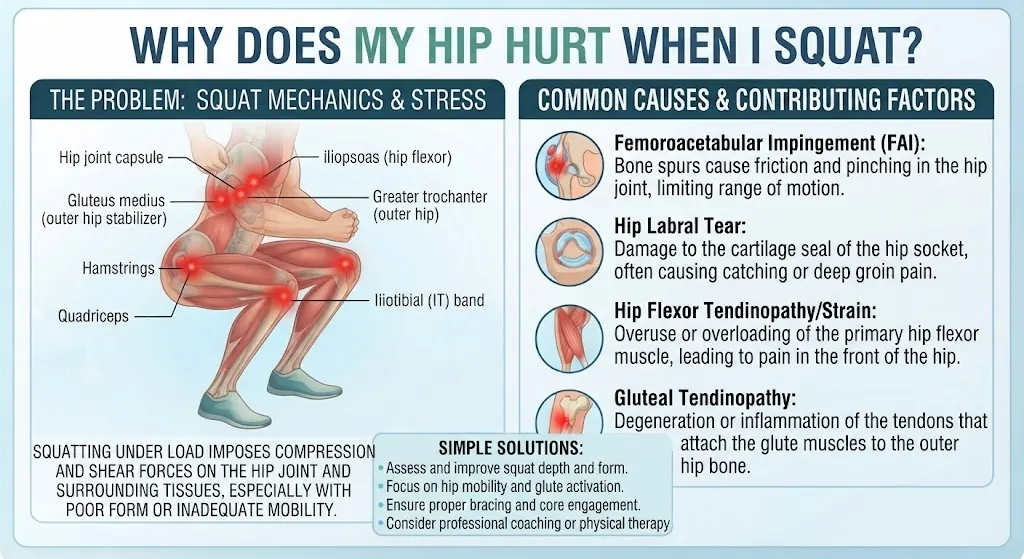
Hip pain when squatting does not automatically mean you have a serious injury. It can develop from limited hip mobility, increased training demands, irritated tendons, or joint conditions. However, persistent pain, significant weakness, or symptoms following an injury deserve attention rather than being pushed through during exercise.
Understanding why your hip hurts during a squat can help you decide which movements to modify, what you can safely try at home, and when to seek medical evaluation. The location of your pain, how it started, and whether it occurs during other activities can provide useful clues, although symptoms alone cannot establish a diagnosis.
What Causes Hip Pain When Squatting?
The hip joint moves through substantial flexion during a squat. Muscles, tendons, cartilage, and other joint structures work together to control this movement. Pain can develop when these tissues are irritated, when movement exceeds your current tolerance, or when an underlying joint condition affects bending.
Common possibilities include:
1. Limited hip mobility or movement-related irritation
If your hips have limited comfortable movement, lowering into a deep squat may cause pinching or pressure. Stance width, foot position, ankle mobility, and trunk position can influence how your hips move.
A deeper squat is not necessary for everyone. Reducing the depth to a comfortable range may help you maintain strength training without repeatedly provoking symptoms.
2. Hip impingement
Femoroacetabular impingement (FAI) occurs when the shape of the hip bones contributes to contact during certain movements. It may cause pain or pinching in the front of the hip or groin, especially with deep hip flexion.
Some people have bone-shape differences without symptoms, so imaging findings alone do not establish that impingement is causing your pain.
3. Hip labral tear
The labrum is a ring of cartilage that helps deepen the hip socket and support joint stability. A tear may cause deep groin pain, clicking, catching, or discomfort with twisting and bending, although these symptoms are not specific to a tear.
A clinician may consider a hip labral tear and its symptoms, causes, and treatment options when persistent groin pain occurs with several hip movements.
4. Tendon or muscle irritation
The hip flexors, gluteal muscles, and surrounding tendons help control squatting. A sudden increase in lifting, repeated deep squats, or returning to training too quickly can irritate these tissues.
A hip flexor strain may cause pain at the front of the hip, particularly after a sudden movement or demanding workout. Outer-hip pain can also involve the gluteal tendons, especially when lying on that side or climbing stairs.
5. Hip osteoarthritis
Osteoarthritis can cause pain, stiffness, and reduced movement, particularly when bending deeply or getting up from a low chair. Stiffness after inactivity and discomfort during several weight-bearing activities may also occur.
Hip pain is not exclusively an age-related problem, and younger adults can experience joint-related pain for other reasons.
Where Does Hip Pain During Squats Usually Occur?
The location of your discomfort can help narrow down possible causes, but it cannot confirm a specific condition.
| Where you feel pain | Possible explanations | What to notice |
|---|---|---|
| Front of the hip or groin | Hip impingement, joint irritation, hip flexor strain | Pinching at the bottom of a squat |
| Outside of the hip | Gluteal tendon irritation or greater trochanteric pain syndrome | Pain when lying on that side or climbing stairs |
| Deep inside the joint | Labral irritation or osteoarthritis | Catching, stiffness, or restricted movement |
| Back of the hip or buttock | Muscle irritation or referred pain from the lower back | Pain that spreads down the leg |
| Sudden pain after lifting | Muscle strain or another acute injury | Weakness, bruising, or difficulty bearing weight |
Pain patterns overlap, and some hip problems produce symptoms in more than one location. For additional context, see common causes of hip pain when walking and why hip pain can spread down the leg.
What Should You Do If Squats Hurt Your Hip?
The first step is to stop repeating the movement that causes sharp or increasing pain. You may not need to stop all physical activity, but you should adjust your training to avoid aggravating the symptoms.
Modify your squat technique
-
Reduce depth: Stop before the point where discomfort begins.
-
Adjust your stance: Experiment with a slightly wider or narrower stance, provided the change feels comfortable.
-
Reduce resistance: Temporarily lower the weight or switch to body-weight movements.
-
Avoid forcing flexibility: Deep stretches that reproduce a sharp pinch may worsen irritation.
If pain also occurs when standing, walking, or bending forward, consider whether your symptoms resemble hip pain when standing up, hip pain after prolonged sitting, or hip pain when bending over.
Try comfortable movement and gradual strengthening
Gentle walking, comfortable hip movement, and exercises prescribed by a physical therapist may help maintain strength and mobility. Low-impact options can be useful while you temporarily reduce painful loading; see these low-impact exercises for people with joint pain.
A 2023 clinical practice guideline for nonarthritic hip pain supports combining activity modification with individualized strengthening and movement training. This means that rehabilitation should address your specific movement limitations rather than relying on one exercise or stretch for everyone.
Which Squat Modifications May Help?
| Modification | Potential benefit | Important limitation |
|---|---|---|
| Partial squat | Reduces deep hip flexion | Pain can still occur at shallower depths |
| Box squat to a comfortable height | Provides a consistent stopping point | The box must not force painful positioning |
| Lighter resistance | Reduces loading demands | Does not treat every underlying cause |
| Temporary alternative exercise | Maintains some activity | Choose movements that do not reproduce symptoms |
Do not assume that a particular foot angle or squat depth is universally correct. A physical therapist can assess your hip movement, strength, and technique and help determine which modifications suit you.
When Should You Seek Medical Care?
Symptoms you can usually monitor
Mild discomfort after a recent increase in training may settle with reduced loading and gentle movement, provided you can walk normally and symptoms are improving.
Arrange a medical evaluation
See a healthcare professional if hip pain repeatedly returns, limits daily activities, affects sleep, or does not improve after about two weeks of home care. Evaluation may include a physical examination and, when appropriate, imaging.
Seek urgent or emergency care
Get urgent medical attention for sudden severe pain, a hot or swollen hip with fever, or feeling seriously unwell. Seek emergency care if a significant injury causes severe pain or you cannot bear weight on the affected leg.
Frequently Asked Questions
1. Why does my hip hurt only at the bottom of a squat?
Deep hip flexion may aggravate joint irritation, impingement-related symptoms, or restricted movement. Reducing squat depth can help you identify a more comfortable range.
2. Should I stop squatting if my hip hurts?
Stop painful repetitions and temporarily modify the exercise. Avoid continuing through sharp, worsening, or persistent pain.
3. Can tight hip flexors cause pain during squats?
Hip flexor irritation or limited mobility may contribute to discomfort. However, not all hip pain results from tight muscles, so aggressive stretching is not always appropriate.
4. Is hip pinching during a squat normal?
A pinch is a symptom worth paying attention to, especially if it recurs. It does not automatically mean you have a structural injury, but persistent pinching deserves assessment.
5. Can hip impingement get worse if I keep squatting?
Repeatedly provoking symptoms may increase irritation. Modify the painful range and seek assessment if symptoms persist rather than assuming that all squatting is harmful.
6. How long does hip pain from squatting take to heal?
Recovery depends on the cause and severity. Mild exercise-related irritation may improve within days, while tendon problems or joint conditions may require several weeks or longer.
7. Are squats bad for hip arthritis?
Not necessarily. Appropriately modified strengthening can be beneficial, but depth, resistance, and exercise selection should reflect your symptoms and functional ability.
8. Should I stretch my hips before squatting?
A gradual warm-up and comfortable mobility exercises may help prepare you for activity. Avoid forcing stretches that cause pinching or sharp pain.
9. Can a hip labral tear cause pain during squats?
Yes, a labral tear can cause deep hip or groin pain during bending and twisting. However, a clinical assessment is needed because several other conditions can produce similar symptoms.
10. What exercises can I do instead of squats?
Depending on your symptoms, comfortable walking, gentle hip strengthening, or other low-impact activities may be suitable. A physical therapist can recommend alternatives that maintain fitness without aggravating your hip.
Conclusion
Hip pain when squatting can result from movement-related irritation, muscle or tendon problems, impingement, a labral injury, or arthritis. Temporarily reduce painful squat depth and resistance, maintain comfortable activity, and seek medical evaluation if symptoms persist or worsen. Sudden severe pain, fever with a hot or swollen hip, or inability to bear weight requires urgent attention.
Disclaimer: This article is provided for educational and informational purposes only.
This article is for education purpose only and is not a diagnosis or a substitute for medical advice.