
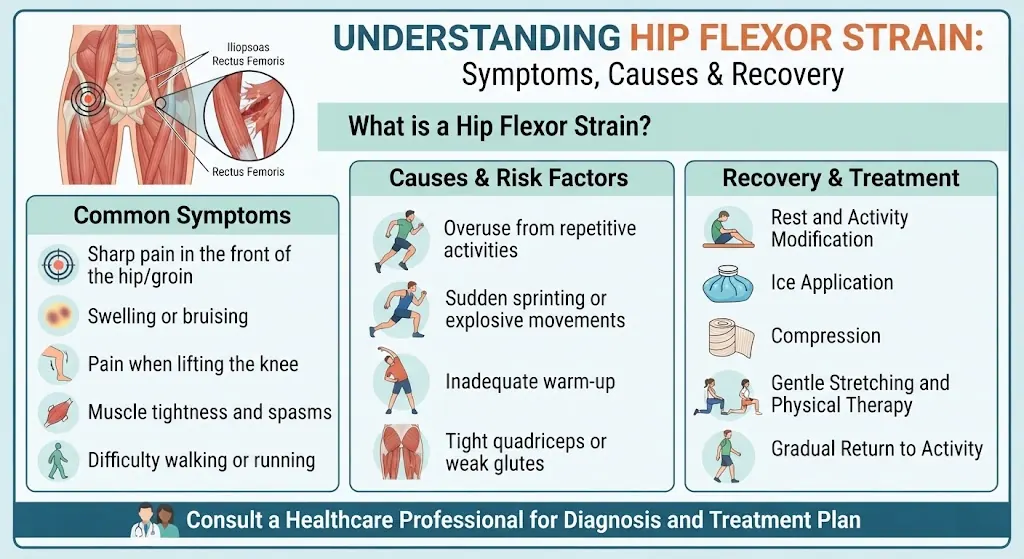
A hip flexor strain can cause pain at the front of the hip or in the groin, particularly when walking, climbing stairs, lifting the knee, or getting up from a chair. The discomfort may feel like a pulling sensation, tightness, or sharp pain when moving the leg. More significant strains can make everyday activities difficult, especially after running, kicking, sprinting, or exercising intensely.
Hip flexor pain does not always mean a muscle is torn. Mild strains may improve with relative rest and gradual movement, while more serious injuries can cause substantial weakness, bruising, or difficulty bearing weight. Pain that persists or worsens also deserves attention because hip joint problems and other injuries can produce similar symptoms.
Understanding hip flexor strain symptoms, common causes, treatment options, and recovery timelines can help you choose appropriate next steps. This guide explains how to manage a suspected strain safely, when to resume exercise, and which warning signs require medical evaluation.
What Is a Hip Flexor Strain?
A hip flexor strain occurs when one or more muscles that help lift the thigh toward the torso become overstretched or develop small tears. The iliopsoas, rectus femoris, and sartorius are among the muscles involved in hip flexion.
These muscles help you walk, run, climb stairs, kick, and rise from a seated position. A strain can affect one muscle or several nearby tissues, depending on the movement that caused the injury.
Hip flexor strains are different from injuries inside the hip joint. For example, a hip labral tear and its symptoms may involve groin pain, clicking, or catching within the joint rather than pain caused primarily by a strained muscle.
What Does a Hip Flexor Strain Feel Like?
The most common symptom is pain at the front of the hip or where the thigh meets the pelvis. Symptoms vary according to the severity of the injury.
Common signs include:
- Pain when lifting the knee toward the chest.
- Tenderness or tightness at the front of the hip.
- Discomfort when walking quickly, running, or climbing stairs.
- Pain when accelerating, kicking, or changing direction.
- Muscle weakness or difficulty lifting the affected leg.
- Swelling or bruising after a more significant injury.
Some people notice symptoms immediately after a sudden movement. Others develop increasing soreness after repeated exercise.
Pain location can provide clues, but it cannot establish the diagnosis. For example, hip pain when walking may also result from joint irritation, tendon problems, or other musculoskeletal conditions.
What Causes a Hip Flexor Strain?
Hip flexor strains commonly occur when the muscles are forced to lengthen or contract rapidly under load.
Typical causes include:
- Sprinting, jumping, or kicking suddenly.
- Increasing exercise intensity or training volume too quickly.
- Repeated uphill running or high-knee drills.
- Slipping, overstretching, or making an abrupt change in direction.
- Returning to sport before an earlier injury has recovered.
- Fatigue that affects movement control during demanding activity.
A limited warm-up, inadequate recovery between strenuous sessions, and previous muscle injuries may also contribute to risk. However, a strain can happen even when someone prepares carefully.
A gradual warm-up and appropriate training progression can help reduce avoidable overload. See these warm-up exercises and stretching principles for practical ways to prepare for physical activity.
How Severe Is a Hip Flexor Strain?
Clinicians commonly describe muscle strains by grade. The exact severity depends on the amount of tissue damage, strength loss, and functional limitation.
| Grade | Typical injury | Possible symptoms | General recovery pattern |
|---|---|---|---|
| Grade 1 | Mild overstretching or small muscle fiber damage | Mild pain with little strength loss | Often improves within days to a few weeks |
| Grade 2 | Partial muscle tear | More pain, weakness, and possible bruising | Often requires several weeks or longer |
| Grade 3 | Complete or near-complete tear | Severe pain or weakness, substantial functional difficulty | May require several months and specialist assessment |
These timelines are estimates, not guarantees. A severe injury may take longer to recover, and a clinician may need to rule out other causes, including tendon injury or a fracture.
How Do You Treat a Hip Flexor Strain at Home?
Most mild hip flexor strains can initially be managed without surgery. The goal is to reduce irritation while preserving comfortable movement and gradually restoring strength.
1. Reduce activities that trigger pain
Temporarily stop sprinting, kicking, jumping, deep lunges, and other movements that reproduce sharp pain. Avoid repeatedly testing the injury to see whether it has healed.
Complete bed rest is generally unnecessary for a mild strain. Short, comfortable walks may be appropriate if you can walk without significant pain or limping.
2. Apply cold therapy for early discomfort
Wrap an ice pack in a thin towel and apply it for approximately 15–20 minutes at a time. Repeat as needed during the first day or two, allowing the skin to return to normal temperature between applications.
Cold therapy may ease pain, but it does not directly repair torn muscle fibers. Never place ice directly on the skin.
3. Use pain medication cautiously
Some people can use an over-the-counter pain reliever, such as acetaminophen or an anti-inflammatory medication, if it is safe for them. Anti-inflammatory medicines can carry risks, including stomach bleeding, kidney problems, and interactions with other medicines.
Ask a pharmacist or clinician if you have medical conditions, take other medications, or are unsure which option is appropriate. Pain relief should not be used to push through strenuous activity.
4. Resume gentle movement when tolerated
Once pain begins settling, gradually reintroduce comfortable hip movement. Stop if an exercise causes sharp pain, increasing discomfort, or a worsening limp.
Gentle activity can help maintain mobility, but aggressive stretching early in recovery may aggravate injured tissue. If you are also experiencing hip pain when standing up, note whether the discomfort improves as you move or remains persistent.
Which Exercises Help a Hip Flexor Strain Recover?
Rehabilitation usually progresses from comfortable movement to strengthening and eventually sport-specific activity. The right starting point depends on injury severity and pain levels.
| Recovery stage | Examples of activity | Main goal |
|---|---|---|
| Early | Comfortable walking and gentle, pain-free hip movement | Reduce stiffness without aggravating the injury |
| Intermediate | Gentle muscle contractions and controlled hip strengthening | Restore strength and movement control |
| Advanced | Progressive resistance, balance work, and sport-specific drills | Prepare for higher physical demands |
Exercises that may be introduced under appropriate guidance include gentle isometric hip flexion, bridges, and controlled strengthening movements. Not every exercise suits every injury, particularly when pain is severe or a tendon may be involved.
A physical therapist can adjust exercise intensity, technique, and progression. General low-impact exercises for people with joint pain may offer ideas for maintaining activity, but they should not replace individualized rehabilitation for a significant muscle strain.
Avoid forceful hip flexor stretches, maximal sprints, heavy resisted knee lifts, and painful lunges until the injury tolerates progressive loading.
How Long Does a Hip Flexor Strain Take to Heal?
Recovery depends on the degree of tissue damage, the muscle involved, general health, and whether the injury is repeatedly aggravated.
| Injury severity | Approximate recovery expectation | Important consideration |
|---|---|---|
| Mild | Several days to a few weeks | Everyday movement should gradually become easier |
| Moderate | Several weeks or longer | Strength and mobility may need structured rehabilitation |
| Severe | Several months in some cases | Specialist assessment may be necessary |
These ranges are practical estimates rather than precise predictions. Returning to activity too soon can prolong symptoms or lead to another strain.
You should not rely on the calendar alone. Before returning to demanding exercise, you should be able to walk normally, move your hip comfortably, and perform progressively harder strengthening and sport-specific movements without significant pain during activity or afterward.
For a broader comparison of muscle recovery, see how long a pulled muscle takes to heal.
When Should You See a Doctor?
Symptoms you can usually monitor
Mild soreness after exercise that steadily improves, with normal walking and no major weakness, can often be monitored initially. Reduce aggravating activities and watch for gradual improvement over the next several days.
Symptoms that need medical evaluation
Arrange an appointment if you have:
- Pain that does not improve after several days of appropriate care.
- Persistent groin or hip pain that interferes with normal activities.
- Repeated episodes of hip flexor pain.
- Noticeable weakness, bruising, or limited movement.
- Pain that occurs without a clear muscular trigger or keeps worsening.
A clinician may assess your walking pattern, strength, range of motion, and the location of tenderness. Imaging is not always needed for a straightforward strain, but X-rays or other tests may be considered when a fracture, tendon injury, or different hip condition is suspected.
Symptoms requiring urgent or emergency care
Seek urgent medical assessment if you cannot bear weight, develop severe pain after an injury, or have substantial swelling or rapidly worsening symptoms. A sudden pop accompanied by major weakness or extensive bruising also warrants prompt evaluation.
Emergency care is appropriate for severe hip pain after major trauma, a visibly deformed limb, or hip pain accompanied by fever and a hot, swollen joint. Sudden hip or groin pain with abdominal symptoms, fainting, or other serious symptoms also needs immediate assessment.
How Can You Prevent Another Hip Flexor Strain?
Prevention focuses on preparing the muscles for the demands you place on them and avoiding abrupt increases in workload.
- Warm up with several minutes of easy activity before intense exercise.
- Increase running speed, distance, and resistance gradually.
- Strengthen the hip and surrounding muscles consistently.
- Allow recovery between demanding training sessions.
- Avoid pushing through fatigue that changes your movement technique.
- Return to sport only after rebuilding strength and comfortable movement.
Athletes who sprint, kick, or change direction frequently may benefit from a structured conditioning plan. Persistent stiffness or repeated injuries should be assessed rather than managed indefinitely through stretching alone.
Frequently Asked Questions
1. Can you walk with a hip flexor strain?
Yes, many people with mild strains can walk, although they may feel pain when taking longer strides or lifting the knee. If walking causes significant pain, produces a pronounced limp, or becomes progressively harder, seek medical assessment.
2. Should you stretch a strained hip flexor?
Gentle movement may be helpful once symptoms begin improving, but forceful stretching can aggravate an acute strain. Start with comfortable movement and progress to stretching only when it does not increase pain.
3. Is heat or ice better for a hip flexor strain?
Ice may help ease pain during the first day or two, especially after a recent injury. Gentle heat may feel soothing later if muscle tightness is the main concern, but neither treatment replaces appropriate activity modification and rehabilitation.
4. Can a hip flexor strain heal on its own?
Many mild strains improve with relative rest, gradual movement, and a progressive return to activity. More serious tears may require professional rehabilitation, and persistent pain should be evaluated to confirm the cause.
5. Can you exercise with a hip flexor strain?
You may be able to continue comfortable activities that do not stress the injured muscle. Avoid sprinting, kicking, and painful lower-body exercises until strength and movement have recovered sufficiently.
6. Does a hip flexor strain cause groin pain?
Yes. The hip flexor muscles attach around the front of the hip and pelvis, so an injury can cause pain that extends into the groin. However, groin pain can also come from the hip joint, tendons, or other conditions.
7. How do you know if a hip flexor strain is severe?
Severe pain, substantial weakness, extensive bruising, and difficulty walking can indicate a more significant injury. A complete tear cannot reliably be identified at home, so prompt clinical evaluation is important when these symptoms occur.
8. Can sitting make a hip flexor strain worse?
Prolonged sitting may increase stiffness or discomfort for some people, particularly when standing up afterward. Change positions regularly and take short, comfortable walks if tolerated.
9. When can you return to running after a hip flexor strain?
Return when normal walking, hip movement, and progressive strengthening are comfortable, followed by gradual running drills without significant symptoms. Sprinting and rapid changes of direction should come later, once lower-intensity activity is tolerated.
10. What is the difference between a hip flexor strain and hip arthritis?
A hip flexor strain typically causes pain related to muscle use, stretching, or a recent increase in activity. Hip arthritis more often causes joint stiffness, restricted movement, and pain during weight-bearing activities, although symptoms overlap and clinical evaluation may be needed.
Conclusion
A hip flexor strain can make walking, lifting your knee, and exercising uncomfortable, but many mild injuries improve with relative rest and gradual rehabilitation. Avoid painful movements, use cold therapy for early symptom relief if helpful, and return to exercise based on restored function rather than a fixed timeline. Seek medical care for persistent symptoms, significant weakness, difficulty bearing weight, or other warning signs.
Disclaimer: This article is provided for educational and informational purposes only.
This article is for education purpose only and is not a diagnosis or a substitute for medical advice.