
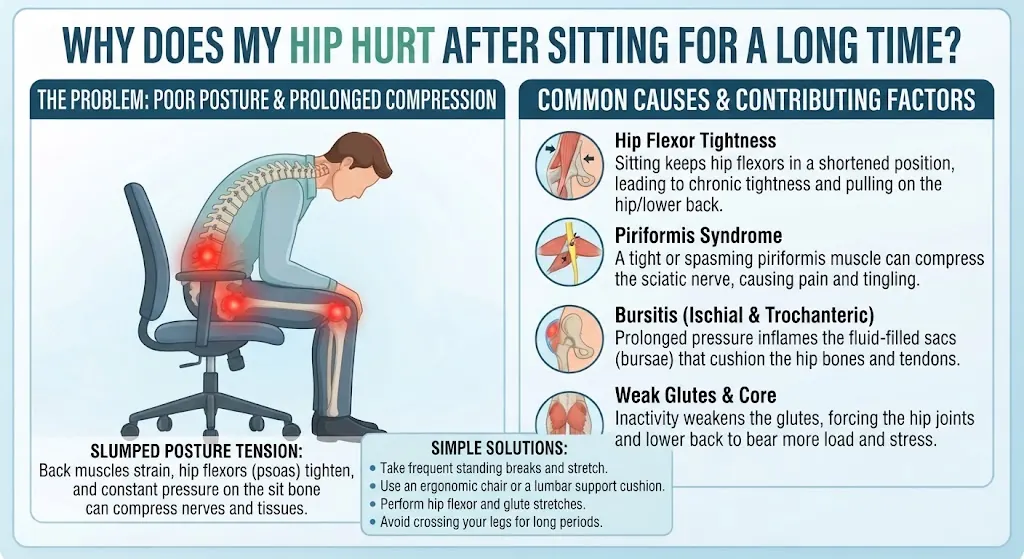
Hip pain after prolonged sitting is common and does not always mean you have damaged your joint. However, recurring pain, significant stiffness, or discomfort that spreads into your leg may have several possible causes, including muscle tightness, tendon irritation, hip arthritis, or a problem involving the lower back.
Understanding where the pain occurs, when it begins, and how it changes with movement can help you decide what to do next. This guide explains common causes of hip pain after sitting, practical ways to relieve it, how long it may last, and when to seek medical care.
What Causes Hip Pain After Sitting for a Long Time?
Hip pain after sitting often develops because the hip remains in a bent position for an extended period. This can increase stiffness and discomfort in surrounding muscles and tissues. The exact cause depends on your symptoms, age, activity level, and medical history.
1. Hip flexor tightness or irritation
The hip flexors are muscles at the front of your hip that help lift your thigh toward your body. Sitting keeps these muscles in a shortened position, which may contribute to stiffness or discomfort when you stand.
You may feel tightness at the front of your hip, especially when straightening your leg or taking your first few steps. Repeated overuse can also irritate these muscles.
2. Hip osteoarthritis
Hip osteoarthritis occurs when the joint’s protective cartilage gradually changes and wears down. Pain and stiffness may develop after inactivity, including sitting for long periods.
Symptoms can include groin pain, reduced hip movement, and difficulty putting on shoes or getting out of a low chair. The discomfort may improve somewhat after gentle movement, although prolonged walking or standing can also aggravate it. For a broader overview, see this guide to hip replacement surgery and when it may be considered.
3. Tendon irritation or outer hip pain
Pain on the outside of the hip may involve the gluteal tendons or nearby structures, sometimes grouped under greater trochanteric pain syndrome. It can worsen after prolonged sitting, climbing stairs, or lying on the affected side.
If your discomfort is mainly on the outside of your hip, these common causes of outer hip pain may help you understand the possibilities.
4. Hip labral problems
The labrum is a ring of cartilage that helps deepen and stabilize the hip socket. A labral tear may cause groin pain, clicking, catching, or discomfort with deep hip bending.
Sitting in a low chair or keeping your hip bent for a long time may aggravate symptoms in some people. Learn more about hip labral tear symptoms and treatment options.
5. Pain referred from the lower back
Not all pain felt around the hip originates in the hip joint. Irritation of nerves or other structures in the lower back can cause discomfort in the buttock, hip, or leg.
Burning pain, tingling, numbness, or pain traveling below the knee may suggest a nerve-related cause. Review the possible causes and symptoms of sciatica if these symptoms accompany your hip discomfort.
6. Sitting posture and chair height
A low chair, slouched posture, or sitting with your legs crossed for long periods may increase discomfort in some people. Deep hip bending can be particularly uncomfortable if you already have limited joint mobility or irritation around the hip.
Changing your sitting position may help, but posture alone does not explain every case of hip pain. If your symptoms occur alongside general stiffness, consider how daily habits affect joint health.
What Does the Location of Your Hip Pain Mean?
The location of your pain can provide useful clues, although it cannot confirm a diagnosis.
| Where you feel the pain | Possible explanations | Common accompanying symptoms |
|---|---|---|
| Front of the hip or groin | Hip joint irritation, arthritis, hip flexor strain | Pain when bending the hip or standing up |
| Outside of the hip | Gluteal tendon irritation, greater trochanteric pain syndrome | Tenderness when lying on that side |
| Buttock or back of the hip | Muscle irritation or referred pain from the back | Aching after sitting or pain spreading down the leg |
| Deep in the hip with clicking | Possible labral or other joint problem | Catching, restricted movement, or groin discomfort |
These patterns overlap. A clinician may need to examine your hip, back, strength, and range of motion to determine the likely cause.
How Can You Relieve Hip Pain After Sitting?
For mild discomfort without warning signs, start by reducing prolonged sitting and introducing gentle movement. The goal is to avoid keeping your hip in one position for too long without suddenly overloading painful tissues.
1. Take regular movement breaks
Stand up periodically, walk around, or gently shift your weight. There is no single scientifically established break interval that works for everyone, but setting a reminder to move every 30–60 minutes is a practical starting point.
If walking is comfortable, short walks may help reduce stiffness. For people who need alternatives, low-impact exercises for painful joints can offer ways to stay active without as much impact.
2. Adjust your sitting position
Choose a stable chair that allows your feet to rest flat on the floor. Keep your hips approximately level with or slightly higher than your knees, avoid sitting on your wallet or another uneven surface, and change positions regularly.
If you work at a desk, adjust your chair and workstation so you do not have to lean or twist repeatedly.
3. Try gentle hip movements
If movement does not increase your pain, try a short, comfortable walk or gentle hip mobility exercises. A mild hip flexor stretch may help if you feel tightness at the front of your hip, but stop if it causes sharp pain, pinching, or worsening symptoms.
Do not force deep squats, aggressive stretches, or repeated movements that reproduce your pain. People with suspected joint injuries should get appropriate guidance before starting a new exercise routine.
For structured options, explore exercises for hip pain and mobility and how to warm up before exercise.
4. Use heat or cold when appropriate
A warm shower or a comfortably warm compress may help ease stiffness. If the pain followed a recent strain or activity and the area feels irritated, a wrapped cold pack may provide temporary relief.
Apply heat or cold for around 15–20 minutes at a time, protecting your skin. Avoid applying either directly to the skin or using them over areas with reduced sensation.
5. Consider pain medication carefully
Acetaminophen or an anti-inflammatory medicine such as ibuprofen may help some people, but neither is suitable for everyone. Anti-inflammatory medicines can pose risks for people with kidney disease, stomach ulcers, certain cardiovascular conditions, or those taking particular medications.
Ask a pharmacist or clinician which option is appropriate for you, especially if you are pregnant, take blood thinners, or have other medical conditions.
Which Home Treatments Are Most Useful?
| Approach | When it may help | Important limitation |
|---|---|---|
| Frequent movement breaks | Stiffness after prolonged sitting | May not address an underlying joint condition |
| Chair and posture adjustments | Discomfort associated with certain sitting positions | Cannot rule out injury or arthritis |
| Gentle mobility exercises | Mild stiffness and movement-related discomfort | Stop if pain sharpens or worsens |
| Heat | Muscle tightness and stiffness | Avoid excessive heat or reduced-sensation areas |
| Cold packs | Recent irritation or activity-related soreness | Protect the skin and limit application time |
No single home treatment works for every cause. Persistent or recurring symptoms deserve assessment rather than relying indefinitely on stretches or pain medication.
How Long Does Hip Pain After Sitting Last?
Recovery depends on the underlying cause. Temporary stiffness may settle after changing position and moving around, while tendon irritation, arthritis, or a joint injury may need longer-term management.
| Possible cause | General pattern | When to seek an assessment |
|---|---|---|
| Temporary stiffness | Often improves after moving | If it keeps recurring or worsens |
| Muscle strain | May improve over days to weeks | If walking is difficult or improvement stalls |
| Tendon irritation | May persist with repeated loading | If pain limits everyday activities |
| Hip osteoarthritis | Often fluctuates over time | If stiffness or pain affects mobility or sleep |
| Nerve-related pain | May recur with certain positions | If pain spreads, numbness develops, or weakness occurs |
These are general patterns, not guaranteed recovery timelines. The cause, severity, and your overall health all influence recovery.
For more specific guidance, see what a hip flexor strain feels like, why hip pain can occur while walking, and why hip pain may worsen during sleep.
When Should You See a Doctor for Hip Pain?
Arrange a medical appointment if hip pain keeps returning, interferes with work or daily activities, affects your sleep, or does not improve after about two weeks of appropriate home care. Seek an assessment sooner if the pain is worsening or your hip movement becomes increasingly restricted.
A clinician may ask where the pain occurs, how long you sit before it starts, whether walking relieves it, and whether you have experienced an injury. The examination may include checking your walking pattern, hip movement, muscle strength, and lower back.
Imaging is not always necessary. An X-ray may help assess arthritis or a suspected fracture, while an MRI may be considered when symptoms suggest certain soft-tissue or joint problems that require further investigation.
If hip pain occurs with symptoms elsewhere, such as pain traveling from the hip down the leg, mention this during your appointment.
Warning signs that need medical attention
-
Usually reasonable to monitor: Mild stiffness that improves with movement and does not limit walking, provided no warning signs develop.
-
Arrange medical evaluation: Persistent or worsening pain, repeated episodes, reduced mobility, or pain that disrupts sleep.
-
Seek urgent medical care: Sudden severe hip pain, a hot or swollen hip, or hip pain accompanied by fever or feeling seriously unwell.
-
Get emergency care: Severe pain after a fall or injury, inability to bear weight, or new loss of sensation after an injury. New leg weakness, numbness around the groin, or loss of bladder or bowel control with back or hip pain also requires emergency evaluation.
Do not try to stretch through severe pain or delay urgent assessment because symptoms temporarily improve.
Frequently Asked Questions
1. Why does my hip hurt when I stand up after sitting?
Your hip may feel stiff because it has remained bent for a long time. Muscle tightness, tendon irritation, and arthritis can all contribute, so recurring pain should not automatically be attributed to sitting.
2. Why does my hip hurt more after sitting than after walking?
Movement may temporarily ease stiffness, while prolonged hip bending can aggravate sensitive tissues. However, some conditions also cause pain during walking, so the pattern alone cannot establish the cause.
3. Can sitting too long damage my hips?
Sitting for long periods can contribute to stiffness and discomfort, but it does not automatically mean you are damaging your hip joints. Regular movement and changes in position can help reduce prolonged inactivity.
4. Why does my hip hurt on only one side after sitting?
One-sided pain may reflect a muscle or tendon problem, arthritis, a joint issue, or referred pain from your back. The exact location and associated symptoms help guide evaluation.
5. Should I stretch my hips if they hurt after sitting?
Gentle stretching may help if stiffness is contributing to your symptoms. Avoid forcing a stretch or continuing an exercise that causes sharp pain, catching, or worsening discomfort.
6. Is hip pain after sitting a sign of arthritis?
It can be, particularly when groin pain, restricted movement, and stiffness accompany the discomfort. Other conditions can cause similar symptoms, and a clinical assessment is needed to distinguish them.
7. Why does my hip hurt after driving for a long time?
Driving keeps your hip bent and limits movement, which may aggravate stiffness or existing hip, tendon, or back problems. When safe, take breaks during long journeys and move around before continuing.
8. Can hip pain from sitting go away on its own?
Mild, temporary stiffness may settle with movement and changes in sitting habits. Pain caused by an underlying joint condition or persistent tissue irritation may need targeted treatment.
9. What is the best sleeping position for hip pain?
If lying on your painful side aggravates symptoms, try sleeping on the opposite side with a pillow between your knees, or on your back with comfortable support. Choose the position that reduces pressure without increasing pain.
10. When should I worry about hip pain after sitting?
Pain that repeatedly returns, worsens, or interferes with walking or sleep deserves medical assessment. Sudden severe pain, fever with a hot or swollen hip, or an inability to bear weight requires urgent attention.
The Bottom Line
Hip pain after sitting for a long time may result from stiffness, muscle or tendon irritation, arthritis, or referred pain from the back. Start with regular movement breaks, comfortable seating, and gentle activity that does not worsen symptoms. If the pain persists, recurs frequently, or limits your mobility, arrange a medical assessment rather than assuming it is simply caused by sitting.
Disclaimer: This article is provided for educational and informational purposes only.
This article is for education purpose only and is not a diagnosis or a substitute for medical advice.