
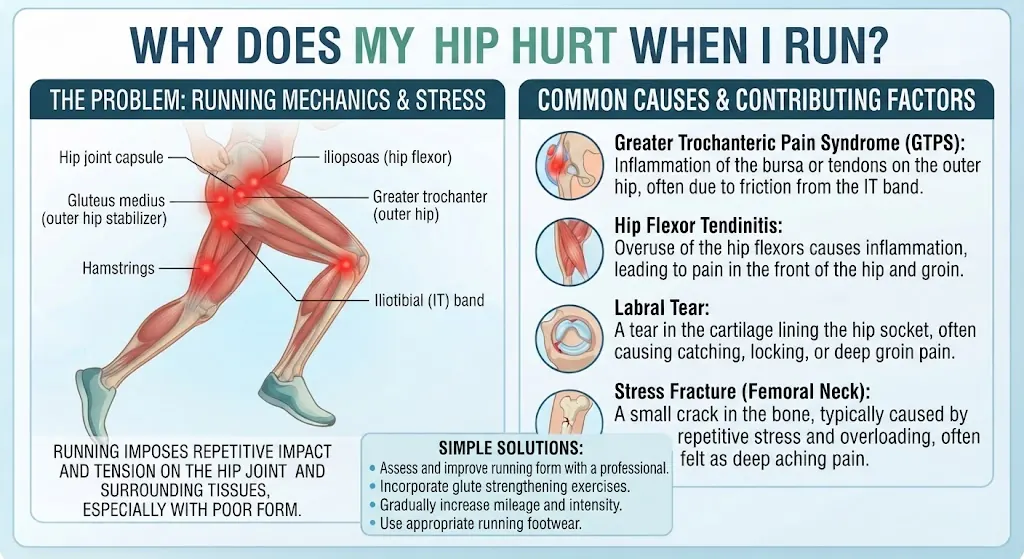
Hip pain after running does not always mean you have a serious injury. It can develop from increasing mileage too quickly, changing your running routine, muscle fatigue, or irritation of the tendons around the hip. However, persistent pain, pain that worsens with each run, or discomfort that affects normal walking deserves attention rather than being pushed through.
Understanding why your hip hurts after running can help you decide whether to rest, modify your training, try gentle movement, or seek medical evaluation. This guide explains common causes, how symptoms differ, what you can safely do at home, typical recovery expectations, and warning signs that should not be ignored.
What Causes Hip Pain After Running?
The hip absorbs repeated forces with every stride. When training demands exceed the body’s ability to recover, muscles, tendons, joints, or bones can become irritated or injured. The cause depends partly on where the pain occurs and whether it develops during exercise, immediately afterward, or several hours later.
Common possibilities include:
-
Muscle strain or fatigue: The hip flexors, gluteal muscles, or other muscles supporting the hip may become overloaded, particularly after hills, sprints, or a sudden increase in distance.
-
Tendon irritation: Tendons around the hip can become painful when repeatedly loaded without enough recovery.
-
Greater trochanteric pain syndrome: This condition causes pain around the outer hip, often when running, climbing stairs, or lying on the affected side.
-
Hip joint irritation or arthritis: Pain may develop in the groin, with stiffness or reduced range of motion, especially in people with underlying joint changes.
-
Hip labral injury: Damage to the cartilage ring around the hip socket may cause groin pain, clicking, catching, or discomfort with twisting movements.
-
Bone stress injury: Repetitive loading can produce a stress reaction or stress fracture, including in the femoral neck. This is particularly important because continuing to run can worsen the injury.
The causes above can overlap, and symptoms alone cannot reliably confirm which condition is present.
Where Does Your Hip Hurt After Running?
Pain location offers useful clues, but it is not a diagnosis. Use the comparison below to understand what different patterns may suggest.
| Pain location | Possible explanations | What to notice |
|---|---|---|
| Outside of the hip | Gluteal tendon irritation, greater trochanteric pain syndrome | Pain when lying on that side, climbing stairs, or running |
| Front of the hip or groin | Hip flexor strain, joint irritation, labral injury, bone stress injury | Pain when lifting the knee, taking long strides, or bearing weight |
| Buttock or back of the hip | Gluteal muscle strain, referred pain from the lower back | Pain with hills, prolonged sitting, or back movement |
| Deep hip pain that worsens with impact | Possible bone stress injury or joint problem | Pain that progresses during running or affects walking |
If you also experience discomfort during ordinary walking, compare your symptoms with this guide to common causes of hip pain when walking. Pain that spreads down the leg or accompanies numbness may involve the lower back or nerves rather than the hip alone.
Why Does Hip Pain Sometimes Start After the Run?
Pain that appears after running may reflect accumulated loading rather than a single sudden injury. Your muscles and tendons work repeatedly to stabilize the pelvis and control each stride. If you increase distance, speed, hills, or training frequency too quickly, the tissues may not have enough time to adapt.
Several factors can contribute:
-
Increasing weekly mileage or adding speed sessions abruptly.
-
Running hills or uneven terrain more often than usual.
-
Returning to running before an earlier injury has recovered.
-
Inadequate recovery between demanding workouts.
-
Changes in footwear, running surface, or stride mechanics.
-
Reduced hip and leg strength or limited movement tolerance.
Runners with pain around the kneecap may also have overlapping training issues; this guide to runner’s knee symptoms and treatment explains a related but distinct source of running pain.
A useful principle from sports medicine is that training load and recovery need to remain balanced. There is no single mileage increase that is safe for every runner, so respond to symptoms rather than relying on a universal percentage rule.
What Should You Do When Your Hip Hurts After Running?
The safest approach depends on the severity and pattern of the pain. Do not attempt to run through sharp, deep, or progressively worsening hip pain.
1. Reduce the activity that triggers pain
Temporarily stop running if it causes pain during exercise or leaves you limping afterward. Avoid sprinting, hill repeats, and long runs until the cause is clearer. If you suspect a bone stress injury, avoid impact exercise and seek prompt medical assessment.
2. Use simple measures for symptom relief
For mild soreness without warning signs, try a cold pack wrapped in a towel for 15–20 minutes at a time. Avoid placing ice directly on the skin. Gentle everyday movement may be reasonable if it does not increase symptoms, but do not force stretches or deep hip movements into pain.
If the discomfort feels concentrated at the front of the hip, a hip flexor strain and its recovery signs may help you understand one possible cause. For broader joint discomfort, low-impact exercises for painful joints offer examples of lower-impact activities to discuss with a clinician.
3. Avoid aggressive stretching and painful strengthening
Stretching is not automatically helpful for every cause of hip pain. For example, deep stretches or forceful massage may aggravate some tendon problems, while strengthening exercises may be inappropriate until a bone injury has been ruled out.
If symptoms are mild and improving, a clinician or physical therapist can help determine whether targeted strengthening, mobility work, or running-mechanics changes are appropriate. A proper warm-up before exercise can also help prepare you for activity once you are ready to resume training.
How Long Does Hip Pain After Running Last?
Recovery depends on the injured tissue, the severity of the problem, and whether the activity that caused it is modified. Mild muscular soreness may settle within several days, while tendon problems can take weeks or longer. Bone stress injuries may require a substantially longer recovery and medical guidance.
| Possible cause | General recovery expectation | Important consideration |
|---|---|---|
| Mild muscle soreness | Often improves within a few days | Should trend toward improvement |
| Muscle strain | Days to several weeks, depending on severity | More severe strains need evaluation |
| Tendon irritation | Several weeks or longer | Repeated overload may delay recovery |
| Hip joint or labral problem | Variable; may persist without appropriate treatment | Assessment depends on symptoms and function |
| Bone stress injury | Often weeks to months | Stop impact activity and seek medical care |
These are broad expectations, not individual recovery predictions. For more detail on muscular injuries, see how long a pulled muscle takes to heal and how long tendonitis may last.
When Should You See a Doctor for Hip Pain After Running?
Symptoms that may be monitored briefly
Mild, diffuse muscle soreness that improves with rest and does not affect normal walking can often be monitored for a short period. Stop running if the pain returns or increases.
Symptoms needing medical evaluation
Arrange an assessment if pain persists, repeatedly returns with running, limits your movement, causes a limp, or comes with clicking and catching. Deep groin pain during weight-bearing deserves particular attention because a bone stress injury may not cause obvious external swelling.
Symptoms requiring urgent care
Seek urgent assessment for sudden severe hip pain, inability to bear weight, or significant pain after a fall or other injury. A hot, swollen hip with fever or feeling seriously unwell may indicate infection and requires emergency evaluation. Do not continue running while awaiting assessment.
A clinician may assess your gait, hip movement, strength, and medical history. Imaging is not always necessary, but X-rays or MRI may be considered when symptoms suggest a fracture or another condition that needs further investigation. A normal early X-ray does not always exclude a bone stress injury.
Frequently Asked Questions
1. Is it normal for my hip to hurt after running?
Mild muscle soreness can occur after an unfamiliar or demanding workout. Recurrent, sharp, deep, or worsening pain should not be assumed to be normal training soreness.
2. Why does my hip hurt the day after running?
Delayed soreness can follow increased training load, muscle strain, or tendon irritation. Pain that worsens with weight-bearing or affects walking needs closer evaluation.
3. Should I keep running if my hip hurts?
Stop running if pain changes your stride, increases as you run, or persists afterward. Deep groin pain or pain with ordinary walking warrants prompt assessment before returning to impact exercise.
4. Why does my hip hurt in the groin after running?
Groin pain may arise from the hip joint, hip flexors, or a bone stress injury. Because these causes can overlap, persistent or weight-bearing pain should be assessed rather than treated with stretching alone.
5. Why does the outside of my hip hurt after running?
Outer hip pain can be associated with irritation of the gluteal tendons or tissues around the greater trochanter. Pain when lying on that side or climbing stairs can provide useful information during an evaluation.
6. Can a hip labral tear cause pain after running?
Yes, a labral injury may cause deep groin pain, clicking, catching, or discomfort with twisting. These symptoms are not specific to a labral tear, so a clinical assessment may be needed; see hip labral tear symptoms and treatment.
7. Can tight hip flexors cause pain after running?
Hip flexor tightness or strain may contribute to pain at the front of the hip, especially when lifting the knee. However, deep pain in this area can have other causes, including joint and bone injuries.
8. Can I walk if my hip hurts after running?
Gentle walking may be reasonable if discomfort is mild and your gait remains normal. Do not force yourself to walk through significant pain or suspected bone stress injury.
9. How can I prevent hip pain when I return to running?
Resume gradually after symptoms have settled and serious causes have been excluded when indicated. Increase training demands according to your tolerance, allow recovery between hard sessions, and address strength or technique issues with professional guidance.
10. Do I need an MRI for hip pain after running?
Not always. A clinician may recommend imaging based on the examination and suspected cause; MRI can be useful when a bone stress injury or soft-tissue problem is suspected despite an inconclusive X-ray.
The Bottom Line
Hip pain after running can result from muscle overload, tendon irritation, joint problems, or bone stress injuries. Reduce painful activity, avoid pushing through worsening symptoms, and seek medical evaluation when pain persists, affects walking, or suggests a more serious injury. Return to running gradually only when it is appropriate for the underlying cause.
Disclaimer: This article is provided for educational and informational purposes only.
This article is for education purpose only and is not a diagnosis or a substitute for medical advice.