
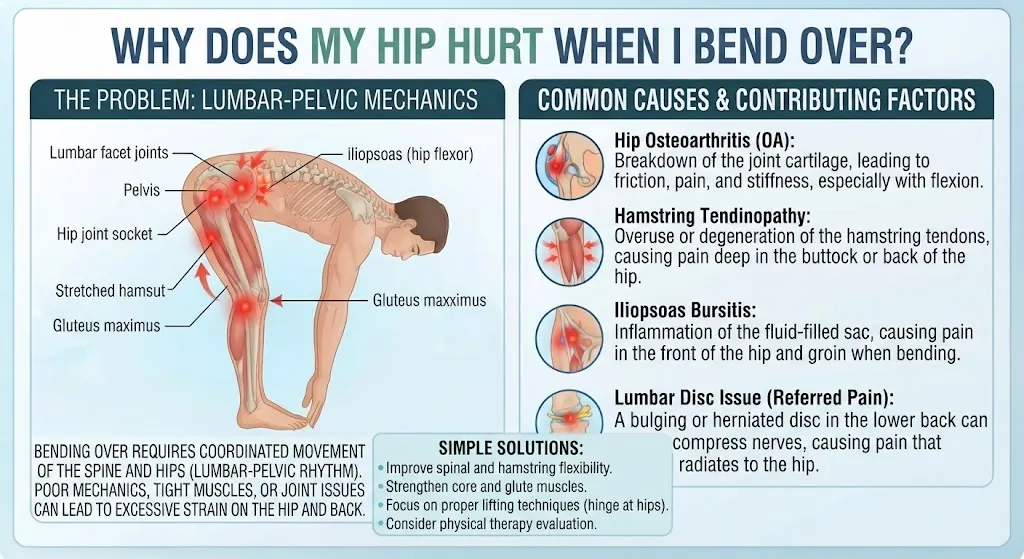
This type of pain does not automatically mean you have arthritis or a serious injury. It can result from muscle strain, irritated tendons, joint stiffness, or problems involving the lower back. However, pain that is severe, persistent, or associated with other symptoms should not be ignored.
Understanding why your hip hurts when you bend over can help you recognize possible causes, adjust movements safely, and decide when to seek medical care. The location of the pain, what triggers it, and whether it began suddenly or gradually can all help guide the next step.
What Causes Hip Pain When Bending Over?
Bending at the hips changes the position of the joint and places tension on surrounding muscles and tendons. If a structure is irritated or movement is restricted, this motion may trigger discomfort. The following causes are possibilities, not a diagnosis.
| Possible cause | Typical pain location | Clues that may help distinguish it |
|---|---|---|
| Hip osteoarthritis | Deep groin or front of hip | Stiffness after resting, reduced movement, discomfort with activity |
| Hip flexor strain | Front of hip or upper thigh | Pain after exercise, lifting, or a sudden movement |
| Hip labral tear | Deep groin | Pinching, catching, clicking, or pain with hip rotation |
| Outer hip tendon irritation | Side of hip | Tenderness when pressing the area or lying on that side |
| Lower-back or nerve-related pain | Buttock, hip, or down the leg | Back discomfort, tingling, numbness, or radiating pain |
1. Hip arthritis and joint stiffness
Hip osteoarthritis develops as the joint’s cartilage and other tissues change over time. Bending deeply, putting on socks, or leaning forward may become uncomfortable, especially when stiffness follows a period of inactivity.
If your hip also hurts after resting, sitting, or walking, compare your symptoms with these guides to hip pain after sitting for a long time and hip pain when walking. Similar symptoms can have different causes, so movement-related pain alone cannot confirm arthritis.
2. Hip flexor strain or tendon irritation
The hip flexors help lift your thigh and control hip movement. These muscles can become strained after running, kicking, lifting, or increasing exercise too quickly. Pain may be noticeable at the front of the hip when you bend, lift your knee, or move from sitting to standing.
Learn more about hip flexor strain symptoms and recovery. Avoid forceful stretching or repeatedly testing the painful movement while symptoms are active.
3. Hip labral problems
The labrum is a ring of cartilage that helps deepen and stabilize the hip socket. An injury or gradual tissue change can sometimes cause deep groin pain, clicking, catching, or discomfort when the hip bends and rotates.
These symptoms can also occur with other hip conditions. A clinician may consider your history, movement examination, and imaging when deciding whether a hip labral tear needs further evaluation.
4. Pain on the outside of the hip
Pain on the outer hip may involve the tendons and soft tissues around the bony prominence at the side of the joint. It can become more noticeable when bending, climbing stairs, or lying on the affected side.
If the pain is mainly on the outside rather than deep in the groin, review the possible causes of pain on the outside of the hip.
5. Referred pain from the lower back
Not every pain felt around the hip originates in the hip joint. Irritated nerves or other lower-back problems may cause discomfort in the buttock, hip, or leg, sometimes worsening when you lean forward.
Pain that travels down the leg, particularly with tingling or numbness, may warrant an assessment for sciatica and its possible causes. Do not assume that all hip pain during bending is a joint problem.
Why Does Bending Forward Trigger Pain?
The movement that triggers your symptoms may offer useful clues, although it cannot identify the cause by itself.
| When pain occurs | What it may suggest | A sensible next step |
|---|---|---|
| Deep bending or squatting | Joint stiffness, irritation, or restricted movement | Reduce bending depth temporarily |
| Leaning forward with back pain | Possible lower-back contribution | Avoid repeatedly provoking the movement |
| Lifting the knee or thigh | Hip flexor or tendon irritation | Pause painful lifting and strenuous exercise |
| Bending with clicking or catching | Possible joint or labral involvement | Arrange an assessment if symptoms persist |
| Bending after prolonged sitting | Stiffness or sensitivity after inactivity | Change positions regularly and move gently |
Pain during squats may overlap with bending-related symptoms, but deeper hip flexion can place different demands on the joint. See why hip pain happens during squats if that movement also triggers discomfort.
How Can You Relieve Hip Pain When Bending Over?
For mild pain without warning signs, start by reducing the movements that aggravate it while maintaining comfortable daily activity. Complete inactivity is usually unnecessary, but pushing through sharp or worsening pain can make recovery harder.
Try these practical adjustments:
-
Bend less deeply: Keep objects close to your body and avoid forcing your hip into a painful position.
-
Use a hip-friendly lifting technique: Bend your knees slightly, move slowly, and avoid twisting while lifting.
-
Apply a cold or warm pack: Use a wrapped cold pack for recent irritation or warmth for stiffness, whichever feels more comfortable. Protect your skin and limit each application to about 15–20 minutes.
-
Keep moving gently: Short, comfortable walks or other low-impact exercises for joint pain may help maintain mobility. Stop if pain increases.
-
Consider medication cautiously: Ask a pharmacist or clinician whether an over-the-counter pain reliever is appropriate, particularly if you have kidney disease, stomach ulcers, cardiovascular conditions, take blood thinners, or are pregnant.
Avoid aggressive hip stretches, heavy lifting, and repeated deep squats until you understand what triggers the pain. If symptoms began after an injury, or you cannot move the hip normally, seek medical advice rather than starting an exercise program.
How Long Does Hip Pain When Bending Over Last?
Recovery depends on the underlying cause, severity, and whether the painful activity continues.
| Possible situation | General expectation |
|---|---|
| Mild muscle strain | May improve over days to several weeks |
| Temporary stiffness or mild irritation | May settle with gentle movement and activity changes |
| Tendon problems | Can take several weeks or longer to improve |
| Arthritis or persistent joint conditions | May require ongoing symptom management |
| Significant injury or fracture | Needs prompt medical assessment and condition-specific treatment |
These are broad patterns, not guaranteed recovery timelines. Arrange a clinical evaluation if pain is worsening, repeatedly returns, affects sleep, causes limping, or does not begin improving after one to two weeks of sensible self-care.
When Should You Seek Medical Care?
Symptoms that may be monitored briefly
Mild discomfort after unfamiliar activity, with normal weight-bearing and no other concerning symptoms, may be monitored while you reduce aggravating movements. Seek care if it persists or worsens.
Symptoms needing a medical appointment
Arrange an assessment for persistent groin or outer-hip pain, reduced range of motion, recurring clicking with pain, unexplained symptoms, or pain that interferes with ordinary activities. A clinician may examine your hip and back and decide whether an X-ray or other testing is appropriate.
A normal X-ray does not exclude every cause of pain; soft-tissue problems may require a different evaluation. See why hip pain can occur despite a normal X-ray.
Symptoms requiring urgent care
Seek urgent medical attention if you have:
-
Sudden, severe hip pain, particularly after a fall or injury.
-
Inability to stand or put weight on the affected leg.
-
A hot, swollen hip area accompanied by fever or feeling seriously unwell.
-
New leg weakness or significant numbness, or loss of bladder or bowel control.
The last group of symptoms can indicate a serious problem and may require emergency evaluation.
Frequently Asked Questions
1. Why does my hip hurt when I bend over but not when I walk?
Some hip conditions are triggered by deeper bending or rotation rather than ordinary walking. The location of the pain and any stiffness, catching, or back symptoms can help a clinician narrow down the possibilities.
2. Can sitting too long cause hip pain when bending?
Yes, prolonged sitting may contribute to stiffness or make existing hip discomfort more noticeable when you stand or bend. Changing positions regularly and moving gently may help.
3. Does hip pain when bending mean I have arthritis?
No. Arthritis is one possible cause, but muscle strains, tendon irritation, labral problems, and referred back pain can cause similar symptoms.
4. Why does my hip hurt when I put on shoes or socks?
These tasks combine hip bending and rotation. Pain may occur when joint movement is restricted or nearby tissues are irritated, but the activity alone does not identify the cause.
5. Should I stretch a painful hip?
Gentle movement may help, but stretching should not cause sharp pain or worsening symptoms. Avoid forceful stretches until the cause is clearer, particularly after an injury.
6. Can a hip problem cause lower-back or leg pain?
Yes. Hip and lower-back conditions can produce overlapping symptoms, and nerve irritation may cause pain that travels into the leg. Numbness or weakness should be medically assessed.
7. Is hip clicking when bending serious?
Painless clicking can occur without a significant problem. Clicking accompanied by pain, catching, instability, or reduced movement deserves clinical evaluation.
8. Should I use ice or heat for hip pain?
Either may provide temporary comfort. Cold can be useful after recent irritation, while warmth may help stiffness; use a protective layer and stop if your skin becomes uncomfortable.
9. Can I keep exercising if my hip hurts when bending?
Choose activities that do not increase your pain during exercise or afterward. Temporarily avoid deep bending, heavy lifting, and high-impact movements that provoke symptoms.
10. When should I see a doctor for hip pain when bending?
Seek an appointment if pain persists, worsens, limits everyday tasks, or repeatedly returns. Sudden severe pain, inability to bear weight, fever with a hot joint, or new neurological symptoms require urgent assessment.
Conclusion
Hip pain when bending over can come from joint stiffness, muscle or tendon irritation, a labral problem, or pain referred from the back. Temporarily modify painful movements, stay gently active within your comfort level, and monitor how symptoms change. If pain persists, worsens, or comes with warning signs, seek appropriate medical evaluation rather than assuming the cause.
Disclaimer: This article is provided for educational and informational purposes only.
This article is for education purpose only and is not a diagnosis or a substitute for medical advice.