
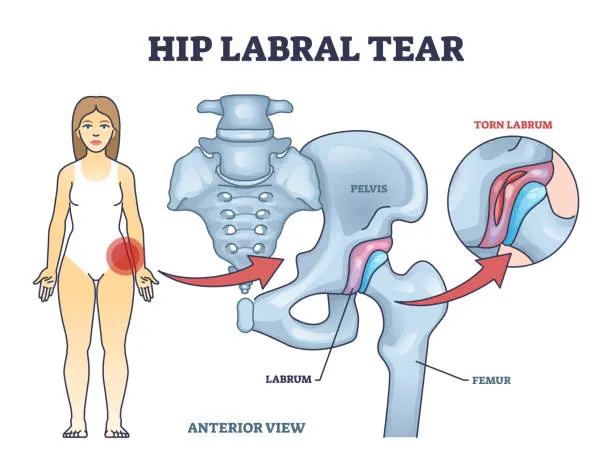
Ahip labral tear can cause a deep ache in the groin, clicking or catching in the hip, pain when sitting for long periods, or discomfort during walking, running, and pivoting. Some people notice symptoms after a sports injury or sudden movement, while others develop hip pain gradually without remembering a specific injury. Because several hip conditions can cause similar symptoms, a labral tear is not something you can reliably identify from pain alone.
Hearing that an MRI shows a labral tear can also be confusing because labral abnormalities can occur in people who have little or no hip pain. Research has found labral tears on imaging in both symptomatic and asymptomatic hips, so an imaging finding does not automatically mean the labrum is the source of symptoms.
A hip labral tear is damage to the ring of fibrocartilage surrounding the socket of the hip joint. This article explains what a labral tear feels like, what commonly causes it, how clinicians evaluate it, what treatment options may involve, when surgery is considered, and which warning signs require medical attention.
What Is a Hip Labral Tear?
Theacetabular labrum is a ring of fibrocartilage attached around the rim of the hip socket, or acetabulum. It contributes to joint stability, helps distribute pressure across the joint, and assists with maintaining the seal between the femoral head and socket.
A tear can occur when the labrum is injured or repeatedly exposed to abnormal stress. Causes may include trauma, repetitive hip motion, femoroacetabular impingement (FAI), hip dysplasia, excessive hip mobility, and age-related tissue changes.
If you are unfamiliar with the terminology, this explanation of what a labral tear is and how labral injuries can affect a joint provides broader context.
A labral tear does not necessarily mean that the hip is severely damaged. The clinical significance depends on the location and extent of the tear, associated structural abnormalities, cartilage condition, symptoms, physical examination findings, and the person’s activity demands.
What Does a Hip Labral Tear Feel Like?
Hip labral tear symptoms can vary considerably. Common symptoms include:
- Deep pain in the groin or front of the hip
- Pain that may extend toward the thigh or buttock
- Clicking, catching, popping, or locking sensations
- A feeling that the hip is unstable or may give way
- Pain with prolonged sitting
- Discomfort when getting out of a chair or car
- Pain with running, twisting, squatting, or pivoting
- Reduced hip range of motion
- Stiffness after activity
Groin pain is particularly common, but symptoms are not specific enough to diagnose a labral tear by themselves. Hip arthritis, FAI, tendon problems, bursitis, muscle strains, and referred pain from the lower back can produce overlapping symptoms.
Can a Hip Labral Tear Cause Pain When Walking?
Yes. A labral tear may cause hip or groin pain during walking, particularly when the hip is repeatedly loaded or moved through certain positions. However,hip pain when walking does not automatically indicate a labral tear.
Pain that occurs mainly during walking should be assessed in context, including where the pain is located, whether it began after an injury, and whether symptoms occur during other movements.
For a broader differential, see this guide to why hip pain can occur when walking and what different patterns may mean.
Can a Hip Labral Tear Hurt at Night?
It can. Some people experience discomfort after prolonged activity or when lying in positions that place pressure on the hip. Nighttime hip pain, however, has many possible causes and should not be attributed to a labral tear without an appropriate evaluation.
If sleeping is a major trigger, review the discussion of why hip pain can occur when sleeping and what may make nighttime symptoms worse.
What Causes a Hip Labral Tear?
There is rarely one universal cause. The major mechanisms include structural abnormalities, acute injury, repetitive loading, and degenerative changes.
Femoroacetabular Impingement
Femoroacetabular impingement, or FAI, occurs when the shape or movement of the femur and acetabulum causes abnormal contact within the hip joint.
Repeated impingement can place stress on the labrum and adjacent cartilage, particularly during activities involving deep hip flexion, rotation, or repeated pivoting.
Hip Dysplasia
Hip dysplasia occurs when the socket does not adequately cover the femoral head. Increased stress at the edge of the socket may place additional demands on the labrum.
Sports and Repetitive Hip Motion
Activities involving frequent pivoting, cutting, kicking, deep squatting, or repetitive hip rotation can place substantial loads on the hip joint.
Athletes are not the only people who can develop labral problems. Repetitive occupational movements and other activities can also contribute depending on the mechanics and individual anatomy.
Acute Trauma
A fall, collision, forceful twisting movement, or other injury can damage the labrum. Traumatic hip injuries may also involve cartilage, bone, or other soft tissues, so persistent symptoms after significant trauma deserve evaluation.
Degenerative Changes
The labrum can become less resilient with age and may develop degenerative abnormalities. Importantly, a degenerative labral finding on imaging is not automatically the explanation for pain.
Labral Tear vs. Other Hip Problems
Several conditions can produce similar symptoms. The location and behavior of pain can provide clues, but they cannot establish a diagnosis by themselves.
| Possible problem | Common symptom pattern | How it differs |
| Hip labral tear | Groin pain, clicking, catching, pain with rotation | Mechanical symptoms may accompany pain |
| FAI | Groin pain with flexion, rotation, or prolonged activity | Structural impingement may coexist with a labral tear |
| Hip osteoarthritis | Pain, stiffness, reduced motion | More common with increasing age; joint-space changes may appear on imaging |
| Hip bursitis | Lateral hip pain and tenderness | Pain is often located on the outside of the hip |
| Tendon injury | Activity-related pain around the hip or thigh | Symptoms may correspond more closely to specific muscle-tendon loading |
| Referred lumbar pain | Back, buttock, hip, or leg symptoms | Neurologic symptoms may accompany the pain |
Because conditions can coexist, identifying the exact source may require a combination of history, physical examination, imaging, and occasionally diagnostic injection.
Hip Labral Tear vs. Shoulder Labral Tear
Both the hip and shoulder contain labral tissue, but they are not interchangeable injuries.
The shoulder labrum helps deepen the relatively shallow shoulder socket and contributes to shoulder stability. The hip labrum surrounds the acetabulum and contributes to the stability and sealing function of the ball-and-socket hip joint.
The symptoms and treatment decisions are therefore different. For a useful anatomical comparison, see the differences between a shoulder labral tear and a hip labral tear.
Understanding the distinction is particularly important when reading medical imaging reports because the term “labral tear” does not identify which joint is affected or what caused the problem.
How Is a Hip Labral Tear Diagnosed?
Diagnosis usually begins with a detailed history and physical examination.
A clinician may ask:
- Where exactly is the pain?
- Did symptoms begin after an injury?
- Does sitting make the pain worse?
- Does rotating or flexing the hip reproduce symptoms?
- Is there clicking, catching, or locking?
- What activities aggravate the problem?
- Have symptoms changed over time?
- Have previous treatments helped?
The examination may include assessment of hip range of motion, strength, gait, and provocative maneuvers designed to reproduce symptoms.
Do You Need an MRI?
Imaging can help, but imaging should be interpreted alongside the clinical picture.
Plain X-rays may be used to evaluate bone structure, arthritis, hip dysplasia, or other abnormalities. MRI or MR arthrography may be used to assess the labrum and other soft tissues.
Research has shown that imaging accuracy varies according to the technique used and the clinical population. A systematic review found substantial variation in the diagnostic performance of MRI, MR arthrography, ultrasound, and CT arthrography, emphasizing that imaging results should not be interpreted in isolation.
A separate systematic review found that labral abnormalities can be present in people without hip symptoms. One meta-analysis estimated labral tear prevalence at approximately54% in asymptomatic individuals, although the evidence varied in quality and the definition of abnormality differed between studies.
This is why an MRI report saying “labral tear” does not, by itself, prove that the tear is causing your pain.
Can a Hip Labral Tear Heal Without Surgery?
Sometimes symptoms can improve without surgery, but whether the torn tissue itself heals completely depends on the nature and location of the injury and the underlying mechanics of the hip.
Nonoperative care may include:
- Temporarily reducing activities that reliably reproduce pain
- Physical therapy
- Strengthening the muscles around the hip and trunk
- Improving movement mechanics
- Gradually restoring activity
- Pain-management strategies recommended by a clinician
- Addressing contributing structural problems where appropriate
A systematic review of nonoperative treatment for hip-related pain found that54% of patients responded to nonoperative treatment overall, although the studies included different hip conditions and treatment approaches. The evidence was not strong enough to establish one universally superior rehabilitation program.
Therefore, improvement with conservative treatment is possible, but individual outcomes vary.
What Exercises Are Used for Hip Labral Tear Recovery?
Exercise selection should depend on symptoms, hip structure, strength deficits, mobility limitations, and whether surgery has occurred.
A rehabilitation program may emphasize:
- Gluteal strengthening
- Hip abductor and extensor strengthening
- Core and trunk control
- Controlled hip range of motion
- Balance and movement coordination
- Gradual return to functional activities
Exercise should not repeatedly provoke sharp, catching, or escalating pain.
For broader guidance, see which exercises may be useful during labral tear recovery.
After surgery, the rehabilitation plan is more specific. Weight-bearing restrictions, range-of-motion precautions, strengthening progression, and return-to-sport timing depend on the procedure performed and the surgeon’s protocol. Research reviews have found substantial variation between postoperative hip arthroscopy rehabilitation protocols, so there is no single recovery schedule that applies to everyone.
What Should You Avoid With a Hip Labral Tear?
There is no universal list of movements that every person with a labral tear must avoid. Instead, activities that consistently reproduce symptoms may need to be temporarily modified.
Common aggravating activities can include:
- Deep squatting
- Repeated pivoting
- High-impact exercise
- Rapid cutting movements
- Deep hip flexion
- Repetitive twisting
- Returning suddenly to high training loads
Avoiding all movement is generally not the goal. Prolonged inactivity can make it harder to restore strength and function.
It is more useful to identify specific movements that provoke symptoms and modify the load while maintaining tolerable activity.
You can also review common mistakes that may make a labral tear harder to manage.
Hip Labral Tear Treatment: Physical Therapy vs. Surgery
Treatment depends on symptoms, functional limitations, hip anatomy, associated cartilage damage, the type of tear, previous treatment, and the person’s goals.
| Treatment | Typical purpose | Main consideration |
| Activity modification | Reduce aggravating mechanical stress | Usually part of initial conservative care |
| Physical therapy | Improve strength, control, mobility, and movement tolerance | Requires individualized progression |
| Medication | Help manage pain or inflammation | Appropriate medication depends on health history |
| Injection | Sometimes used diagnostically or therapeutically | Benefits and limitations vary |
| Arthroscopic repair | Reattach or stabilize repairable labral tissue | Requires postoperative rehabilitation |
| Debridement | Remove unstable or damaged tissue in selected cases | Not appropriate for every tear |
| Reconstruction | Replace or restore irreparable or deficient labral tissue | Usually reserved for selected cases |
Research does not support treating every labral tear surgically. In patients with nonarthritic hip-related pain, more than half may respond to nonoperative care, although the evidence is heterogeneous.
For people with symptomatic FAI, randomized trials have found improvement with both physical therapy and surgery, with some analyses showing greater short-term patient-reported improvement after arthroscopy. Importantly, physical therapy did not appear to prevent later successful surgery when surgery became necessary.
A 2024 randomized trial involving patients aged 40 and older with symptomatic acetabular labral tears and limited osteoarthritis similarly found better 24-month outcomes with arthroscopy plus postoperative physical therapy than with physical therapy alone, while allowing some patients to avoid surgery.
These findings donot mean surgery is automatically the best option. The studies involve selected patient populations, and treatment decisions should be individualized.
When Is Surgery Considered?
Surgery may be considered when:
- Symptoms remain significant despite appropriate conservative treatment
- Pain substantially limits work, sport, sleep, or daily activities
- The clinical findings and imaging support the labrum as a pain source
- A structural abnormality such as FAI is contributing to the problem
- The labral tissue is considered repairable or otherwise appropriate for surgical treatment
Hip arthroscopy may involve labral repair, selective debridement, treatment of FAI, or other procedures depending on the underlying problem.
Evidence generally favors preserving and repairing viable labral tissue when technically appropriate. A systematic review comparing repair with debridement reported better functional outcomes after repair in the included studies, although the overall quality of evidence was considered low.
Repair vs. Reconstruction
Repair attempts to preserve and reattach the person’s existing labral tissue.
Reconstruction uses graft tissue to recreate the labrum when the native tissue is severely damaged, deficient, or otherwise unsuitable for repair.
Recent systematic reviews report improvements in patient-reported outcomes after reconstruction, but the evidence base is still largely composed of observational studies and different surgical techniques.
The appropriate operation depends on the condition of the labrum and the surrounding hip joint rather than simply the presence of a tear.
What Is Recovery Like After Hip Labral Surgery?
Recovery varies according to the procedure performed and whether additional procedures, such as treatment of FAI, were required.
Early rehabilitation may focus on protecting repaired tissue, controlling symptoms, maintaining appropriate mobility, and gradually restoring strength. Later stages generally progress toward functional activities and, when appropriate, sport-specific movements.
There is no reliable universal timetable for everyone. Rehabilitation research has identified considerable variation in postoperative protocols, particularly regarding weight bearing, range of motion, strengthening, and return to sport.
People considering surgery should ask their surgical team:
- What exactly will be repaired or treated?
- Will the labrum be repaired, debrided, or reconstructed?
- Will FAI or another structural problem also be treated?
- How much weight can I place on the leg initially?
- When can I drive?
- When can I return to work?
- When can I resume exercise?
- What symptoms during rehabilitation should prompt a call?
Living With a Hip Labral Tear
Not everyone with a labral tear needs an operation. Some people can manage symptoms with activity modification, rehabilitation, and appropriate medical care.
Daily strategies may include breaking up prolonged sitting, adjusting activities that repeatedly provoke symptoms, maintaining strength, and increasing activity gradually rather than making abrupt changes.
For practical strategies beyond the treatment discussion, see daily tips for managing pain and function with a labral tear.
The important distinction is betweenmanaging an imaging finding andtreating a clinically meaningful pain problem. If a labral abnormality is present but you have no symptoms, treatment may not be necessary.
When Should You See a Doctor?
Consider a medical evaluation if hip or groin pain:
- Persists despite reducing aggravating activities
- Repeatedly interferes with walking, exercise, work, or sleep
- Is accompanied by clicking, catching, or a sensation of instability
- Began after a significant injury
- Progressively worsens
- Causes substantial loss of hip motion
- Keeps returning after activity
A clinician can determine whether the symptoms are more consistent with a labral problem, FAI, arthritis, tendon injury, bursitis, referred spinal pain, or another condition.
Warning Signs: When Hip Pain Needs Urgent Attention
Symptoms that can usually be monitored
Mild, activity-related hip discomfort without significant loss of function can often be monitored initially while arranging routine medical evaluation if it persists.
Symptoms that need medical evaluation
Arrange prompt evaluation for persistent or worsening pain, significant mechanical symptoms, progressive loss of motion, recurrent instability, or symptoms that substantially interfere with normal activities.
Symptoms requiring urgent or emergency care
Seek urgent medical attention after major trauma if you cannot bear weight, the hip appears deformed, or severe pain occurs suddenly. Fever or systemic illness accompanying severe joint pain can also require urgent assessment because infection and other serious conditions need to be excluded.
Frequently Asked Questions
1. What is the most common symptom of a hip labral tear?
Deep pain in the groin or front of the hip is a common symptom. Clicking, catching, stiffness, and pain with certain hip movements can also occur, but these symptoms are not specific enough to confirm a labral tear.
2. Can you walk normally with a hip labral tear?
Yes. Some people with labral tears can walk normally, particularly when symptoms are mild. Others develop pain during longer walks, stairs, running, pivoting, or other weight-bearing activities.
3. Can a hip labral tear heal on its own?
Symptoms may improve without surgery, particularly with appropriate activity modification and rehabilitation. Whether the torn labral tissue itself heals completely is a different question and depends on the injury and underlying hip mechanics.
4. Is a hip labral tear always painful?
No. Labral abnormalities can occur on imaging in people without significant hip symptoms. This is one reason clinicians consider the patient’s symptoms and examination rather than treating an imaging report by itself.
5. Can an MRI miss a hip labral tear?
Yes. Imaging accuracy varies according to the technique, equipment, interpretation, and clinical setting. MR arthrography may provide additional information in selected cases, but no imaging test should be interpreted independently of the clinical evaluation.
6. What activities can make a hip labral tear hurt more?
Deep hip flexion, pivoting, repetitive twisting, running, jumping, and other high-load activities may aggravate symptoms in some people. The specific triggers vary, so activity modification should be individualized rather than based on a universal list of prohibited movements.
7. Does every hip labral tear require surgery?
No. Conservative treatment is often considered first, particularly when there is no major structural problem requiring correction. Surgery may become appropriate when symptoms persist, function remains limited, and the clinical and imaging findings support a surgically treatable problem.
8. Is physical therapy useful for a hip labral tear?
Physical therapy can help improve hip and trunk strength, movement control, mobility, and tolerance for activity. Evidence suggests that a substantial proportion of people with nonarthritic hip-related pain respond to nonoperative treatment, although the best rehabilitation program varies between individuals.
9. How long does recovery take after hip labral surgery?
Recovery commonly occurs in stages rather than on a single fixed timeline. Weight-bearing restrictions, strengthening, work activities, and return to sport depend on the exact procedure and the surgeon’s rehabilitation protocol.
10. Can a hip labral tear lead to a hip replacement?
A labral tear does not automatically mean that a person will eventually need hip replacement. Long-term outcomes depend on factors such as underlying arthritis, hip structure, age, cartilage condition, and the success of treatment; osteoarthritis is one of the factors associated with less favorable long-term outcomes after hip arthroscopy.
If substantial hip arthritis eventually develops, hip replacement is a separate treatment pathway; see this patient guide to what hip replacement surgery involves and what recovery entails.
Conclusion
A hip labral tear can cause groin or hip pain, clicking, catching, stiffness, and activity-related symptoms, but these features can overlap with several other hip and spine conditions. An imaging finding alone does not establish that the labrum is responsible for pain.
Evaluation usually combines the symptom pattern, physical examination, and appropriate imaging. Depending on the underlying problem and severity, treatment may include activity modification, physical therapy, medication or injections, or hip arthroscopy with repair or another procedure. Persistent, worsening, or function-limiting symptoms deserve professional evaluation rather than self-diagnosis.
Disclaimer: This article is provided for educational and informational purposes only. It is not a substitute for professional medical advice
This article is for education purpose only and is not a diagnosis or a substitute for medical advice.