
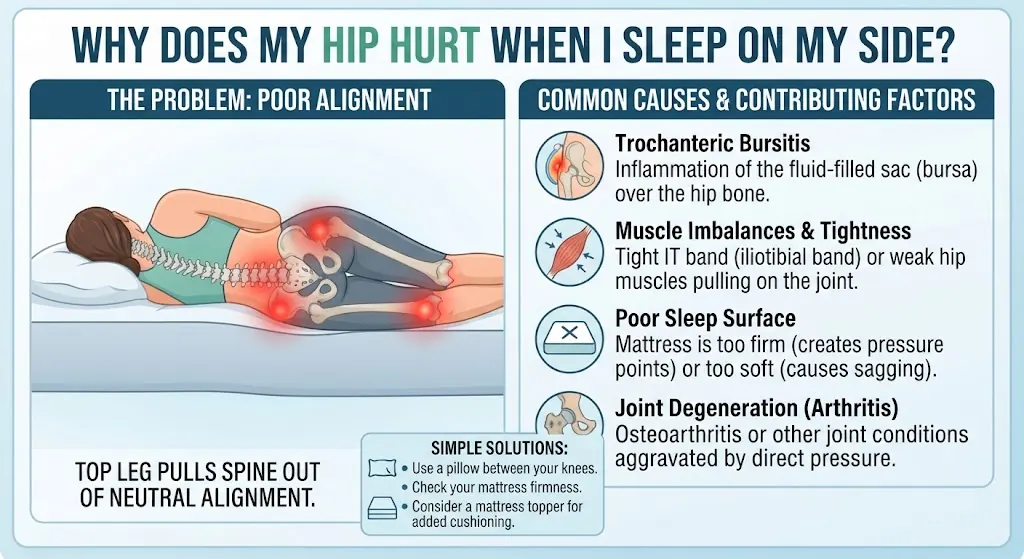
Hip pain when sleeping on your side is common and does not always indicate a serious injury. However, recurring pain can be associated with irritated tendons, inflammation around the hip, arthritis, or problems inside the joint. The location of the pain, your activity level, and other symptoms can help a clinician narrow down the possible causes.
Understanding why your hip hurts when you sleep on your side can help you choose a more comfortable position, adjust your daily activities, and decide when to seek medical advice. This guide explains common causes, practical ways to relieve nighttime discomfort, expected recovery, and warning signs that should not be ignored.
What Causes Hip Pain When Sleeping on Your Side?
The most common causes include irritation of the tendons and soft tissues around the outside of the hip, pressure from lying directly on the affected area, and arthritis affecting the hip joint. The exact cause depends partly on where you feel the pain and whether it occurs during walking, sitting, or other activities.
1. Greater trochanteric pain syndrome
Greater trochanteric pain syndrome (GTPS) is a frequent cause of pain on the outside of the hip. It often involves irritation or overload of the gluteal tendons that attach to the outer hip, sometimes alongside inflammation of nearby bursae.
Typical symptoms include:
-
Aching or tenderness over the bony outer hip.
-
Pain when lying on the affected side.
-
Discomfort when climbing stairs, walking uphill, or standing on one leg.
-
Pain that becomes worse after prolonged activity or pressure.
Although this condition is often called hip bursitis, tendon problems are frequently an important part of the pain. Repeatedly compressing the area during sleep can aggravate symptoms.
2. Hip osteoarthritis
Osteoarthritis develops when the tissues within a joint change over time. Hip osteoarthritis commonly causes pain in the groin or front of the hip, stiffness after rest, and difficulty with walking, bending, or putting on shoes.
Side-sleeping may increase discomfort, especially if the hip is already sensitive. However, pain isolated to the outside of the hip is not enough to establish arthritis as the cause.
3. Gluteal tendinopathy
Gluteal tendinopathy involves irritation and changes in the tendons that help stabilize the pelvis during movement. It may cause persistent outer-hip pain that worsens with side-sleeping, prolonged standing, or activities that repeatedly load the hip.
Excessive hip stretching or suddenly increasing walking and exercise can aggravate symptoms in some people. Recovery usually requires gradually adjusting activity and rebuilding strength rather than simply resting indefinitely.
4. Hip labral problems or referred pain
The hip labrum is a ring of cartilage that helps support the hip socket. A labral tear may cause deep groin pain, clicking, catching, or discomfort with certain hip movements. It is less characteristic of pain caused only by direct pressure on the outer hip.
Pain originating in the lower back or surrounding nerves can also spread toward the hip. Symptoms such as tingling, numbness, or pain traveling down the leg may suggest that the source is not solely the hip joint.
For more detail about the symptoms and evaluation of a hip labral tear, consider whether your discomfort is deep in the groin or primarily over the outer hip.
How Can You Relieve Hip Pain When Sleeping on Your Side?
The first step is to reduce pressure on the painful area while keeping your hip in a comfortable, supported position. Small changes to your sleeping posture and daytime activities may help, although persistent pain may need targeted treatment.
1. Change your sleeping position

Sleep on your back
Place a pillow beneath your knees to reduce tension around the hips and lower back. This position avoids direct pressure on the outer hip.

Sleep on your less painful side
Place a pillow between your knees and thighs to keep your hips aligned. Avoid letting the upper knee fall far across your body if that increases discomfort.

Try a supported reclined position
If lying flat is uncomfortable, use supportive pillows or an adjustable bed to elevate your upper body slightly. Choose a position that does not increase pain.
2. Adjust daytime activities
Avoid repeatedly pressing on the painful hip or pushing through movements that clearly worsen symptoms. Temporarily reduce long walks, steep inclines, deep squats, and prolonged standing if they trigger pain. Guidance on hip pain when walking and hip pain when climbing stairs can help you identify activity-related patterns.
Gentle movement is generally preferable to prolonged bed rest. Consider low-impact exercises for joint pain, provided they do not aggravate your symptoms. Avoid forceful stretches or strengthening exercises that reproduce sharp pain.
3. Use heat or cold when appropriate
A cold pack wrapped in a towel may ease pain after activity, particularly if the area feels irritated. Gentle heat may help stiffness, but avoid applying it directly to bare skin or sleeping with a heating pad.
If pain persists despite these adjustments, a clinician or physical therapist can help determine whether you need specific strengthening exercises, medication, or further investigation.
How Can You Tell What Is Causing the Pain?
The location and behavior of your symptoms provide clues, but they cannot confirm a diagnosis on their own.
| Symptom pattern | Possible explanation |
|---|---|
| Pain directly over the outer hip when lying on it | Gluteal tendon irritation or greater trochanteric pain syndrome |
| Groin pain with stiffness and limited movement | Hip osteoarthritis or another joint problem |
| Deep hip pain with catching or clicking | Possible labral or other joint-related problem |
| Pain traveling from the back into the hip or leg | Referred pain or nerve irritation |
For example, hip pain in the groin may suggest a different source than pain associated with a hip flexor strain. Pain that spreads down the leg may also warrant assessment for sciatica or other nerve-related conditions.
How Long Does Nighttime Hip Pain Last?
Recovery depends on the cause, severity, and whether the aggravating activity continues. Mild irritation may improve after pressure and activity are adjusted, while tendon problems and arthritis can require longer-term management.
| Possible cause | General course |
|---|---|
| Mild soft-tissue irritation | May improve over days to a few weeks |
| Gluteal tendinopathy | Often requires several weeks or longer of tailored rehabilitation |
| Hip osteoarthritis | May fluctuate and require ongoing management |
| Significant injury or fracture | Requires medical assessment and condition-specific treatment |
These are general patterns, not guaranteed recovery times. If pain repeatedly wakes you, affects walking, or fails to improve after one to two weeks of sensible adjustments, arrange a medical evaluation sooner if symptoms are significant or worsening.
When Should You Seek Medical Care?
Most mild hip discomfort can initially be managed by adjusting sleeping positions and activities. However, certain symptoms need prompt attention.
| Level of concern | Symptoms and next steps |
|---|---|
| Monitor at home | Mild pain that improves with position changes and does not limit normal movement |
| Arrange medical evaluation | Persistent nighttime pain, worsening symptoms, difficulty walking, or unexplained pain that keeps returning |
| Seek urgent care | Sudden severe pain, inability to bear weight, significant pain after a fall, or a hot, swollen hip with fever |
Seek emergency care if hip pain occurs with chest pain, shortness of breath, or fainting. These symptoms may indicate a condition unrelated to the hip that requires immediate attention.
Frequently Asked Questions
1. Why does my hip hurt only when I sleep on my side?
Direct pressure on the outer hip can irritate nearby tendons and other soft tissues. If the pain continues despite changing positions, seek an evaluation.
2. Why does my hip hurt on both sides when sleeping?
Both hips may be sensitive because of tendon irritation, changes in activity, or other joint conditions. A clinician can assess whether the cause is the same on both sides.
3. Can a mattress cause hip pain?
A mattress that does not provide comfortable support may contribute to pressure-related discomfort. However, persistent pain should not automatically be attributed to the mattress.
4. Why does my hip hurt after sitting for a long time?
Prolonged sitting can aggravate stiffness or certain hip conditions. Notice whether standing and gentle movement help, and discuss persistent symptoms with a clinician. See also hip pain after prolonged sitting.
5. Can hip pain come from the lower back?
Yes. Problems affecting the lower back or nearby nerves can refer pain toward the hip or leg. Relevant symptoms may overlap with lower back pain causes.
6. Should I stretch my hip before bed?
Gentle, comfortable movement may help, but aggressive stretching can aggravate irritated tendons. Stop any movement that causes sharp or increasing pain.
7. Does hip pain at night mean arthritis?
No. Arthritis is one possibility, but tendon irritation and other conditions can also cause nighttime discomfort. A physical examination helps distinguish between possible causes.
8. Can stress make nighttime hip pain worse?
Stress can contribute to muscle tension and affect sleep and pain sensitivity. It should not be assumed to be the underlying cause of persistent hip pain.
9. Can exercise make hip pain worse?
Yes, particularly when activity increases suddenly or repeatedly loads irritated tissues. Adjust the intensity and type of exercise rather than pushing through worsening symptoms.
10. When should I see a doctor for hip pain during sleep?
Arrange an appointment if pain persists, disrupts sleep regularly, or limits daily activities. Seek urgent care for severe sudden pain, inability to bear weight, or signs of infection.
The Bottom Line
Hip pain when sleeping on your side often improves with reduced pressure, better pillow support, and appropriate activity adjustments. Persistent or worsening symptoms deserve medical evaluation to identify the cause and guide treatment.
Disclaimer: This article is provided for educational and informational purposes only.
This article is for education purpose only and is not a diagnosis or a substitute for medical advice.