
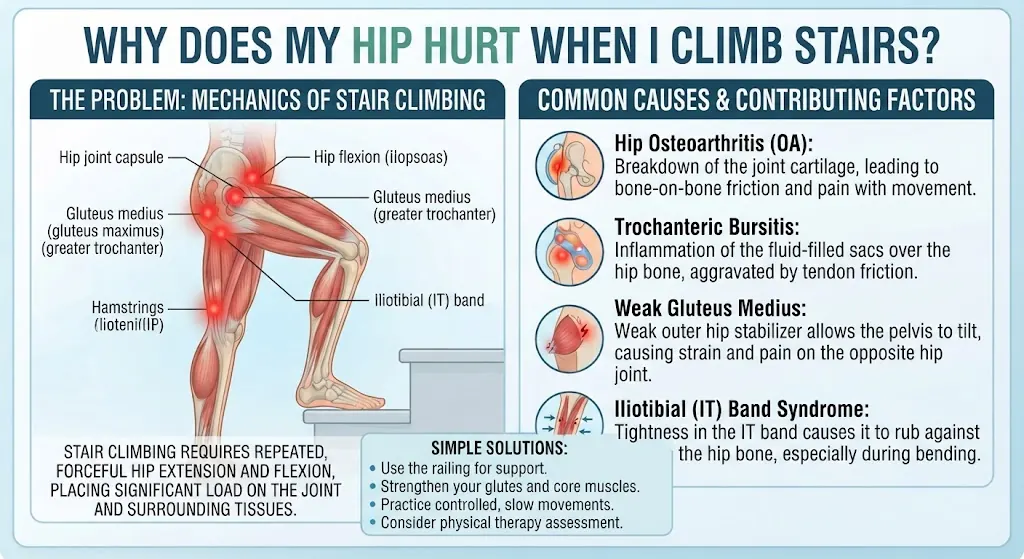
Stair-related hip pain does not always mean you have arthritis or a serious injury. Muscle strain, irritated tendons, and joint problems can cause similar symptoms, so the location of the pain, how it started, and whether it occurs during other activities all matter.
Understanding why your hip hurts when you climb stairs can help you choose sensible home-care measures, recognize when to reduce activity, and know when a medical evaluation is appropriate.
What Causes Hip Pain When Climbing Stairs?
Climbing stairs requires the hip muscles to lift and stabilize your body while the joint moves under load. Pain can develop when these muscles, tendons, or joint structures become irritated.
Common possible causes include:
-
Hip muscle or tendon strain: A sudden increase in activity, exercise, or lifting may irritate the muscles around the hip.
-
Hip osteoarthritis: Cartilage changes can cause groin pain, stiffness, and discomfort when putting weight on the joint.
-
Greater trochanteric pain syndrome: This often causes tenderness on the outer hip, especially when climbing stairs or lying on that side.
-
Hip flexor irritation: The muscles that lift your thigh may hurt when you raise your leg onto a step. Learn about hip flexor strain symptoms and recovery.
-
Hip labral injury: Damage to the cartilage rim around the hip socket may cause deep groin pain, clicking, or catching. Read about hip labral tear symptoms and treatment options.
Pain location can provide clues, but it cannot confirm the cause on its own.
Where Does Your Hip Hurt When You Climb Stairs?
| Pain location | Possible explanations | Clues to notice |
|---|---|---|
| Front of hip or groin | Hip joint irritation, osteoarthritis, hip flexor strain | Pain when lifting the knee or bearing weight |
| Outside of hip | Greater trochanteric pain syndrome or tendon irritation | Tenderness when lying on that side |
| Buttock or back of hip | Muscle problems or referred pain from the lower back | Pain that may extend into the thigh |
| Deep hip pain with catching | Possible labral or other joint problem | Clicking, catching, or restricted movement |
These patterns are not diagnostic. For example, hip pain in the groin may originate inside the joint, while pain on the outside of the hip may involve nearby tendons.
Why Do Stairs Hurt More Than Walking on Flat Ground?
Stairs require you to lift your body against gravity, bend the hip more deeply, and rely on your hip and thigh muscles for stability. These demands may make an irritated joint or tendon more noticeable than ordinary walking.
Symptoms may also become worse after a sudden increase in exercise, repeated stair climbing, or prolonged sitting. If you also experience hip pain when walking, hip pain when standing up, or hip pain after sitting for a long time, tell your clinician. The pattern across activities can help guide an assessment.
What Can You Do at Home to Relieve Hip Pain on Stairs?
If the pain is mild and you can bear weight normally, try reducing the activities that trigger it while maintaining comfortable movement.
-
Reduce repeated stair climbing: Take breaks and avoid unnecessary trips while symptoms settle.
-
Use the handrail: Move slowly and avoid carrying heavy items on stairs.
-
Apply a cold pack: Wrap it in a towel and apply for 15–20 minutes if it helps relieve discomfort.
-
Choose comfortable activity: Short, easy walks on level ground may be reasonable if they do not worsen symptoms.
-
Avoid painful exercises: Do not force deep squats, aggressive stretches, or movements that cause sharp pain.
Gentle alternatives may include low-impact exercises for people with joint pain. However, stop any activity that increases pain during exercise or leaves symptoms worse afterward. If you are also uncomfortable when bending deeply, review possible causes of hip pain when squatting.
How Can You Tell Whether Hip Pain Needs Medical Attention?
The next step depends on how severe the pain is, whether it followed an injury, and whether your ability to walk has changed.
| Symptom pattern | Suggested response |
|---|---|
| Mild discomfort that improves with reduced activity | Monitor symptoms and avoid movements that aggravate them |
| Pain that persists, returns, or limits stair climbing | Arrange a medical assessment |
| New pain with limping or worsening weight-bearing discomfort | Seek prompt medical advice |
| Severe pain after a fall or inability to stand or walk | Seek emergency evaluation |
| Hot, swollen hip with fever or feeling very unwell | Seek urgent medical care |
Do not assume severe pain is harmless because you can still move your leg. Some bone injuries, including stress injuries, can worsen with continued weight-bearing. If pain began after a fall or exercise injury, an evaluation may be needed to determine whether imaging is appropriate. A normal X-ray does not explain every cause of persistent pain; see what hip pain with a normal X-ray can mean.
How Is Hip Pain When Climbing Stairs Diagnosed?
A clinician may ask where the pain occurs, when it started, whether you recently changed your activity level, and whether you have stiffness, clicking, weakness, or night pain. They may examine your walking pattern, hip movement, strength, and tenderness.
Imaging is not always necessary. X-rays may help assess arthritis or certain bone injuries, while other tests may be considered if a tendon, cartilage, or stress injury is suspected. Treatment depends on the findings and may include activity modification, physical therapy, medication when appropriate, or further evaluation.
Frequently Asked Questions
1. Why does my hip hurt when I climb stairs but not when I walk?
Stair climbing requires more hip bending and muscle effort than walking on level ground. An irritated tendon, muscle, or joint may hurt only when those demands increase.
2. Can hip arthritis cause pain on stairs?
Yes. Hip osteoarthritis can cause groin pain, stiffness, and discomfort during weight-bearing activities such as climbing stairs. A clinical assessment is needed to determine whether arthritis is responsible.
3. Why does the front of my hip hurt when I lift my leg onto a step?
The hip flexor muscles help lift your thigh, so strain or irritation in this area can cause front-of-hip pain. Joint problems can produce similar symptoms, particularly if the pain feels deep in the groin.
4. Why does the outside of my hip hurt on stairs?
Pain on the outer hip can occur with irritation of the tendons and tissues around the bony prominence at the side of the hip. It may also hurt when lying on that side or standing on one leg.
5. Should I keep climbing stairs if my hip hurts?
Reduce unnecessary stair climbing if it triggers pain, and use a handrail for support. Avoid pushing through sharp or worsening pain, especially if you develop a limp.
6. Can tight hip muscles cause stair pain?
Tight or irritated muscles may contribute to discomfort, but tightness is not the only possible cause. Gentle movement may help, but stretching should not reproduce sharp pain.
7. How long does hip pain from climbing stairs last?
Mild muscle irritation may improve over several days to a few weeks, depending on its cause and severity. Persistent, recurrent, or worsening pain deserves medical assessment rather than an assumed recovery timeline.
8. Can hip pain on stairs come from the back?
Yes. Problems involving the lower back or nerves can refer pain into the buttock or hip region. Pain that travels down the leg or comes with numbness or weakness should be discussed with a clinician.
9. Do I need an X-ray for hip pain on stairs?
Not everyone needs imaging. A clinician may recommend an X-ray or other tests based on your symptoms, injury history, examination, and concern for a bone or joint condition.
10. When should I see a doctor for hip pain on stairs?
Arrange an appointment if pain persists, repeatedly returns, disrupts daily activities, or limits movement. Seek urgent care for severe pain, inability to bear weight, fever with a hot or swollen hip, or significant pain after an injury.
Conclusion
Hip pain when climbing stairs can come from muscles, tendons, or the hip joint, and the pain location alone cannot identify the cause. Reduce painful activities, move within a comfortable range, and monitor whether symptoms improve. Seek medical evaluation if pain persists or affects walking, and get urgent help for severe symptoms or inability to bear weight.
Disclaimer: This article is provided for educational and informational purposes only.
This article is for education purpose only and is not a diagnosis or a substitute for medical advice.