
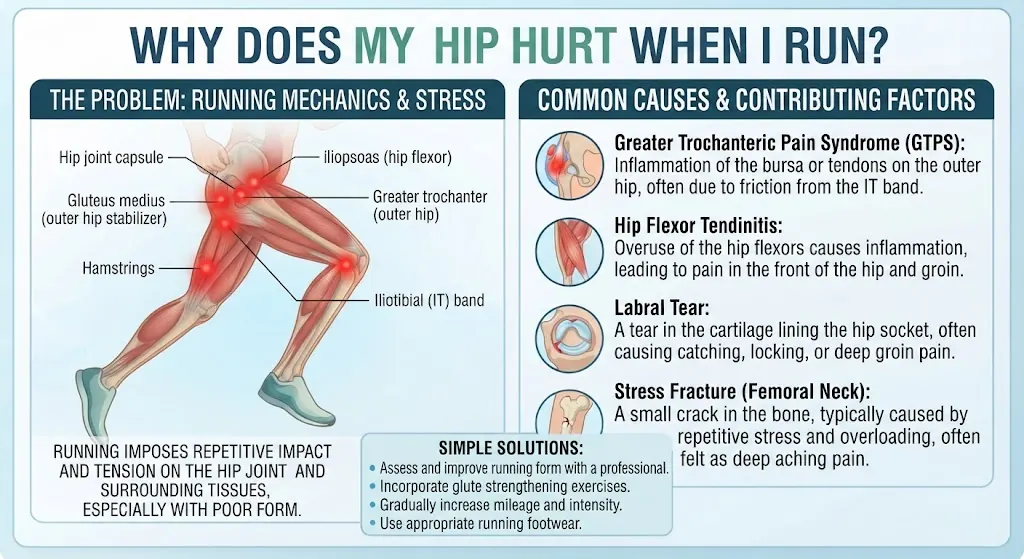
Hip pain does not always mean you have a serious injury, but it is not something you should automatically push through. Muscle strain, training overload, tendon irritation, and joint problems can cause similar symptoms. The location of the pain, when it begins, and whether it changes with movement can help guide the next step.
Understanding why your hip hurts when you run can help you recognize common causes, adjust your training, choose safer alternatives, and know when to seek medical care. This guide explains the main possibilities, practical recovery strategies, and warning signs that runners should not ignore.
What Causes Hip Pain When Running?
Hip pain during running commonly develops when training demands exceed what the muscles, tendons, bones, or joints can comfortably tolerate. However, the cause may also be an underlying hip condition or an injury that needs medical evaluation.
The hip absorbs and transfers substantial forces with every stride. Increasing mileage, adding hills, running faster, changing surfaces, or returning too quickly after a break can increase the demands on these structures.
The location of your pain offers useful clues, although it cannot confirm a diagnosis on its own.
| Where you feel the pain | Possible causes | Common clues |
|---|---|---|
| Front of the hip or groin | Hip flexor strain, hip joint irritation, labral injury | Pain when lifting your knee, accelerating, or taking long strides |
| Outside of the hip | Gluteal tendinopathy, greater trochanteric pain syndrome | Tenderness when lying on that side or running uphill |
| Deep in the groin | Hip joint problems, stress injury | Pain with weight-bearing, reduced movement, or progressively worsening discomfort |
| Buttock or back of the hip | Gluteal muscle irritation, referred pain from the lower back | Pain with prolonged sitting, running, or certain back movements |
These patterns overlap. For example, a hip labral tear and its symptoms, causes, and treatment options may involve deep groin pain, clicking, or catching, but those symptoms can also occur with other conditions.
1. Muscle strain or hip flexor irritation
The hip flexors help lift your thigh during each stride. Sprinting, hill repeats, sudden acceleration, and abrupt increases in training can overload these muscles.
A strain may cause sharp or pulling pain at the front of the hip, tenderness, and discomfort when lifting your knee against resistance. Learn more about what a strained hip flexor feels like and how recovery works.
2. Gluteal tendon irritation
The gluteal muscles stabilize your pelvis as you run. Their tendons can become irritated when training loads increase or the tissues are repeatedly compressed.
Pain is often felt over the outer hip and may worsen with hills, stairs, single-leg activities, or lying on the affected side. Not every case of outer hip pain is bursitis, and several conditions can produce similar symptoms.
3. Hip joint irritation or a labral injury
The labrum is a ring of cartilage that helps deepen and stabilize the hip socket. A labral injury or another joint problem may cause groin discomfort, stiffness, clicking, or a catching sensation during movement.
Some runners also have femoroacetabular impingement, in which the shape of the hip bones can contribute to restricted movement and pain in certain positions. Symptoms alone cannot reliably distinguish these conditions.
4. Hip stress fracture
A femoral neck stress fracture is a less common but potentially serious cause of running-related hip pain. It develops when repeated loading creates small cracks in the upper thighbone. Pain may begin during exercise and gradually occur with walking or at rest.
A review of 48 reported runners with femoral neck stress fractures found that delayed diagnosis and displaced fractures were associated with poorer outcomes. Although this is not a population-wide risk estimate, it highlights why persistent, deep groin pain should not be ignored.
If you suspect a stress fracture, stop running and seek prompt medical assessment. Do not try to test the injury by hopping or continuing your workout.
Can Running Form or Training Changes Cause Hip Pain?
Yes. Running mechanics and training changes can influence how forces are distributed across the hip, but there is no single running form or mileage threshold that prevents every injury.
A systematic review published in 2022 included 36 studies involving 23,047 runners. Approximately 26.2% sustained a running-related injury, although rates varied substantially across studies and runner groups. The review found conflicting evidence linking specific training parameters to injury risk.
| Training factor | How it may contribute | Practical adjustment |
|---|---|---|
| Sudden mileage increase | More repetitive loading than your body is prepared for | Build training progressively |
| Speed work or hills | Higher muscular and mechanical demands | Reduce intensity while symptoms settle |
| Insufficient recovery | Less opportunity to recover between demanding sessions | Schedule rest or easier days |
| Returning after a break | Previous fitness may exceed current tissue tolerance | Resume below your former workload |
Research does not establish a universally safe weekly mileage increase. A systematic review of four studies found limited evidence connecting abrupt training changes with injury, so the popular 10% rule should not be treated as a guarantee of safety.
What Should You Do When Your Hip Hurts During a Run?
The safest approach depends on the severity and pattern of your symptoms.
-
Stop the run if pain develops. Do not force yourself to finish a planned distance, particularly if the pain is sharp, deep in the groin, or worsening.
-
Reduce aggravating activities. Temporarily avoid sprinting, hills, long runs, and movements that reproduce the pain.
-
Consider gentle alternatives only if comfortable. Swimming or easy cycling may be reasonable for mild muscular discomfort, but avoid weight-bearing exercise if a stress fracture is possible.
-
Use simple symptom relief. A wrapped cold pack for 15–20 minutes may help soreness. Avoid placing ice directly against your skin.
-
Return gradually. Resume running only when ordinary walking is comfortable and symptoms have substantially improved. Increase duration before intensity, and stop if pain returns.
For general conditioning, low-impact exercises for people with joint pain may provide alternatives while you recover. If symptoms persist, a clinician or physical therapist can help determine appropriate hip pain when walking causes and movement modifications.
Avoid aggressive stretching or strengthening through pain. Exercises appropriate for a muscle strain may be unsuitable for a bone stress injury or certain hip joint conditions.
When Should You Seek Medical Care?
Use the following guide to decide what to do next.
| Symptom pattern | Recommended action |
|---|---|
| Mild muscular soreness that improves with rest | Monitor symptoms and temporarily reduce running |
| Recurrent pain, limping, reduced hip movement, or pain lasting several days | Arrange a medical evaluation |
| Deep groin pain during weight-bearing or progressively worsening pain | Stop running and seek prompt assessment for a possible stress injury |
| Inability to bear weight, severe pain after an injury, or a visibly deformed hip or leg | Seek emergency care |
Fever with a hot, swollen joint also requires urgent medical assessment. Sudden hip or leg pain accompanied by significant swelling, or symptoms following a major fall or collision, should not be managed through exercise alone.
How Is Hip Pain From Running Diagnosed?
A clinician will ask where the pain occurs, when it started, how your training changed, and whether walking or resting affects it. They may examine your hip movement, strength, gait, and nearby structures.
Imaging is not always necessary for uncomplicated muscular pain. X-rays may help identify some bone or joint problems, but early stress fractures can be invisible on X-rays; MRI may be needed when suspicion remains. Treatment depends on the underlying cause rather than the pain location alone.
Frequently Asked Questions
1. Should I keep running if my hip hurts?
No, not if running causes pain that worsens, changes your stride, or persists after exercise. Stop and assess the symptoms rather than running through them.
2. Why does my hip hurt only when I run?
Running repeatedly loads the hip, so some conditions become noticeable only during higher-demand activity. Muscle, tendon, joint, and bone problems can all produce exercise-related pain.
3. Why does my hip hurt after running but not during it?
Pain may emerge after exercise because irritated tissues become more symptomatic afterward. Repeated post-run pain is a reason to review your training and seek assessment if it continues.
4. Can tight hip flexors cause pain while running?
Yes. Tightness or irritation around the hip flexors can contribute to front-of-hip discomfort, particularly with faster running or uphill strides. However, similar symptoms can have other causes.
5. How long does running-related hip pain take to heal?
Mild muscle soreness may improve within days, while tendon or joint problems can take weeks or longer. Stress fractures require medical management and a substantially different return-to-running plan.
6. Can I walk if my hip hurts from running?
Walking may be comfortable with mild muscular soreness, but pain during weight-bearing can indicate a more significant injury. Avoid pushing through pain, especially deep groin pain or a limp.
7. Do I need an MRI for hip pain?
Not always. A clinician may recommend imaging when symptoms, examination findings, or suspected bone injury warrant it, particularly if an early stress fracture needs to be ruled out.
8. Can weak glute muscles cause hip pain when running?
Reduced strength or control may affect pelvic stability and loading. Strengthening can help some runners, but the appropriate exercises depend on the cause of pain.
9. Is groin pain during running serious?
It can result from a muscle strain or hip joint problem, but it can also signal a femoral neck stress fracture. Stop running and seek prompt evaluation for deep, persistent, or worsening groin pain.
10. How can I prevent hip pain from returning?
Increase training gradually, allow recovery between demanding sessions, and address persistent strength or mobility limitations. There is no single mileage rule that eliminates injury risk.
Conclusion
Hip pain when running can stem from muscle strain, tendon irritation, joint conditions, or a more serious bone stress injury. Reduce aggravating activity, avoid running through worsening pain, and seek medical assessment for persistent symptoms or warning signs. A gradual, cause-appropriate return to running is safer than resuming your usual training before your hip is ready.
Disclaimer: This article is provided for educational and informational purposes only.
This article is for education purpose only and is not a diagnosis or a substitute for medical advice.