
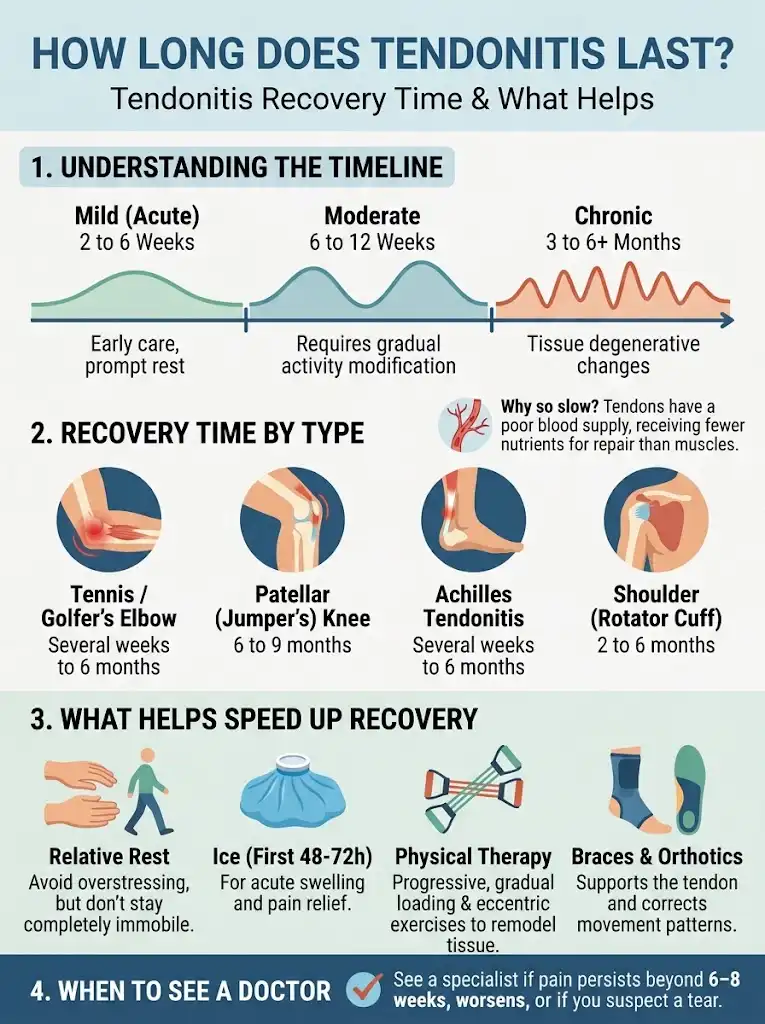
Tendonitis can cause pain, tenderness, and stiffness that make everyday activities harder. You might notice discomfort when climbing stairs, lifting your arm, walking, or exercising. If you are wondering how long tendonitis lasts, recovery can range from a few weeks to several months, depending on the affected tendon, the severity of irritation, and whether the activities causing pain continue.
Tendon pain does not always disappear with rest alone. Returning to exercise too quickly, repeatedly overloading the tendon, or avoiding movement for too long may complicate recovery. Persistent pain can also indicate a different tendon problem, so symptoms that worsen or fail to improve deserve medical assessment.
This guide explains typical tendonitis recovery times by body part, what can delay healing, which treatments may help, and when to see a healthcare professional. These timelines are general estimates rather than guarantees, and the right approach depends on the specific tendon injury.
How Long Does Tendonitis Take to Heal?
Mild tendonitis may improve within a few weeks when you reduce aggravating activities and gradually restore normal movement. More persistent symptoms can take several months to settle, particularly when the tendon has been repeatedly overloaded or has developed longer-term structural changes.
The term tendonitis is commonly used for tendon pain, although some ongoing tendon conditions involve changes in the tendon rather than inflammation alone. Recovery therefore depends on the underlying problem, not just how much pain you feel.
| Severity or pattern | General recovery estimate | What may help |
|---|---|---|
| Mild, recent symptoms | A few weeks | Reduce painful activities and gradually reload the tendon |
| Moderate or persistent symptoms | Several weeks to a few months | Progressive rehabilitation and activity modification |
| Long-lasting or complex tendon problems | Several months or longer | Clinical assessment and an individualized treatment plan |
These estimates are not diagnostic rules. Significant weakness, sudden pain, or a possible tendon rupture requires prompt evaluation rather than waiting for the expected recovery period.
Tendonitis Recovery Time by Body Part
Different tendons experience different loads, so recovery varies by location and activity.
| Type of tendon problem | Typical recovery pattern | Common aggravating activities |
|---|---|---|
| Shoulder tendonitis | Weeks to several months | Overhead reaching, lifting, repetitive arm movements |
| Patellar tendonitis | Several weeks to months | Jumping, running, squatting, stairs |
| Achilles tendonitis | Weeks to several months | Running, hills, jumping, prolonged walking |
| Ankle tendonitis | Weeks to months | Walking, uneven surfaces, repetitive ankle movements |
Shoulder Tendonitis
Shoulder tendon pain may make it uncomfortable to lift your arm, reach overhead, or sleep on the affected side. Recovery can take weeks or months, depending on the tendon involved and the degree of irritation. Learn about shoulder tendonitis symptoms, causes, and treatment for more specific guidance.
Patellar Tendonitis
Patellar tendonitis affects the tendon connecting the kneecap to the shinbone. It often causes pain below the kneecap during jumping, running, or squatting. Persistent symptoms may require a structured strengthening program rather than rest alone. See what causes patellar tendonitis and how it is treated.
Achilles Tendonitis
Achilles tendon pain often occurs near the heel or along the back of the ankle. Walking, running, and pushing off the foot may become uncomfortable. Recovery may take several months in persistent cases; Achilles tendonitis symptoms and recovery provides more information about this condition.
Ankle Tendonitis
Ankle tendonitis can cause pain, swelling, or tenderness around the ankle, depending on which tendon is affected. Reducing painful loading and following a gradual rehabilitation plan may help. Learn more about ankle tendonitis symptoms and treatment.
What Helps Tendonitis Heal Faster?
There is no guaranteed shortcut, but appropriate load management and progressive rehabilitation can support recovery.
- Modify aggravating activities. Temporarily reduce movements that sharply increase pain, but avoid unnecessary prolonged immobilization unless advised by a clinician.
- Return to activity gradually. Increase duration, resistance, or intensity in small steps instead of returning immediately to your previous routine.
- Use a structured exercise plan. Tendon-specific strengthening can improve load tolerance, but the correct exercises depend on the tendon and stage of recovery.
- Consider physical therapy. A physical therapist can tailor movement and strengthening to your symptoms. This overview of physical therapy versus chiropractic care explains some differences between treatment approaches.
- Warm up before exercise. Preparing for activity may make movement more comfortable. Review how warming up differs from stretching.
Ice wrapped in a towel may provide short-term comfort after an activity. Over-the-counter pain relievers may help some people, but they are not suitable for everyone and do not necessarily speed tendon healing. Ask a healthcare professional or pharmacist about medication risks, particularly if you have other medical conditions or take other medicines.
For general activity planning, low-impact exercises for people with joint pain may offer ideas, but exercises should be adapted to the affected tendon.
What Can Delay Tendonitis Recovery?
Recovery may take longer when you repeatedly perform painful activities, increase exercise intensity too quickly, or do not allow adequate time to adapt to rehabilitation. Other factors include the affected tendon, the duration of symptoms, overall health, and whether the original diagnosis is correct.
Persistent pain is not always caused by ongoing inflammation. Understanding the role of inflammation in joint pain can provide broader context, although tendon conditions do not all behave the same way.
When Should You See a Doctor?
Arrange a medical assessment if tendon pain is worsening, repeatedly returns, limits normal activities, or does not improve after a couple of weeks of sensible activity modification. A clinician can assess the affected tendon and decide whether imaging or supervised rehabilitation is needed.
Seek urgent medical care if you experience sudden severe pain, a popping sensation followed by major weakness, a visible change in the tendon area, or an inability to bear weight or use the affected limb normally. These symptoms can indicate a significant tear or another injury.
Frequently Asked Questions
1. Can tendonitis heal in one week?
Mild symptoms may improve within a week, but complete recovery often takes longer. Feeling less pain does not necessarily mean the tendon is ready for full activity.
2. Should I rest completely if I have tendonitis?
Not usually. Temporarily reducing painful activities is often more helpful than complete inactivity, but some injuries require specific restrictions recommended by a clinician.
3. Is walking good or bad for tendonitis?
It depends on the tendon affected and how walking influences your symptoms. Reduce distance or intensity if walking noticeably worsens pain, and seek advice if you struggle to bear weight.
4. Why does tendonitis keep coming back?
Symptoms may recur when the tendon is exposed to more load than it can currently tolerate. A gradual return to activity and appropriate strengthening may reduce repeated flare-ups.
5. Does tendonitis hurt more in the morning?
Some tendon conditions cause stiffness after sleep or inactivity. Severe, persistent, or unexplained symptoms should be assessed rather than automatically attributed to tendonitis.
6. Can I exercise with tendonitis?
Often, modified exercise is possible, but movements that significantly worsen pain should be adjusted. The appropriate strengthening plan depends on the tendon involved.
7. Does tendonitis need surgery?
Most tendon problems are initially managed without surgery. Surgery may be considered in selected cases involving substantial damage or persistent symptoms despite appropriate treatment.
8. Is heat or ice better for tendonitis?
Either may provide comfort, depending on your symptoms and preference. Ice may help after activity, while gentle warmth may ease stiffness; neither replaces appropriate rehabilitation.
9. Does tendonitis get worse if left untreated?
It can persist or worsen if aggravating loads continue, although the course varies. Ongoing pain, weakness, or reduced function warrants medical evaluation.
10. When can I return to sports?
Return when symptoms, strength, and function have improved enough for the demands of your sport, ideally following professional guidance. Increase training gradually rather than relying on a fixed number of days.
Conclusion
Tendonitis may improve within weeks, but persistent tendon problems can take several months to recover. Modify painful activities, rebuild strength gradually, and seek medical advice if symptoms worsen or fail to improve. Sudden severe pain or major weakness needs prompt assessment rather than waiting for recovery.
Disclaimer: This article is provided for educational and informational purposes only.
This article is for education purpose only and is not a diagnosis or a substitute for medical advice.