
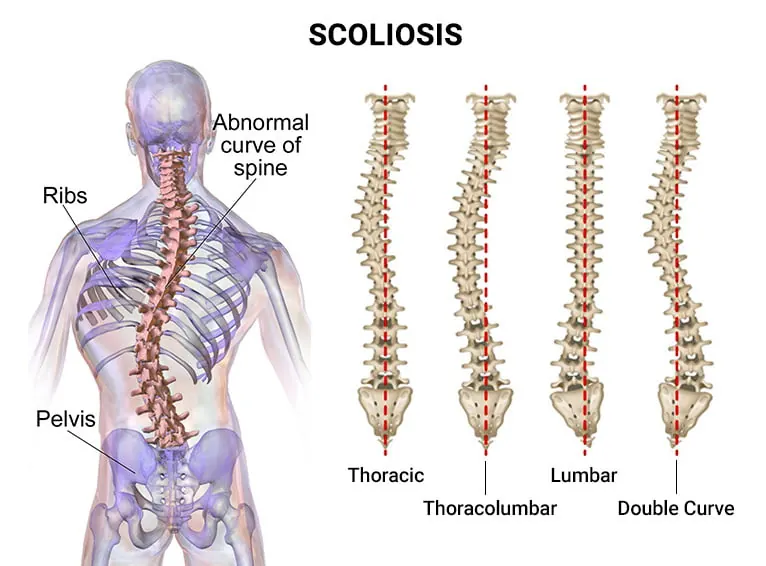
Scoliosis is commonly thought of as a condition that only affects children and teenagers, but adult scoliosis is far more prevalent than most people realize, affecting an estimated 8–9% of adults over 25 and up to 68% of adults over 60 in the United States. For many adults, scoliosis produces a gradual progression of back pain, postural changes, and functional limitations that develop so slowly they are initially dismissed as normal aging. The characteristic sideways curvature of the spine — combined with rotational deformity — creates asymmetrical loading patterns that stress spinal discs, facet joints, and surrounding muscles in ways that progressively accumulate into significant discomfort and disability if left unmanaged.
If you have recently been diagnosed with adult scoliosis or have been living with a known curve for years without proper guidance, it is important to understand that the vast majority of adults with scoliosis never require surgery and can manage their condition effectively with the right combination of exercise, physical therapy, and lifestyle adjustments. The goal of management is not to eliminate the curve — which is rarely achievable in adults without surgery — but to control pain, maintain function, slow progression, and preserve quality of life for the long term. With the right approach, most adults with scoliosis live active, fulfilling lives.
Adult scoliosis is defined as a lateral spinal curvature of 10 degrees or more, measured by the Cobb angle on a standing X-ray, in a skeletally mature individual. It differs importantly from adolescent scoliosis in both its causes and its clinical priorities. While adolescent scoliosis management focuses primarily on preventing curve progression during growth, adult scoliosis management centers on pain control, functional preservation, and quality of life — making it a fundamentally different clinical challenge that requires a tailored approach.
Types of Adult Scoliosis
De Novo Degenerative Scoliosis
De novo — meaning “newly developed” — degenerative scoliosis is the most common form of adult scoliosis and develops in previously straight spines as a direct consequence of asymmetric age-related degeneration. When intervertebral discs and facet joints degenerate unevenly on one side of the spine, they create asymmetric collapse and rotation that produces a lateral curve, most commonly in the lumbar spine. This form is closely related to the degenerative processes described in our guide on lumbar spinal stenosis causes symptoms and non-surgical treatment and frequently coexists with stenosis in older adults.
Idiopathic Scoliosis Progressing Into Adulthood
Some adults carry an adolescent idiopathic scoliosis curve into adulthood that was either undetected during childhood or treated but continued to progress after skeletal maturity. Curves above 30 degrees at skeletal maturity carry a meaningful risk of continued slow progression through adulthood, particularly thoracic curves above 50 degrees and lumbar curves above 30 degrees. These individuals require periodic monitoring and proactive management to prevent progressive functional decline.
Secondary Adult Scoliosis
Secondary scoliosis develops as a consequence of another underlying condition. Osteoporosis-related vertebral compression fractures can create asymmetric collapse producing a scoliotic curve. Leg length discrepancy creates pelvic obliquity that drives compensatory spinal curvature. Neuromuscular conditions including Parkinson’s disease, post-polio syndrome, and various myopathies weaken spinal stabilizers asymmetrically, allowing progressive curvature to develop.
Causes and Risk Factors
Asymmetric Spinal Degeneration
The primary driver of de novo adult scoliosis is uneven degeneration of discs and facet joints that creates differential collapse across the width of the spine. When one side of a disc degenerates faster than the other, the vertebrae above tilt toward the more collapsed side, initiating lateral curvature. This process is closely related to the disc changes discussed in our article on slipped disc herniated disc symptoms treatment and recovery.
Osteoporosis
Osteoporosis significantly accelerates adult scoliosis development and progression by weakening vertebral bone structure, making vertebrae vulnerable to asymmetric compression fractures that tilt spinal segments and create or worsen curvature. Adequate calcium, vitamin D, and weight-bearing exercise are essential preventive measures — our detailed article on vitamin D deficiency and bone pain covers this critical relationship comprehensively.
Muscle Imbalance and Poor Posture
Chronic asymmetric muscle tension and postural habits create uneven loading patterns across spinal segments that contribute to both the initiation and progression of scoliotic curves in predisposed individuals. The postural factors explored in our guide on how back pain starts and the role of poor posture are directly relevant to understanding how habitual posture influences scoliosis progression.
Additional Risk Factors
- Female sex: Women are significantly more prone to both progressive adolescent scoliosis and de novo adult scoliosis, with hormonal factors and lower baseline bone density contributing to increased risk.
- Age: Progressive disc and facet degeneration with aging is the primary driver of de novo scoliosis, making advancing age the single strongest risk factor.
- Sedentary lifestyle: Weak spinal stabilizing muscles provide inadequate support against the asymmetric loading forces that drive curve progression over time.
Symptoms of Adult Scoliosis
Back Pain
Unlike adolescent scoliosis which is frequently painless, adult scoliosis almost always produces back pain as its primary symptom. The pain arises from multiple simultaneous sources — asymmetrically loaded facet joints, compressed and degenerated discs on the concave side of the curve, chronically fatigued paraspinal muscles working asymmetrically to maintain upright posture, and in many cases coexisting lumbar stenosis producing neurogenic claudication. Pain is typically felt across the lower back and flanks, worsens with prolonged standing and walking, and improves with rest and positional changes.
Postural Changes and Asymmetry
Progressive adult scoliosis produces visible postural changes that patients and their families often notice before formal diagnosis. One shoulder sitting higher than the other, a prominent shoulder blade, uneven waistline, a visible trunk shift to one side, or one hip appearing higher than the other are all characteristic findings. Clothes hanging unevenly and difficulty standing symmetrically are common early complaints. In more advanced curves, a visible trunk rotation produces a rib hump on the convex side of thoracic curves.
Leg Pain and Neurological Symptoms
- Radicular leg pain: Nerve root compression within the narrowed concave side of the curve produces radiating leg pain similar to sciatica. Our comprehensive sciatica causes symptoms and complete treatment guide covers the management of this nerve pain component in detail.
- Neurogenic claudication: When scoliosis coexists with spinal stenosis — which is common in older adults — walking-related leg pain, heaviness, and cramping develop from combined canal narrowing and neural compression.
- Numbness and weakness: Advanced nerve compression produces numbness, tingling, and leg weakness that significantly impairs walking ability and functional independence.
Cardiopulmonary Symptoms
Severe thoracic scoliosis with Cobb angles above 70–80 degrees can reduce chest cavity volume, impairing lung expansion and cardiac function. Reduced exercise tolerance, exertional breathlessness, and fatigue may result. This level of severity is less common in adult-onset degenerative scoliosis but may be present in adults with severe progressive adolescent curves.
Diagnosis
Clinical Assessment
A spine specialist performs a thorough physical examination including the Adam’s forward bend test — where spinal rotation producing a rib hump becomes visible during forward bending — assessment of postural alignment, leg length measurement, neurological examination, and evaluation of spinal mobility and muscle balance.
Imaging
Standing full-length X-rays of the entire spine in both frontal and lateral views are the essential imaging investigation, allowing measurement of the Cobb angle, assessment of spinal balance and alignment, identification of degenerative changes, and monitoring of curve progression over time. MRI is obtained when neurological symptoms are present to assess nerve root compression, disc pathology, and canal dimensions. Bone density scanning is recommended for all postmenopausal women and older adults with scoliosis to assess osteoporosis contribution.
Management and Treatment
Physical Therapy and Exercise
Physical therapy is the cornerstone of adult scoliosis management and the treatment with the strongest evidence for reducing pain, improving function, and slowing curve progression. The Schroth method — a scoliosis-specific exercise approach developed specifically for three-dimensional scoliosis correction — is the most widely studied and evidence-supported exercise system for adult scoliosis. It uses postural correction, rotational breathing, and asymmetric muscle activation to elongate the spine, reduce rotational deformity, and strengthen the stabilizing muscles that resist further curve progression.
General physical therapy for adult scoliosis focuses on core stabilization to support the asymmetrically loaded spine, flexibility work to address the muscle tightness on the concave side of the curve, strengthening of the elongated and weakened muscles on the convex side, and aerobic conditioning through low-impact activities. Swimming is particularly recommended as the horizontal position eliminates gravitational loading on the scoliotic spine while providing excellent cardiovascular and strengthening benefits. Incorporating the broader lifestyle principles in our guide on lifestyle medicine and its role in orthopedic pain supports a comprehensive approach to scoliosis management.
Pain Management
NSAIDs and acetaminophen provide useful short-term pain relief during acute exacerbations. Epidural steroid injections or nerve root blocks target specific radicular pain components when leg pain is prominent. Facet joint injections address the arthritic facet pain that contributes significantly to chronic scoliosis-related back pain. All pain management strategies are most effective when combined with active rehabilitation rather than used in isolation. Managing back pain causes symptoms and risk factors through a multimodal approach is equally relevant to scoliosis-related back pain management.
Bracing in Adults
Unlike in adolescents where bracing aims to prevent curve progression during growth, rigid bracing in adults serves primarily as a pain management tool rather than a curve correction strategy. A custom-fitted thoracolumbar orthosis can significantly reduce pain during prolonged standing and walking by providing external spinal support and reducing asymmetric loading. Soft dynamic braces are better tolerated than rigid orthoses for daily activity and may provide meaningful functional benefit for adults with painful progressive curves.
Lifestyle and Nutritional Support
Weight management reduces the mechanical load on asymmetrically degenerated spinal structures and slows the progression of the degenerative changes driving curve worsening. Anti-inflammatory dietary patterns reduce systemic inflammation that amplifies pain sensitivity in chronically stressed spinal tissues. Our practical guide on how changing your diet can help reduce pain naturally provides directly applicable nutritional strategies for adults managing scoliosis alongside other spinal conditions.
Surgical Treatment
Surgery is considered for adult scoliosis only when conservative management has failed to provide adequate pain relief, when curves are progressive and severe — typically above 50 degrees — when significant neurological deficits are present, or when spinal imbalance produces severe functional limitation. Adult scoliosis surgery is complex, carries significant risks, and requires lengthy recovery, making patient selection and realistic expectations critically important. The decision to pursue surgery should involve detailed discussion with an experienced spine surgeon weighing the realistic benefits against the substantial risks for each individual patient.
Prevention of Progression
- Maintain consistent core and back strengthening: Regular spinal stabilization exercise is the single most effective strategy for slowing degenerative scoliosis progression by reducing asymmetric loading on spinal structures.
- Address osteoporosis proactively: Adequate calcium, vitamin D, and bone-loading exercise protect vertebral integrity and reduce the risk of compression fractures that accelerate scoliosis worsening.
- Maintain healthy body weight: Reducing spinal mechanical load through weight management slows the degenerative cascade driving curve progression.
- Stay physically active: Regular low-impact activity including swimming, walking, and cycling maintains spinal mobility, muscle strength, and bone density — all factors that resist progressive curvature.
- Monitor curve progression periodically: Adults with known scoliosis should have periodic standing spinal X-rays — typically every 2–5 years — to detect meaningful curve progression before it becomes symptomatic or surgical.
Conclusion
Adult scoliosis is a common, complex condition that requires a thoughtful, individualized management approach focused on pain control, functional preservation, and quality of life rather than curve correction. The overwhelming majority of adults with scoliosis achieve excellent long-term outcomes through consistent physical therapy, targeted exercise, appropriate pain management, and proactive lifestyle modification. Surgery, while sometimes necessary, is reserved for a carefully selected minority of patients with severe symptoms or progressive neurological compromise. By understanding your condition clearly, engaging consistently with evidence-based conservative management, and addressing the lifestyle factors that influence curve progression, you can live a full, active life with adult scoliosis.
Frequently Asked Questions
1. Is scoliosis in adults common? Yes — adult scoliosis affects approximately 8–9% of the general adult population and up to 68% of adults over 60, making it one of the most prevalent spinal conditions in older Americans.
2. Does adult scoliosis always get worse over time? Not necessarily. Small curves below 30 degrees are less likely to progress significantly. Curves above 30 degrees and those associated with significant degeneration carry a higher risk of gradual progression, particularly after age 50.
3. Can exercise straighten an adult scoliosis curve? Exercise cannot straighten a structural scoliosis curve in adults but can significantly reduce pain, improve posture, slow progression, and maintain functional capacity through targeted strengthening and the Schroth method.
4. What is the best exercise for adult scoliosis? Schroth method exercises, swimming, core stabilization training, and gentle flexibility work addressing the tight concave side of the curve are among the most effective and evidence-supported approaches.
5. When does adult scoliosis require surgery? Surgery is considered when conservative management fails after adequate trial, when curves exceed 50 degrees and are progressive, when significant neurological deficits develop, or when spinal imbalance severely impairs daily function.
6. Can scoliosis cause leg pain? Yes — nerve root compression within the narrowed concave side of a scoliotic curve can produce radiating leg pain similar to sciatica. Coexisting lumbar stenosis is also common in older adults with degenerative scoliosis.
7. How is adult scoliosis diagnosed? Standing full-length spinal X-rays measuring the Cobb angle confirm diagnosis and quantify severity. MRI is added when neurological symptoms are present to assess nerve root compression.
8. Does scoliosis affect breathing? Severe thoracic curves above 70–80 degrees can reduce chest cavity volume and impair lung function. This level of severity is most common in adults with longstanding progressive adolescent curves rather than de novo adult scoliosis.
9. Can a brace help adult scoliosis? In adults, bracing primarily serves as a pain management tool rather than a curve correction strategy. Custom orthoses can significantly reduce pain during prolonged standing and walking by providing external spinal support.
10. What is the difference between adult scoliosis and adolescent scoliosis? Adolescent scoliosis management focuses on preventing curve progression during growth. Adult scoliosis management centers on pain control, functional preservation, and quality of life since curves cannot be corrected without surgery in skeletally mature spines.
Disclaimer
The information in this article is for educational purposes only and does not constitute professional medical advice, diagnosis, or treatment.
This article is for education purpose only and is not a diagnosis or a substitute for medical advice.