
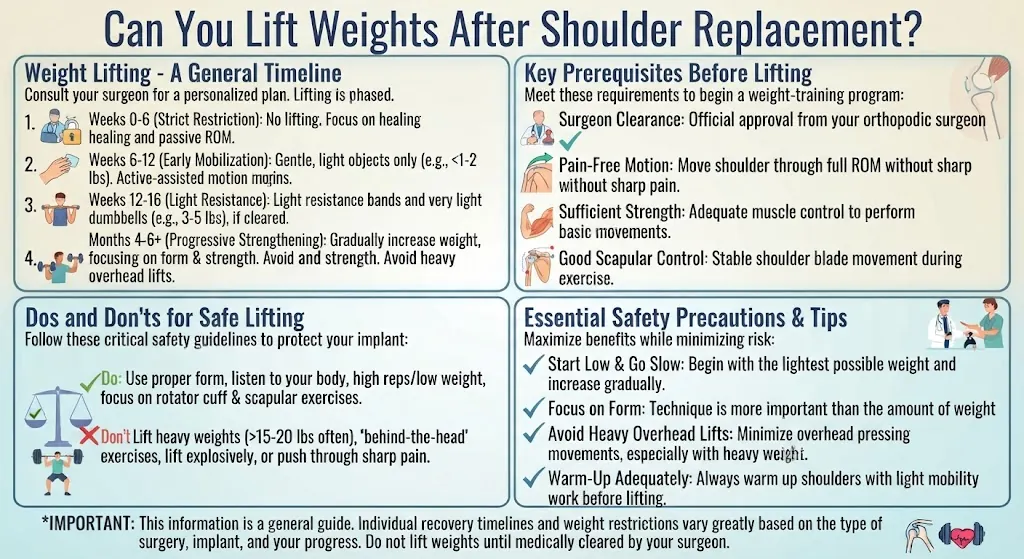
Many people worry about whether they will ever lift weights again after surgery. The answer depends on the type of shoulder replacement, your recovery, muscle function, and your surgeon’s restrictions. Light daily activities and heavy resistance training are not the same.
Understanding when you can lift weights after shoulder replacement, which movements may be risky, and how to rebuild strength safely can help you set realistic expectations and protect your shoulder over the long term.
When Can You Lift Weights After Shoulder Replacement?
Many patients gradually return to resistance exercises over several months, but there is no universal timeline. Your surgeon must confirm when it is appropriate to begin strengthening based on healing, shoulder movement, and the type of replacement performed.
| Recovery stage | General focus | Weight-training guidance |
|---|---|---|
| First several weeks | Protect healing tissues and follow movement restrictions | Avoid lifting weights unless specifically authorized |
| Early rehabilitation | Regain permitted movement and control | Follow your prescribed physical therapy plan |
| Later rehabilitation | Build strength and endurance gradually | Add resistance only when cleared |
| Longer-term recovery | Maintain function and activity | Adjust loads and exercises to your implant and surgeon’s advice |
These stages are general descriptions, not a personal rehabilitation schedule. Recovery can take longer when complications occur or when additional procedures are needed. For more detail, see this guide to the shoulder replacement recovery timeline.
Does the Type of Shoulder Replacement Matter?
Yes. The type of surgery can significantly affect which muscles and movements need protection.
With an anatomic total shoulder replacement, the surgeon replaces the joint while relying on a functioning rotator cuff for normal shoulder mechanics. A reverse shoulder replacement changes the joint’s structure so the deltoid muscle can play a greater role in raising the arm, particularly when the rotator cuff is severely damaged.
| Exercise goal | Important consideration |
|---|---|
| Biceps curls | May be restricted early, especially if the biceps tendon was treated during surgery |
| Shoulder presses | Place substantial demand on the shoulder and usually require specific clearance |
| Chest presses and push-ups | Can create significant joint forces and may need modification |
| Resistance bands | Offer adjustable resistance but are not automatically safe early in recovery |
| Lower-body strength training | May be possible sooner, provided you do not push, pull, or support your body weight through the healing arm |
If you have a reverse replacement, learn why a reverse shoulder replacement may be recommended and ask your surgeon which long-term loading limits apply to your specific implant.
Which Weight-Lifting Exercises Should You Avoid?
Avoid heavy or unsupervised shoulder training until your surgical team clears it. Movements that require forceful pushing, pulling, overhead lifting, or sudden changes in resistance can place unnecessary stress on healing tissues.
Exercises that may require restrictions include:
-
Overhead shoulder presses and heavy lateral raises.
-
Heavy bench presses, dips, and push-ups.
-
Pull-ups, heavy rows, and forceful resistance-band exercises.
-
Lifting heavy objects away from your body or above shoulder height.
-
Explosive lifts, jerking movements, and attempts to lift maximum weight.
These are not permanent prohibitions for every patient. Your surgeon or physical therapist can determine whether a movement can be reintroduced, modified, or avoided long term. Follow the individualized instructions in activities to avoid after shoulder replacement.
How Can You Return to Weight Training Safely?
Start with medical clearance rather than a particular number of weeks after surgery. Your rehabilitation team may assess your range of motion, strength, pain, and ability to control the arm before progressing to resistance.
A safer return generally involves the following steps:
-
Follow your rehabilitation plan. Do not add exercises simply because the shoulder feels better.
-
Begin with approved movements. Early rehabilitation may focus on protected motion and control rather than strengthening.
-
Increase resistance gradually. Add weight only when your clinician approves the movement and load.
-
Monitor your response. New or increasing pain, swelling, or a clear decline in function means you should stop the activity and contact your care team.
-
Prioritize controlled technique. Avoid sudden movements, breath-holding, and lifting to exhaustion while rebuilding strength.
Your shoulder may feel comfortable before the underlying tissues are ready for heavy loading. Pain alone is not a reliable measure of healing. If postoperative discomfort is making rehabilitation difficult, review what to expect from pain after shoulder replacement surgery.
What Warning Signs Should You Watch For?
Some mild soreness can occur during rehabilitation, but symptoms that worsen or appear suddenly should not be ignored.
| Symptom | What to do |
|---|---|
| Mild, short-lived muscle soreness after an approved exercise | Monitor it and follow your rehabilitation instructions |
| Increasing pain, swelling, warmth, redness, wound drainage, or fever | Contact your surgical team promptly |
| Sudden severe pain, a new deformity, or sudden loss of arm function | Seek urgent medical evaluation |
| Chest pain, shortness of breath, or fainting | Call 911 for emergency assistance |
Do not attempt to test your shoulder’s strength after a sudden painful event. If you develop new weakness, numbness, or a major change in movement, stop training and seek prompt medical advice.
Frequently Asked Questions
1. Can you lift weights after shoulder replacement?
Often, yes, but the type and amount of resistance may need to change. Your surgeon should approve your return to weight training based on your healing and implant.
2. How long after shoulder replacement can I lift weights?
There is no single safe date for everyone. Strengthening may progress over several months, depending on the procedure and your rehabilitation milestones.
3. Can I do biceps curls after shoulder replacement?
Biceps curls may be allowed later in recovery, but they can be restricted early if the biceps tendon was treated. Ask your surgeon when and how to restart them.
4. Can I bench press after shoulder replacement?
Bench pressing may place substantial force through the shoulder. Whether it is appropriate depends on your implant, technique, resistance, and surgeon’s guidance.
5. Can I do push-ups after shoulder replacement?
Push-ups put body weight through the shoulder and may be unsuitable during early recovery. Do not resume them without specific clearance.
6. Can I lift weights after reverse shoulder replacement?
Some patients return to selected resistance exercises, but heavy loading and overhead movements may need lasting modifications. Follow restrictions specific to your reverse implant.
7. Will lifting weights damage my shoulder replacement?
Excessive or inappropriate loading may increase stress on the implant or surrounding tissues. Properly selected activity can support function, but no exercise plan eliminates every risk.
8. Should I use resistance bands instead of dumbbells?
Resistance bands allow gradual changes in resistance, but they can still strain the shoulder. Use them only for movements approved by your rehabilitation team.
9. Can I train my legs after shoulder replacement?
Possibly, if the activity does not require pushing, pulling, carrying heavy weights, or supporting your body through the healing arm. Ask about safe options for your stage of recovery.
10. What should I do if my shoulder hurts after lifting weights?
Stop the exercise and avoid repeating the movement until you understand the cause. Contact your surgical team if pain persists, worsens, or occurs with swelling, weakness, or reduced movement.
Conclusion
You may be able to lift weights after shoulder replacement, but the safest approach is to return gradually under your surgeon’s guidance. The type of replacement, tissue healing, exercise selection, and resistance level all matter. Before restarting your usual workout, ask which movements are permitted, what loads to avoid, and how to progress without compromising recovery.
Disclaimer: This article is provided for educational and informational purposes only.
This article is for education purpose only and is not a diagnosis or a substitute for medical advice.