
After shoulder replacement surgery, everyday activities such as reaching into a cupboard, lifting a grocery bag, getting dressed, or sleeping comfortably can become challenging. You may also wonder whether you can drive, exercise, lift weights, or use your operated arm normally again.
Most restrictions are temporary, but some movements need special care while the shoulder heals. Doing too much too soon can strain healing tissues, increase pain, or raise the risk of complications. The exact restrictions depend on the type of shoulder replacement, the surgical technique, and your recovery.
Understanding what you are not allowed to do after shoulder replacement can help you protect the joint, follow rehabilitation safely, and return to daily activities at the right pace.
What Should You Avoid After Shoulder Replacement?
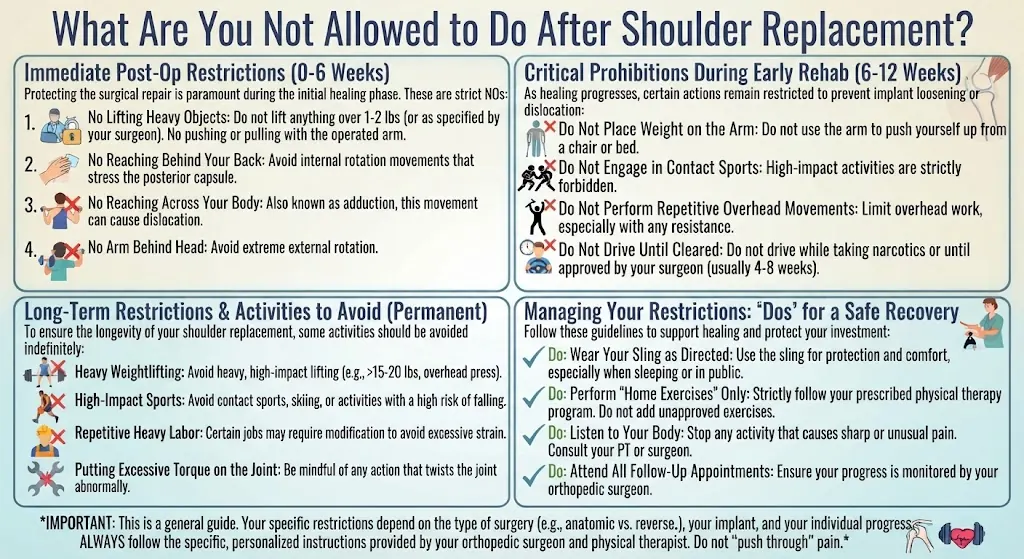
During early recovery, avoid lifting, pushing, pulling, or moving the operated arm beyond the limits set by your surgical team. Your surgeon may also restrict particular shoulder positions to reduce the risk of dislocation or damage to healing tissues.
| Activity | Why it may be restricted |
|---|---|
| Lifting heavy objects | Places stress on healing tissues and the implant |
| Reaching overhead or behind your back | May exceed your permitted range of motion |
| Pushing yourself up from a chair with the operated arm | Places substantial force through the shoulder |
| Sudden pulling or twisting | Can strain healing structures |
| Driving too soon | Pain, limited movement, a sling, or medication may impair control |
| Returning to heavy gym workouts | Resistance may exceed what the shoulder can safely tolerate |
These restrictions are not identical for everyone. Follow your discharge instructions even if you feel comfortable enough to do more.
How Long Do Restrictions Last?
Many people progress through recovery over several months, but there is no universal schedule for resuming every activity. Your surgeon and physical therapist will guide you according to healing, movement, strength, and the type of procedure.
| Recovery period | General focus | What to keep in mind |
|---|---|---|
| First few weeks | Protect the shoulder and manage symptoms | Use your sling as instructed; do not lift or exercise independently |
| Early rehabilitation | Regain approved movement | Follow your prescribed exercises and movement limits |
| Later rehabilitation | Improve strength and function | Add resistance only when cleared |
| Longer-term recovery | Return to appropriate daily and recreational activities | Continue respecting any lasting lifting or movement limits |
For a more detailed overview, see the shoulder replacement recovery timeline. Your personal timeline may differ if healing is delayed or additional procedures were performed.
Can You Lift Weights, Exercise, or Play Sports?
You may be able to return to selected forms of exercise, but heavy lifting and high-impact activities require careful consideration. Do not restart your usual workout simply because pain has decreased.
Exercises such as heavy bench presses, overhead presses, push-ups, dips, and forceful pulling movements can place considerable stress on the shoulder. Your clinician may permit modified versions later, depending on your recovery and implant.
Before returning to resistance training, review which weight-lifting activities may be appropriate after shoulder replacement. Avoid unsupervised shoulder strengthening and do not add resistance beyond your prescribed plan.
Walking and other activities that do not load the operated arm may be possible earlier, provided your balance, overall health, and surgical instructions allow them. Your rehabilitation plan should determine when to progress.
Does the Type of Shoulder Replacement Matter?
Yes. An anatomic total shoulder replacement and a reverse shoulder replacement have different mechanics and may require different precautions.
A reverse shoulder replacement changes the joint structure so the deltoid muscle can help raise the arm when the rotator cuff is severely damaged. Certain positions and loading activities may therefore need particular attention. Read more about why a reverse shoulder replacement may be recommended.
Your surgeon may also restrict specific movements based on how the shoulder was repaired during surgery. Do not copy another patient’s exercise plan or assume that the same restrictions apply to every replacement.
What About Sleeping, Driving, and Daily Activities?
Use your sling for the duration prescribed by your surgical team. Do not remove it early or stop wearing it at night unless your instructions allow this. Guidance on how long you may need a sling after shoulder replacement can help you understand why this support matters.
Sleeping on the operated side may be uncomfortable or restricted during early recovery. Follow the positioning advice you receive, and see these tips for sleeping more comfortably after shoulder replacement.
Do not drive until your surgeon says it is safe, you can control the vehicle comfortably, and you are no longer affected by sedating pain medicines. Review when you may be able to drive after shoulder replacement before planning to return to driving.
For everyday tasks, keep frequently used items within easy reach, avoid carrying heavy bags with the operated arm, and ask for help with tasks that require forceful pushing or pulling.
Warning Signs: When Should You Contact Your Surgeon?
Some soreness and stiffness can occur during recovery, but worsening symptoms should not automatically be attributed to normal healing.
| Symptom | Recommended action |
|---|---|
| Mild discomfort that improves with rest and follows your expected recovery pattern | Monitor and follow your care plan |
| Increasing pain, redness, warmth, wound drainage, or fever | Contact your surgical team promptly |
| Sudden severe pain, a new deformity, or an abrupt loss of shoulder function | Seek urgent medical evaluation |
| Chest pain or shortness of breath | Call 911 for emergency assistance |
If you experience a sudden painful movement or suspect a dislocation, do not try to force the shoulder back into position. Keep the arm supported and seek urgent care.
Frequently Asked Questions
1. What is the biggest restriction after shoulder replacement?
The main restriction is avoiding movements or loads that could damage healing tissues or destabilize the joint. Your surgeon will specify which positions and activities are most important to avoid.
2. Can I use my operated arm to get out of bed?
Avoid pushing your body up with the operated arm unless your surgical team specifically permits it. Use the transfer method recommended by your physical therapist or caregiver.
3. Can I reach behind my back after shoulder replacement?
This movement may be restricted during recovery, depending on the operation and your surgeon’s precautions. Do not force your arm behind your back to dress or reach for an object.
4. Can I lift groceries after shoulder replacement?
Heavy grocery bags may be unsuitable during early recovery. Ask when you can carry items and what weight limits apply to your particular procedure.
5. Can I drive while wearing a sling?
Driving with a sling may limit steering and emergency responses. Do not drive until your surgeon clears you and you can operate the vehicle safely without impairment from medication.
6. Can I sleep on my operated shoulder?
This may be uncomfortable or prohibited during early healing. Follow your surgeon’s positioning instructions and return to side-sleeping only when permitted.
7. Can I do housework after shoulder replacement?
Light tasks may be possible as recovery progresses, but vacuuming, mopping, lifting laundry baskets, and reaching overhead can place excessive stress on the shoulder. Resume chores gradually with clinical guidance.
8. Are shoulder replacement restrictions permanent?
Many restrictions ease as healing progresses, but some patients need long-term limits on heavy lifting or high-demand activities. Your surgeon can explain which restrictions apply to your implant and goals.
9. What happens if I accidentally move my arm the wrong way?
One unexpected movement does not automatically mean damage has occurred. Stop the activity and contact your surgical team if you develop sudden pain, new weakness, swelling, or a significant change in movement.
10. When can I return to the gym after shoulder replacement?
Returning to the gym depends on your healing and rehabilitation progress, not just the number of weeks since surgery. Get clearance before restarting shoulder resistance exercises or heavy upper-body training.
Conclusion
After shoulder replacement, avoid heavy lifting, forceful pushing and pulling, restricted shoulder positions, and activities that could compromise your balance or joint stability. Follow your sling instructions, progress through rehabilitation gradually, and ask your surgeon when each activity is safe to resume. New or worsening symptoms deserve medical attention rather than another workout.
Disclaimer: This article is provided for educational and informational purposes only.
This article is for education purpose only and is not a diagnosis or a substitute for medical advice.