
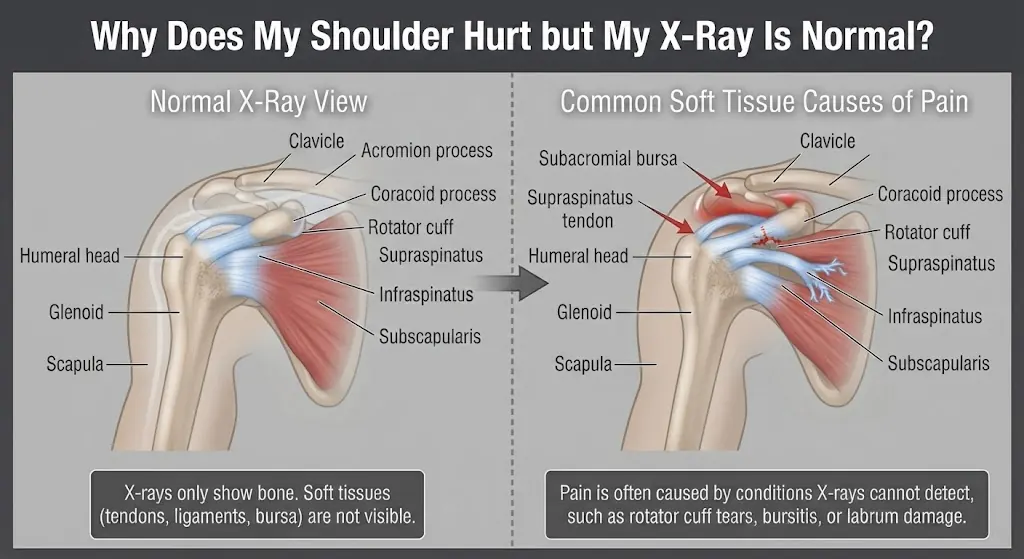
A normal X-ray is reassuring in some ways, but it does not rule out every shoulder condition. X-rays are best for evaluating bones and joint alignment; many tendons, ligaments, and other soft tissues are not clearly visible on them.
Understanding why your shoulder hurts despite a normal X-ray can help you identify possible explanations, know what to do next, and recognize when further evaluation is appropriate.
Why can your shoulder hurt when the X-ray is normal?
A normal shoulder X-ray does not rule out a soft-tissue injury or every joint problem. Several conditions can cause pain without producing obvious changes on an X-ray.
| Possible cause | Common symptoms |
|---|---|
| Rotator cuff irritation or tear | Pain lifting the arm, weakness, or discomfort at night |
| Tendonitis or bursitis | Pain during overhead movement or when lying on the affected side |
| Shoulder impingement | Pain when raising the arm through certain positions |
| Labral tear | Catching, clicking, or a feeling of instability |
| Frozen shoulder | Gradually increasing pain and stiffness |
| Neck-related nerve irritation | Pain spreading into the arm, sometimes with tingling or numbness |
1. Rotator cuff problems
The rotator cuff is a group of muscles and tendons that stabilizes the shoulder and helps move the arm. Irritation or a tear may cause pain and weakness even if the bones look normal on an X-ray. Learn about rotator cuff tear symptoms and recovery.
2. Tendonitis, bursitis, and impingement
Tendon irritation and inflammation of the fluid-filled bursa can make reaching overhead or sleeping on the affected side painful. Shoulder tendonitis symptoms and treatment and shoulder bursitis symptoms can help you understand these possibilities.
Shoulder impingement symptoms may include pain during particular arm movements, but symptoms alone cannot confirm the cause.
3. Labral problems or frozen shoulder
The labrum is cartilage that helps deepen and stabilize the shoulder socket. A tear may cause catching or instability, while frozen shoulder typically produces progressive stiffness and restricted movement. Neither condition is reliably ruled out by a normal X-ray.
Explore early signs of a shoulder labral tear or early signs of frozen shoulder for more detail.
What does a normal X-ray actually show?
An X-ray can help identify fractures, dislocations, some forms of arthritis, and certain changes in bone structure. It does not directly show most rotator cuff tendons, the labrum, or many other soft tissues in sufficient detail.
| Test | What it can help evaluate |
|---|---|
| X-ray | Bones, joint alignment, fractures, and some arthritic changes |
| Ultrasound | Rotator cuff tendons and some other soft tissues |
| MRI | Tendons, muscles, labrum, and other soft tissues |
A clinician may recommend an ultrasound or MRI if your symptoms and physical examination suggest a problem that an X-ray cannot detect. Additional imaging is not always necessary; the decision depends on your symptoms, examination findings, and whether the results would change treatment.
For a closer comparison, see when an X-ray or MRI may help evaluate shoulder pain.
What can you do if your shoulder still hurts?
For mild pain without warning signs, temporarily reduce activities that aggravate it while maintaining gentle, comfortable movement. Avoid heavy overhead lifting and forceful stretches that increase pain.
| At-home step | How to approach it |
|---|---|
| Modify activity | Keep loads light and close to your body |
| Apply a cold pack | Wrap it in a towel and use it for 15–20 minutes |
| Keep moving gently | Avoid forcing painful movements or keeping the shoulder completely still for long periods |
| Consider pain relief | Follow medication directions and check with a clinician or pharmacist if you have health conditions or take other medicines |
You can find additional ways to relieve shoulder pain at home. Once the cause is clearer, a clinician or physical therapist may recommend appropriate exercises for shoulder pain relief and strength.
Arrange a medical evaluation if pain persists, keeps returning, disrupts sleep, limits daily activities, or comes with weakness or restricted movement. Treatment may include activity modification, physical therapy, medication when appropriate, or further investigation.
When should shoulder pain be checked urgently?
Seek urgent medical assessment for sudden severe pain, major new weakness, inability to move the arm, a visible deformity, or a hot, red, swollen shoulder with fever.
Call emergency services if shoulder pain occurs with chest pressure, shortness of breath, sweating, nausea, or pain spreading to the jaw or back. These can be signs of a heart emergency; shoulder pain does not always originate in the shoulder itself. Read about when shoulder pain may signal a heart problem.
Frequently asked questions
1. Can you have a rotator cuff tear with a normal X-ray?
Yes. X-rays do not directly show most rotator cuff tears. A physical examination and, when appropriate, ultrasound or MRI can help assess the tendons.
2. Does a normal X-ray mean my shoulder is healthy?
Not necessarily. It means the X-ray did not show a clear abnormality, but soft-tissue problems may still be present.
3. Why does my shoulder hurt when I raise my arm?
Rotator cuff irritation, bursitis, and impingement are possible causes. Persistent pain or weakness should be assessed rather than self-diagnosed.
4. Can shoulder pain come from my neck?
Yes. Nerve irritation or arthritis in the neck can cause pain that spreads to the shoulder or arm, sometimes with tingling or numbness.
5. Will I need an MRI if my X-ray is normal?
Not always. An MRI may be considered if the examination suggests a soft-tissue problem or symptoms persist despite appropriate initial care.
6. How long can shoulder pain last when an X-ray is normal?
Duration depends on the underlying cause. Mild irritation may improve over days or weeks, while more persistent tendon, joint, or nerve conditions may take longer.
7. Should I exercise with shoulder pain?
Gentle movement may help maintain mobility, but avoid exercises that worsen pain or weakness. A clinician or physical therapist can guide safe strengthening.
8. Is shoulder pain at night concerning?
Night pain can occur with several common shoulder conditions. If it repeatedly disrupts sleep or is worsening, arrange an assessment.
9. Can a labral tear be missed on an X-ray?
Yes. The labrum is soft tissue and is not adequately assessed by a standard X-ray. Further evaluation depends on the symptoms and examination.
10. When should I see a doctor for shoulder pain?
Seek care if pain persists, worsens, limits movement, or comes with weakness. Sudden severe symptoms or possible heart attack signs require urgent or emergency care.
Conclusion
A normal X-ray does not rule out every cause of shoulder pain. Soft-tissue problems, including rotator cuff conditions, bursitis, and labral injuries, may require clinical assessment and sometimes additional imaging. Modify painful activities, keep movement gentle, and seek medical care if symptoms persist or worsen.
Disclaimer: This article is provided for educational and informational purposes only.
This article is for education purpose only and is not a diagnosis or a substitute for medical advice.