
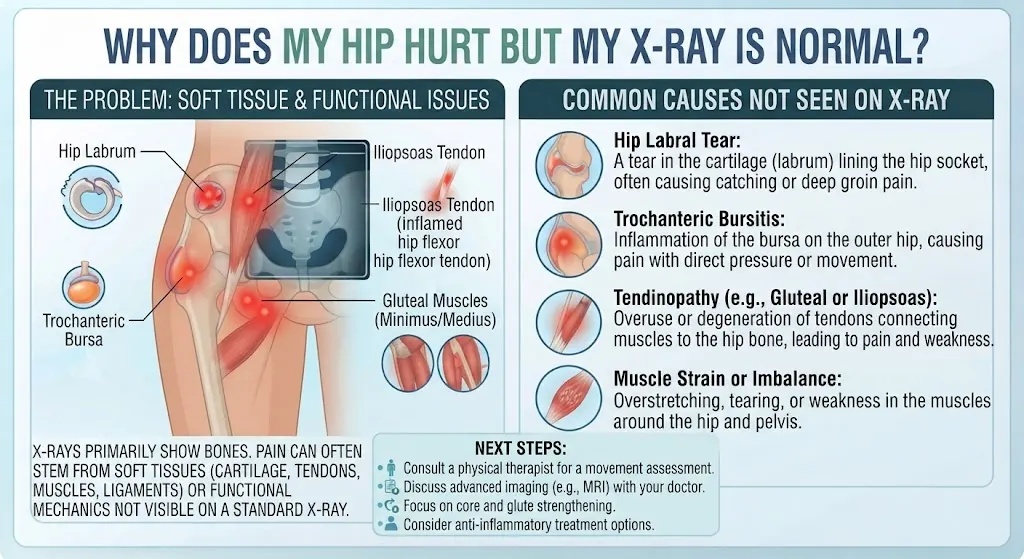
An X-ray mainly shows bones and joint alignment. It may reveal fractures, some signs of arthritis, and other bone changes, but it does not clearly show many tendons, muscles, cartilage, or other soft tissues. Therefore, hip pain with a normal X-ray does not automatically mean nothing is wrong.
Understanding why symptoms persist can help you decide what to do next. This guide covers common causes, when additional testing may be useful, practical ways to manage discomfort, and warning signs that need medical attention.
Why can my hip hurt when an X-ray is normal?
A normal X-ray does not rule out soft-tissue injuries, early joint changes, or pain referred from the lower back. The cause depends on where the pain occurs, what triggers it, and whether other symptoms are present.
| Possible cause | Common clues | What an X-ray may miss |
|---|---|---|
| Hip labral tear | Deep groin pain, clicking, catching | Damage to the cartilage rim |
| Tendon irritation | Outer-hip pain, worse with walking or stairs | Tendon inflammation or degeneration |
| Muscle strain | Pain after exercise or sudden movement | Muscle or tendon injury |
| Early osteoarthritis | Stiffness, discomfort after rest or activity | Subtle early joint changes |
| Nerve-related pain | Burning, tingling, pain traveling down the leg | Nerve compression in the spine |
These patterns are clues, not a diagnosis. For example, hip labral tear symptoms and treatment options may be relevant if you experience catching or deep groin pain, while hip flexor strain symptoms may fit discomfort that began after a sudden stretch or workout.
What tests can find the cause when an X-ray is normal?
Your clinician may recommend further evaluation if pain persists, limits daily activities, or suggests an injury that X-rays cannot show.
-
Physical examination: Checks hip movement, strength, tenderness, walking pattern, and whether symptoms may originate in the back.
-
MRI: Can show many soft-tissue structures, including tendons, muscles, cartilage, and bone marrow. It may be considered when a labral injury, stress fracture, or other hidden problem is suspected.
-
Ultrasound: Can help assess certain tendons, bursae, and fluid around the hip.
-
CT scan: Provides detailed bone images and may be useful for selected injuries or when more bone detail is needed.
Not everyone needs an MRI or another scan. Imaging decisions depend on your symptoms, examination, injury history, and whether the result would change treatment. If you are wondering why hip pain continues despite a normal X-ray, discuss the timing and purpose of further testing with your clinician.
What can you do at home?
If the pain is mild, you can bear weight, and there are no warning signs, temporary adjustments may help.
-
Reduce activities that trigger sharp pain, but avoid prolonged bed rest.
-
Try shorter, flatter walks and gentle movement within a comfortable range.
-
Apply a wrapped cold pack for 15–20 minutes after activity, or gentle heat if stiffness is the main problem.
-
Choose supportive footwear and avoid repeatedly testing painful movements.
-
Ask a clinician or pharmacist before using pain medication if you have other medical conditions, take other medicines, or are pregnant.
Gentle low-impact exercises for painful joints may be useful when symptoms allow. Stop any exercise that causes sharp pain, increasing symptoms, or a limp.
When should you seek medical attention?
Seek emergency care for severe hip pain after a fall or injury, an inability to stand or bear weight, or a hip deformity. Sudden severe pain accompanied by fever, chills, or a hot, swollen joint also requires urgent assessment because infection is possible.
Arrange prompt medical evaluation if pain keeps worsening, repeatedly wakes you, causes persistent limping, or does not improve with reasonable activity changes. Pain that travels down the leg with numbness or weakness may require assessment of the nerves and lower back.
Frequently Asked Questions
1. Can you have a hip labral tear with a normal X-ray?
Yes. X-rays do not directly show the hip labrum, so a tear may require clinical assessment and sometimes MRI or other specialized imaging.
2. Does a normal X-ray rule out a hip fracture?
No. Some fractures, including stress fractures, may not be visible initially. Seek urgent assessment if you have significant pain after an injury or difficulty bearing weight.
3. Why does my hip hurt when I walk but not when I rest?
Walking loads the hip joint and surrounding muscles and tendons. Several conditions can cause activity-related pain, so persistent symptoms deserve evaluation.
4. Why does hip pain spread down my leg?
Pain may originate from the hip or from irritated nerves in the lower back. Hip pain that travels down the leg is especially worth discussing if it comes with tingling, numbness, or weakness.
5. Can tendon damage be missed on an X-ray?
Yes. X-rays are better for evaluating bones than tendons. A clinician may consider ultrasound or MRI when tendon injury is suspected.
6. Why does my hip hurt in the groin?
Groin pain can arise from the hip joint, including arthritis or a labral problem, but muscle injuries can also cause it. Learn more about hip pain felt in the groin.
7. Why does the outside of my hip hurt?
Outer-hip pain may involve the gluteal tendons or nearby bursae. It may become more noticeable when walking, climbing stairs, or lying on the affected side.
8. Should I keep walking if my hip hurts?
Gentle walking may be reasonable if pain is mild and does not worsen your symptoms. Shorten your walks or stop if you develop sharp pain, increasing discomfort, or a limp.
9. When is an MRI needed for hip pain?
An MRI may be considered when symptoms and examination suggest a problem that an X-ray cannot identify, such as a stress fracture or labral injury. The decision depends on the suspected cause and whether imaging will guide care.
10. Can hip pain improve without surgery?
Yes. Many causes can be managed with activity modification, rehabilitation, and appropriate pain relief. Treatment depends on the underlying condition, and persistent or worsening pain should be reassessed.
The bottom line
A normal hip X-ray does not rule out every meaningful cause of pain. If symptoms persist, limit walking, or worsen, arrange a clinical assessment to determine whether further testing or targeted treatment is needed.
Disclaimer: This article is provided for educational and informational purposes only.
This article is for education purpose only and is not a diagnosis or a substitute for medical advice.