
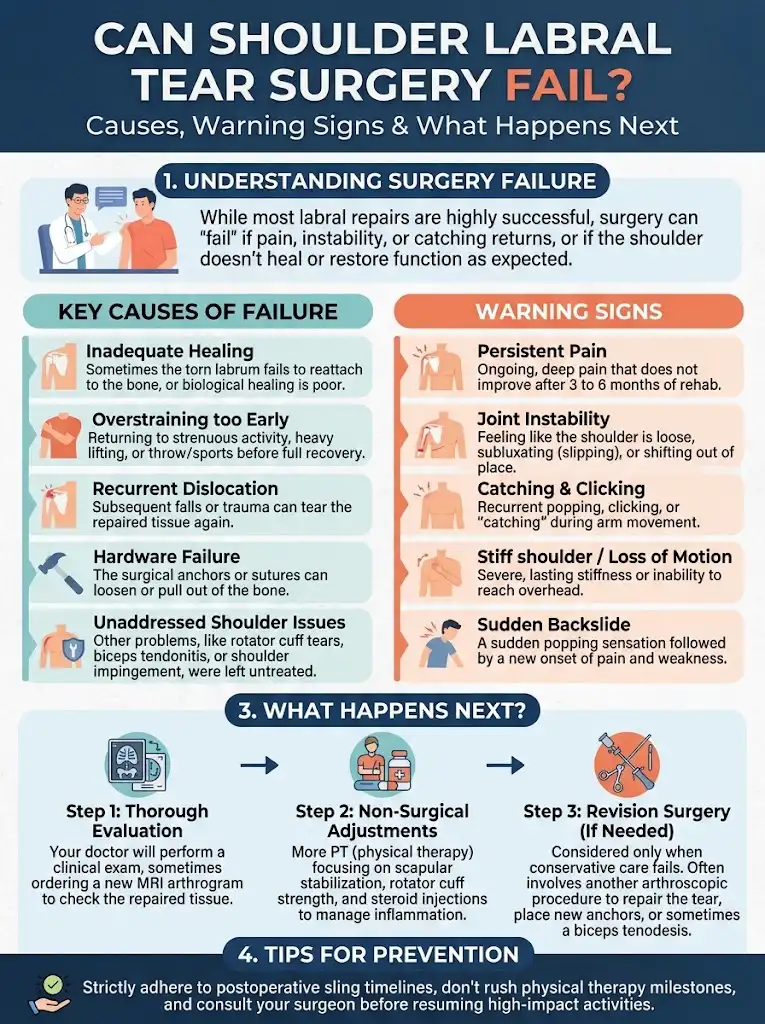
Shoulder labral tear surgery is intended to improve pain, stability, and shoulder function, but recovery does not always go as expected. Some people continue to experience pain, clicking, weakness, or a feeling that the shoulder might slip out of place, even months after surgery. These symptoms can be frustrating, especially when daily activities or sports remain difficult.
Can shoulder labral tear surgery fail? Yes. A repair may not heal as intended, the labrum may tear again, or another shoulder problem may continue causing symptoms. However, ongoing pain does not automatically mean the operation has failed.
Understanding possible causes, warning signs, recovery expectations, and treatment options can help you decide when to contact your surgeon and what questions to ask. The next step depends on your symptoms, the type of repair performed, and how far you are into rehabilitation.
What Does Failed Shoulder Labral Tear Surgery Mean?
Failed shoulder labral tear surgery generally means the procedure has not achieved its intended goals, or symptoms have returned after an initial improvement. Failure can involve a structural problem, persistent shoulder instability, limited movement, or pain from another condition.
The labrum is cartilage that helps deepen the shoulder socket and supports joint stability. Different injuries affect different areas, including SLAP tears compared with Bankart tears. The location and severity of the original injury can influence healing and the likelihood of persistent symptoms.
Why Can Shoulder Labral Tear Surgery Fail?
Several factors may contribute to an unsuccessful outcome. More than one can be involved.
| Possible cause | What it means |
|---|---|
| Recurrent tear | The repaired labrum becomes damaged again, sometimes after another injury. |
| Incomplete healing | The repaired tissue does not attach or heal as expected. |
| Persistent instability | The shoulder continues to feel loose or may partially dislocate. |
| Stiffness or scar tissue | Healing tissues restrict movement and make the shoulder difficult to use. |
| Another source of pain | A biceps tendon, rotator cuff, cartilage, or other shoulder problem contributes to symptoms. |
A repair can also be affected by the original injury, tissue quality, the type of procedure, and the demands placed on the shoulder during recovery. Returning to heavy lifting or throwing before the surgeon approves it may put excessive stress on healing tissue.
What Are the Signs of Failed Labral Repair?
Symptoms that deserve review include:
- Shoulder pain that remains severe, worsens, or returns after improving.
- Repeated catching, painful clicking, or a sensation that something shifts inside the joint.
- A feeling that the shoulder is slipping, giving way, or becoming unstable.
- Persistent weakness or difficulty with everyday activities.
- Movement that remains significantly restricted despite following rehabilitation instructions.
Some clicking and soreness can occur during recovery without indicating a failed repair. The pattern matters: symptoms that worsen, return after a period of improvement, or interfere with expected progress should be discussed with your surgical team.
Because early signs of a shoulder labral tear can overlap with postoperative symptoms, your clinician will need to assess the shoulder rather than rely on symptoms alone.
How Do Doctors Check Whether the Repair Has Failed?
Evaluation usually begins with a review of your pain, activity level, recovery timeline, and any new injury. Your surgeon may examine shoulder movement, strength, tenderness, and stability.
Imaging may be recommended if the examination suggests a structural problem. A standard MRI or MRI arthrogram for a shoulder labral tear can help assess the labrum and other joint structures. Findings must be interpreted alongside symptoms and the physical examination because postoperative changes can complicate interpretation.
| Assessment | What it may help identify |
|---|---|
| Physical examination | Instability, weakness, restricted movement, or pain patterns |
| MRI | Recurrent injury and other soft-tissue abnormalities |
| MRI arthrogram | Selected labral defects that may be difficult to assess on routine MRI |
| X-ray | Bone alignment, fractures, or other bony changes; it does not directly show the labrum |
No single test automatically proves that surgery has failed. Your clinician may consider alternative explanations, including rotator cuff tears and their symptoms.
What Happens Next if the Repair Has Failed?
Treatment depends on the cause and severity of symptoms. Revision surgery is not always necessary. If the repair is structurally intact, treatment may focus on rehabilitation, movement restrictions, pain management, or another identified condition.
| Management option | When it may be considered |
|---|---|
| Modified physical therapy | Strength, movement, or control needs improvement and the repair is considered stable |
| Activity modification | Certain movements or loads aggravate symptoms |
| Further assessment | Symptoms persist or the cause remains uncertain |
| Revision surgery | A significant structural problem or ongoing instability warrants another operation |
If another procedure is recommended, ask why the first repair may not have worked, what the proposed surgery would address, and what the expected benefits and risks are. Recovery may differ from the original operation; see shoulder labral tear surgery recovery timelines.
Warning Signs After Shoulder Labral Surgery
Contact your surgical team promptly for worsening pain, new instability, increasing swelling, or a sudden decline in movement. Fever, spreading redness, warmth, wound drainage, or rapidly worsening pain may indicate a complication requiring urgent medical evaluation.
Seek emergency care for trouble breathing, facial or throat swelling, chest pain, or other severe symptoms. Do not wait for a routine follow-up if these occur.
Frequently Asked Questions
1. How common is failed shoulder labral tear surgery?
The risk varies with the type of tear, surgical technique, patient factors, and activity demands. A reliable estimate for an individual requires knowing the specific procedure and circumstances; one general percentage cannot predict your outcome.
2. Can a labral repair fail months after surgery?
Yes. Symptoms may develop later if the tissue does not heal adequately or the shoulder is reinjured. New pain or instability after improvement warrants reassessment.
3. Does persistent pain mean my surgery failed?
No. Pain may relate to stiffness, muscle weakness, rehabilitation progress, or another shoulder condition. Your surgeon can help distinguish expected recovery from a complication.
4. Can a repaired labrum tear again?
Yes. A new injury or excessive loading during healing may damage the repair. Follow your surgeon’s restrictions and progress activity gradually under professional guidance.
5. Can physical therapy help after an unsuccessful repair?
It may help when symptoms relate to weakness, movement limitations, or impaired shoulder control and the repair is stable. Therapy should be tailored to the findings rather than continued through worsening pain.
6. Will I need a second surgery?
Not necessarily. Revision surgery is considered when symptoms, examination findings, and imaging indicate a problem that is unlikely to improve sufficiently with nonoperative care.
7. Can an MRI confirm that labral surgery failed?
MRI can reveal abnormalities, but postoperative findings do not always correspond directly to symptoms. Your clinician interprets imaging alongside your history and examination.
8. Can I return to sports after a failed labral repair?
Possibly, depending on the cause, shoulder stability, strength, pain, and treatment plan. Do not resume throwing, contact sports, or heavy lifting until your surgical team clears you.
9. What should I avoid if I suspect my repair has failed?
Avoid activities that trigger sharp pain, instability, or worsening symptoms, and do not test the shoulder repeatedly to see whether it is stable. Contact your clinician before changing rehabilitation exercises or lifting restrictions.
10. When should I contact my surgeon?
Contact your surgeon if pain is worsening, progress has stalled, or clicking is accompanied by pain or instability. Seek urgent assessment for fever, wound changes, severe worsening pain, or other possible complications.
Conclusion
Shoulder labral tear surgery can fail, but persistent symptoms do not always mean the repair has torn again. A clinical assessment, with imaging when appropriate, can help identify the cause and guide the next step. Report worsening symptoms early, follow rehabilitation guidance, and discuss the benefits and risks of further treatment with your surgeon.
Disclaimer: This article is provided for educational and informational purposes only.
This article is for education purpose only and is not a diagnosis or a substitute for medical advice.