
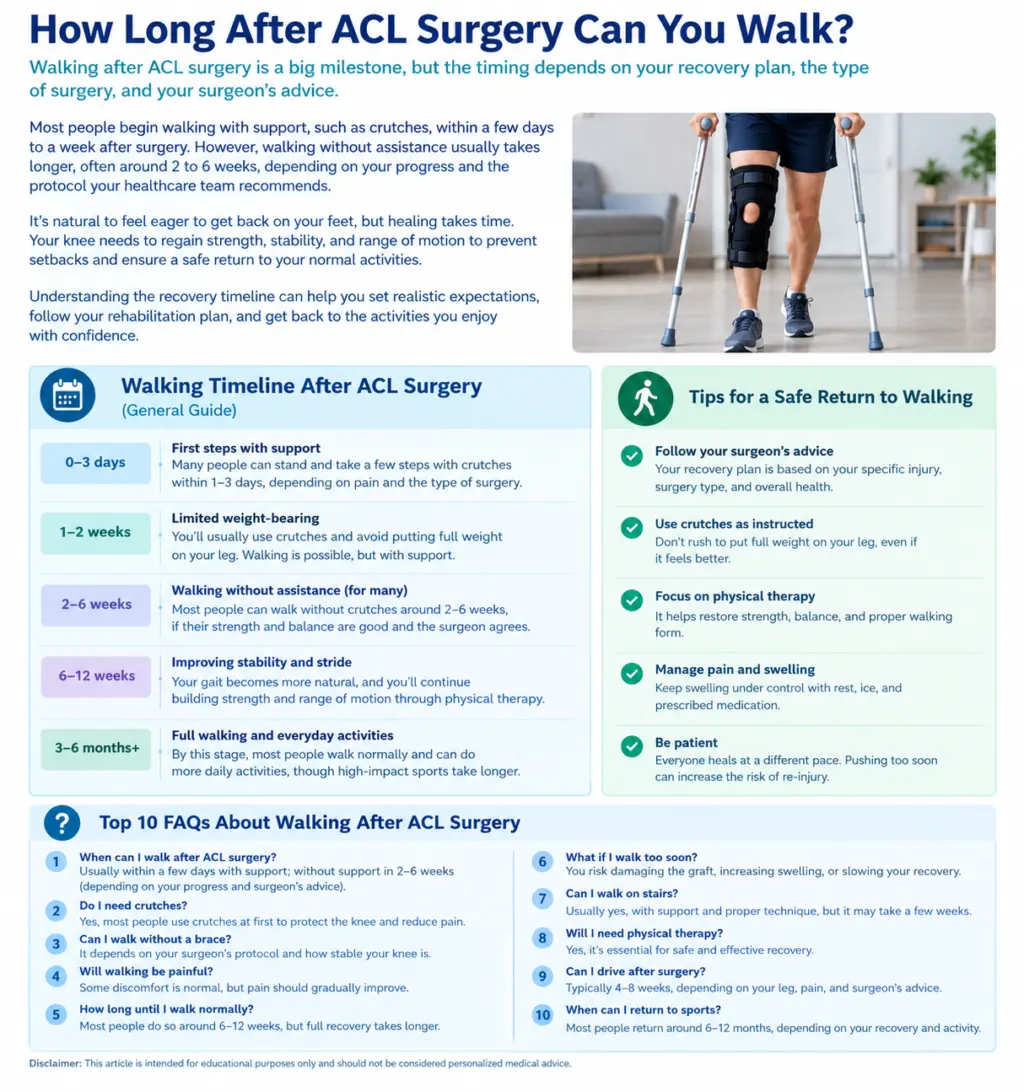
After anterior cruciate ligament (ACL) surgery, one of the first questions patients ask is when they can stand up, put weight on the operated leg, and walk without crutches. The answer depends on the type of surgery, whether other knee structures were injured, pain and swelling, and how well the knee regains control.
Walking soon after surgery is possible for many patients, but walking does not mean the knee has fully healed. Even when you can move around independently, the reconstructed ligament needs months of rehabilitation before it is ready for demanding activities.
This guide explains when you can walk after ACL surgery, how recovery typically progresses, when crutches may be discontinued, and which symptoms should prompt medical attention.
How Soon Can You Walk After ACL Surgery?
Many patients begin walking with crutches on the day of surgery or within the first few days, provided their surgeon allows weight-bearing. Some can put weight on the operated leg immediately, while others need temporary restrictions.
Your timeline may differ if you also had a meniscus repair, cartilage procedure, or another ligament injury. For example, recovery after an ACL injury versus a meniscus tear can differ because the damaged structures and surgical procedures are not the same.
ACL Surgery Walking Timeline
| Recovery stage | Typical walking ability | Main priority |
|---|---|---|
| First few days | Short, assisted walks with crutches or a walker | Protect the knee and control swelling |
| Weeks 1–2 | Gradually increase walking as permitted | Improve knee extension and quadriceps control |
| Weeks 2–6 | Some patients transition away from crutches | Walk with a steady gait without buckling |
| Weeks 6–12 | Walking often becomes more comfortable | Restore strength, balance, and mobility |
| Months 3–6 and beyond | Longer walks may be easier; running requires separate clearance | Build strength and control for higher-impact activity |
These are general examples, not guaranteed milestones. Some patients progress faster or slower, and additional procedures can significantly change the schedule.
When Can You Walk Without Crutches After ACL Surgery?
Many patients begin transitioning away from crutches within the first few weeks, but you should stop using them only when your surgeon or physical therapist confirms that it is safe.
Before walking independently, you may need to demonstrate that you can:
- Put the permitted amount of weight through the operated leg.
- Walk without a significant limp.
- Straighten the knee adequately.
- Control the knee without it buckling.
- Manage pain and swelling during and after activity.
Stopping crutches too early can increase the risk of falls and encourage an abnormal walking pattern. If your knee feels unstable or you are limping noticeably, continue following your prescribed mobility plan.
Patients with other injuries, including knee ligament injuries, may require a different progression.
What Affects Walking Recovery After ACL Surgery?
Several factors influence how quickly you regain normal walking.
Type of procedure
An isolated ACL reconstruction may allow earlier weight-bearing than a combined procedure. If your surgeon repairs a meniscus, you may need to limit weight-bearing or knee bending for a specified period.
Swelling and muscle control
Swelling can restrict knee movement and make the quadriceps muscle difficult to activate. Even if the surgical graft is secure, poor muscle control can make walking unsafe.
Pain and range of motion
Pain can affect your stride, while difficulty straightening the knee can contribute to a persistent limp. Your rehabilitation plan may prioritize swelling management, gentle movement, and progressive strengthening.
Other knee conditions
Additional injuries may influence your recovery. For instance, meniscus tear symptoms and treatment differ from those of an isolated ACL injury, and treatment restrictions may differ as well.
How Can You Walk Safely After ACL Surgery?
Follow your postoperative instructions rather than trying to reach a particular milestone quickly.
- Use your prescribed walking aid. Adjust crutches as instructed and avoid walking unsupported if your knee is unstable.
- Take short, controlled walks. Increase distance gradually according to your rehabilitation plan.
- Manage swelling. Elevation, ice when appropriate, and prescribed medication may help. Follow your surgical team’s instructions.
- Complete approved exercises. Early rehabilitation commonly focuses on knee movement, quadriceps activation, and safe walking mechanics.
- Avoid twisting and pivoting. These movements can place unnecessary stress on the recovering knee.
A physical therapist can help you progress safely through low-impact exercises for people with joint pain, adapted to your postoperative restrictions. Do not start exercises simply because they appear gentle; confirm they are appropriate for your procedure.
Walking After ACL Surgery: What Is Safe?
| Activity | General guidance |
|---|---|
| Short walks at home | Often encouraged when cleared and performed with the prescribed support |
| Stairs | Use the technique taught by your care team and a handrail |
| Longer outdoor walks | Increase gradually if your gait remains controlled |
| Walking without crutches | Wait until your clinician confirms adequate control and safe weight-bearing |
| Running, jumping, or pivoting | Requires later rehabilitation milestones and explicit clearance |
Walking tolerance alone does not determine whether the graft is ready for sports. Returning to running or pivoting activities requires more advanced strength, balance, and functional testing.
What Is Normal, and When Should You Call Your Surgeon?
Some pain, bruising, and swelling are common after ACL surgery and should generally improve over time. However, worsening symptoms should not automatically be dismissed as normal recovery.
Contact your surgical team promptly if pain or swelling suddenly increases, the knee becomes increasingly red or warm, you develop a fever, or your recovery unexpectedly deteriorates.
Seek urgent medical attention for chest pain, shortness of breath, or significant calf pain or swelling, which can indicate a blood clot or another serious complication. A sudden loss of foot sensation, new weakness, or a cold or unusually pale foot also needs urgent assessment.
If walking remains difficult, your knee repeatedly gives way, or you cannot regain expected movement, ask your surgeon or physical therapist to reassess your rehabilitation plan.
Frequently Asked Questions
1. Can I walk the same day as ACL surgery?
Many patients take a few assisted steps on the day of surgery, depending on their procedure and clinical instructions. You may need crutches and supervision.
2. How long do I need crutches after ACL surgery?
Some patients use crutches for a few weeks, while others need them longer. Meniscus repair and other restrictions can extend this period.
3. Can I put full weight on my leg after ACL surgery?
Some patients are allowed to bear weight as tolerated soon after surgery. Others must follow specific limits, so confirm your instructions before increasing weight-bearing.
4. When can I walk normally without a limp?
Walking may improve over the first several weeks, but the timing varies. Adequate knee extension, quadriceps control, and reduced swelling are important milestones.
5. Is pain while walking normal after ACL surgery?
Some discomfort can occur during early recovery. Severe, worsening, or unexpected pain should be discussed with your surgical team.
6. Can walking too much damage an ACL graft?
Walking within your prescribed limits is generally part of rehabilitation. Excessive activity that increases swelling, causes limping, or violates restrictions can interfere with recovery.
7. When can I walk up and down stairs?
Stairs may be possible early with assistance and the correct technique, but safety depends on strength, balance, and weight-bearing restrictions.
8. When can I return to running?
Running usually requires several months of rehabilitation and specific strength and functional milestones. Your clinician should clear you before you begin.
9. Does a meniscus repair change the walking timeline?
Yes. A meniscus repair may require restricted weight-bearing or limited knee bending, depending on the tear and repair technique.
10. When can I return to sports after ACL surgery?
Return to pivoting sports often takes around 9–12 months or longer, depending on recovery and functional testing. Calendar time alone is not enough to establish readiness.
Conclusion
Many patients begin assisted walking within days of ACL surgery, but walking independently can take several weeks or longer. Follow your surgeon’s weight-bearing instructions, use crutches until you can walk safely, and progress through rehabilitation rather than rushing recovery.
Disclaimer: This article is provided for educational and informational purposes only.
This article is for education purpose only and is not a diagnosis or a substitute for medical advice.