
Lower back pain, leg pain, numbness, or difficulty walking can make everyday activities uncomfortable and leave you wondering whether a spinal disc problem or spinal stenosis is responsible. You might notice sharp pain when bending, tingling that travels down one leg, or heaviness in your legs after standing or walking for several minutes.
Spinal stenosis and a herniated disc can cause overlapping symptoms, but they involve different structural changes in the spine. Neither diagnosis automatically means surgery is necessary, and symptoms alone cannot reliably identify which condition you have.
This guide explains the differences between spinal stenosis and a herniated disc, how each affects nerves, which symptoms matter most, how clinicians evaluate them, and what treatments may help you move more comfortably.
What Is the Difference Between Spinal Stenosis and a Herniated Disc?
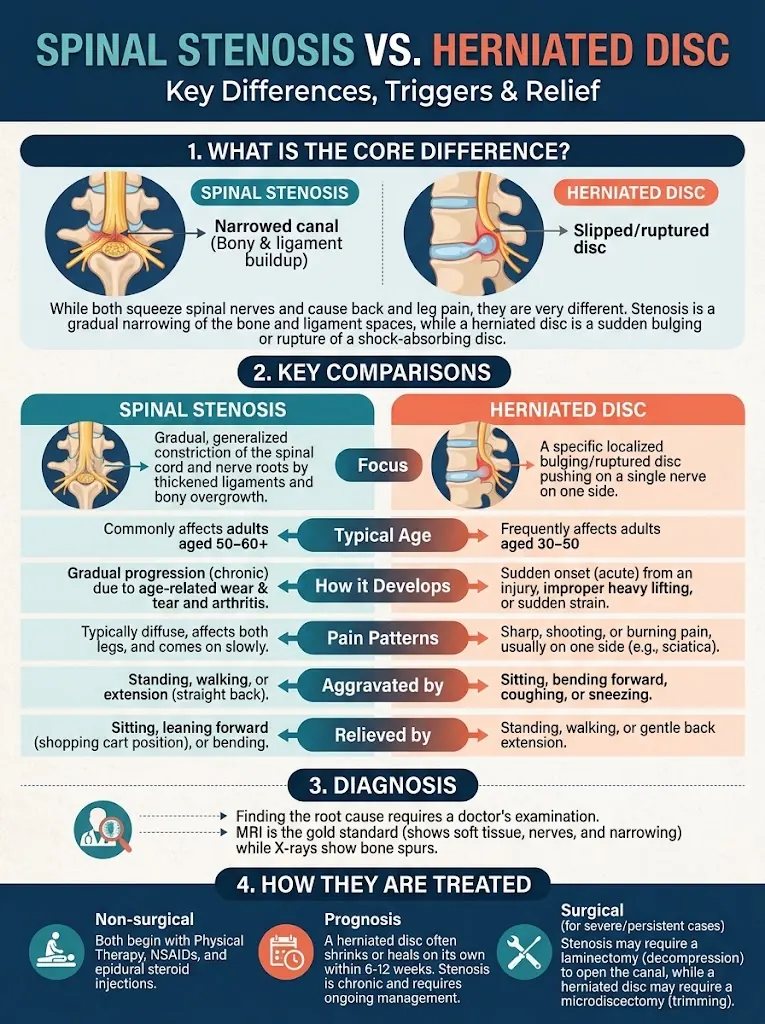
Spinal stenosis is a narrowing of spaces within the spine, while a herniated disc occurs when material from a spinal disc pushes through its outer layer. Either condition can reduce space around nerves, irritate nerve roots, and cause pain or neurological symptoms. They can also occur together.
| Feature | Spinal stenosis | Herniated disc |
|---|---|---|
| What happens | The spinal canal or nerve openings become narrower | Disc material extends through a weakened or damaged outer layer |
| Common contributors | Age-related changes, thickened ligaments, bone spurs, disc degeneration | Disc wear, strain, injury, or age-related changes |
| Typical symptom pattern | Leg pain, heaviness, or numbness during standing or walking; sometimes better when sitting or bending forward | Back pain or radiating leg pain, often aggravated by certain movements |
| Onset | Often develops gradually, but symptoms vary | May begin suddenly or gradually |
| Can both occur? | Yes | Yes |
Spinal stenosis can affect the neck or lower back. When it occurs in the lumbar spine, symptoms may involve the buttocks and legs. A herniated disc can also occur in different spinal regions, but a lumbar herniation may irritate a nerve that travels into the leg.
What Does Spinal Stenosis Feel Like?
Lumbar spinal stenosis commonly causes symptoms that become more noticeable while standing or walking. Some people experience aching, tingling, numbness, or a feeling of weakness in one or both legs. Symptoms may improve when sitting or leaning forward, although this pattern is not present in everyone.
The narrowing may involve the central spinal canal or the openings where individual nerves exit. Learn more about lumbar spinal stenosis symptoms and nonsurgical treatment options.
Neck spinal stenosis can cause neck discomfort, arm symptoms, or signs of spinal cord involvement. New problems with balance, hand coordination, or walking deserve prompt medical assessment because they may indicate pressure on the spinal cord.
What Does a Herniated Disc Feel Like?
A herniated disc may cause localized back pain, but symptoms depend on whether nearby nerves are irritated or compressed. When a lumbar disc affects a nerve root, pain may travel from the buttock down the leg, sometimes reaching the foot.
Possible symptoms include:
- Sharp, burning, or electric-like pain that radiates into an arm or leg.
- Tingling or numbness in a specific area.
- Muscle weakness affecting certain movements.
- Pain that worsens with coughing, sneezing, bending, or prolonged sitting.
Some people have a herniated disc visible on imaging without experiencing symptoms. For a closer look at herniated disc symptoms, treatment, and recovery, it is important to distinguish an imaging finding from the cause of current pain.
What Causes These Spinal Conditions?
Both conditions can be associated with age-related changes in the spine, but their immediate mechanisms differ.
Common causes of spinal stenosis
- Bone spurs associated with arthritis.
- Thickening of spinal ligaments.
- Bulging discs and other degenerative changes.
- Less commonly, structural conditions present from birth or changes following injury or surgery.
Common causes of a herniated disc
- Gradual weakening of disc tissue over time.
- Repeated lifting, bending, or twisting under load.
- A sudden strain or injury.
- Age-related changes that make the disc less flexible.
A herniated disc can contribute to spinal narrowing, so the conditions are not mutually exclusive. Degenerative disc disease symptoms and treatment explains another type of disc-related change that may coexist with these problems.
How Do Doctors Tell Them Apart?
A clinician considers the symptom pattern, medical history, physical examination, and—when appropriate—imaging results. The examination may assess strength, reflexes, sensation, walking, balance, and movements that reproduce symptoms.
| Test or assessment | What it can show | What it cannot establish alone |
|---|---|---|
| Medical history and examination | Symptom distribution, functional changes, possible nerve involvement | The exact structural cause in every case |
| MRI | Discs, spinal canal, nerve openings, and soft tissues | Whether every abnormality is causing symptoms |
| X-ray | Bone alignment and some degenerative changes | Detailed views of discs and nerves |
| CT or other testing | Selected bone details or additional diagnostic information | A complete explanation of symptoms without clinical context |
MRI may be appropriate when symptoms persist, neurological deficits are present, a serious condition is suspected, or imaging would affect treatment decisions. A scan should be interpreted alongside the examination because spinal changes can occur in people who have no pain.
What Treatment Helps Spinal Stenosis or a Herniated Disc?
Treatment depends on symptom severity, the affected spinal region, the underlying cause, and whether nerve or spinal cord function is threatened.
Nonsurgical treatment
When there are no emergency warning signs, treatment may include:
- Activity adjustments: Temporarily reduce movements that consistently aggravate symptoms while maintaining tolerable daily activity.
- Physical therapy: A tailored program may improve strength, mobility, balance, and tolerance for walking or other activities.
- Medication: Certain pain relievers may help, but suitability depends on medical history, other medicines, and potential side effects.
- Selected injections: A clinician may discuss injections for some cases of radiating pain, explaining their potential benefits and limitations.
For lumbar stenosis, some people tolerate cycling or exercises performed in a slightly forward-leaning position better than prolonged upright walking. For a herniated disc, exercises should be selected according to symptom response rather than forcing repeated bending or stretching. Low-impact exercises for people with joint pain may offer general movement ideas, but a spinal rehabilitation plan should be individualized.
When is surgery considered?
Surgery may be considered when symptoms remain substantially limiting despite appropriate nonsurgical care, or when a specific structural problem is causing significant neurological impairment. Procedures differ: stenosis surgery generally aims to create more room for nerves, while disc surgery may remove the portion pressing on a nerve.
Progressive weakness, spinal cord symptoms, or emergency warning signs can change the urgency of evaluation. Surgery is not determined by the MRI report alone.
Warning Signs: When Should You Seek Medical Care?
Arrange medical evaluation for persistent or worsening pain, ongoing numbness, new weakness, reduced walking ability, or symptoms that interfere with normal activities.
Seek emergency care immediately for new loss of bladder or bowel control, difficulty starting urination, numbness around the groin or inner thighs, or rapidly worsening weakness in the legs. These symptoms may indicate serious nerve compression.
If neck symptoms occur with new balance problems, loss of hand coordination, or difficulty walking, seek prompt medical assessment for possible spinal cord involvement.
Frequently Asked Questions
1. Which is worse, spinal stenosis or a herniated disc?
Neither is always worse. The impact depends on the location and degree of nerve involvement, symptom severity, and whether weakness or spinal cord problems develop.
2. Can a herniated disc cause spinal stenosis?
Yes. A herniated or bulging disc can reduce the space available for nearby nerves and contribute to spinal canal or nerve-opening narrowing.
3. Is leg pain when walking a sign of spinal stenosis?
It can be, especially when pain, heaviness, or numbness develops during standing or walking and improves with sitting. Other conditions can cause similar symptoms, so an evaluation may be needed.
4. Can a herniated disc heal without surgery?
Many people improve with nonsurgical treatment, and some herniated disc material can shrink over time. Recovery varies, and persistent or worsening neurological symptoms need medical assessment.
5. Does spinal stenosis always require surgery?
No. Treatment often begins with activity modification, physical therapy, and other nonsurgical options when appropriate. Surgery is considered based on symptoms, function, examination findings, and response to treatment.
6. Can spinal stenosis and a herniated disc occur together?
Yes. Degenerative changes, disc bulging, and herniation can coexist with spinal narrowing. A clinician evaluates which findings best match the symptoms.
7. Is walking good for spinal stenosis?
Walking may help maintain activity, but longer periods can aggravate symptoms for some people. Shorter walks, rest breaks, or other tolerable activities may be more manageable.
8. What is the best sleeping position for a herniated disc?
There is no single best position for everyone. Side sleeping with a pillow between the knees or back sleeping with support beneath the knees may feel more comfortable, depending on the individual.
9. Can an MRI show spinal stenosis or a herniated disc?
MRI can usually show spinal narrowing and disc herniation in detail. However, the findings must be compared with symptoms and examination results to determine their clinical relevance.
10. When should spinal pain be treated as an emergency?
New bladder or bowel dysfunction, numbness around the groin, or rapidly worsening leg weakness requires emergency evaluation. New balance or coordination problems with neck symptoms also warrant prompt medical attention.
Conclusion
Spinal stenosis involves narrowing around the spinal nerves, while a herniated disc involves disc material extending beyond its normal boundary. Both can cause radiating pain, numbness, or weakness, and both may respond to nonsurgical care. A clinical assessment can help identify the cause and guide treatment; worsening weakness or bladder, bowel, or saddle-area symptoms should never be ignored.
Disclaimer: This article is provided for educational and informational purposes only.
This article is for education purpose only and is not a diagnosis or a substitute for medical advice.