
Aching, stiffness, or recurring pain in the lower back or neck can make ordinary activities—sitting at a desk, bending, lifting, driving, or getting out of bed—surprisingly difficult. With degenerative disc disease, symptoms may fluctuate rather than remain constant, and some people have significant disc changes on imaging with little or no pain. If you are trying to understanddegenerative disc disease symptoms, the most important point is that a scan alone cannot tell you how much pain a person should have.
It is also easy to assume that “degeneration” means the spine is rapidly deteriorating or that surgery will eventually be necessary. That is not necessarily the case. Disc degeneration is common with aging, and research has found degenerative findings even in people without back pain. The key is to interpret imaging alongside symptoms, physical findings, age, activity level, and possible nerve involvement.
This guide explains what degenerative disc disease is, what its stages may mean, which symptoms are most important, how clinicians evaluate it, what treatments can help, and when back or leg symptoms need medical attention. It also explains why an MRI report that sounds alarming does not automatically mean that your spine is dangerously damaged.
What is degenerative disc disease?
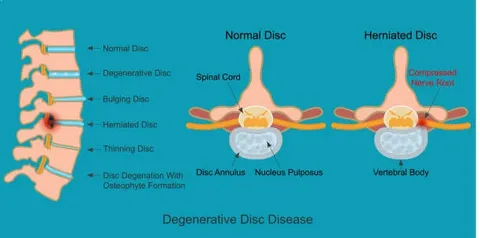
Degenerative disc disease is a term used to describe age- and wear-related changes in the intervertebral discs—the flexible structures between the vertebrae that help the spine absorb and distribute loads.
A disc contains a softer inner portion surrounded by a tougher outer ring. Over time, discs can lose water content, become less flexible, develop small structural changes, and gradually lose height. These changes can alter how forces move through the spine.
Despite its name, degenerative disc disease is not always a progressive “disease” in the conventional sense. Disc degeneration is often part of normal aging, although it can become painful in some people.
A systematic review of 33 studies involving 3,110 people without back pain found that MRI evidence of disc degeneration increased from about37% at age 20 to 96% at age 80. Disc bulging also became more common with age.
| Age | Disc degeneration found on imaging in people without back pain |
| 20 | 37% |
| 30 | More than half |
| 40 | Common |
| 50 | Very common |
| 60 | Nearly 90% |
| 80 | 96% |
These numbers demonstrate why “degenerative” does not automatically mean “damaged and painful.”
What are the symptoms of degenerative disc disease?
Some people have no symptoms. When degeneration is associated with pain, symptoms commonly include:
- Aching or intermittent pain in the lower back or neck
- Pain that becomes worse after prolonged sitting or certain movements
- Stiffness after inactivity
- Reduced tolerance for bending, lifting, or twisting
- Pain that improves or worsens depending on position
- Episodes of pain that come and go
- Muscle tension or guarding around the painful area
If degeneration contributes to narrowing around a spinal nerve, symptoms can extend beyond the spine.
For example, lumbar nerve irritation may cause pain, tingling, numbness, or weakness traveling into the buttock or leg. In that situation, the symptoms may overlap with sciatica causes and treatment options and should be evaluated according to the pattern of symptoms rather than the MRI wording alone.
Can degenerative disc disease cause leg pain?
It can, but leg pain is not caused by disc degeneration alone in every case.
A degenerating disc can contribute to changes in the space available for nearby nerves. A disc bulge or herniation, spinal narrowing, or other structural changes may irritate or compress a nerve.
Leg symptoms deserve particular attention if they are accompanied by numbness, weakness, changes in walking, or progressive symptoms.
What causes degenerative disc disease?
Aging is the major factor, but several influences can affect disc health and symptoms.
Age-related changes
Discs naturally change as people get older. Their water content and elasticity can decrease, and the disc may become less capable of distributing loads as effectively as it did earlier in life.
Repetitive physical loading
Repeated lifting, bending, twisting, vibration, or physically demanding work may increase mechanical stress on the spine. This does not mean that a single movement necessarily “caused” degeneration.
Previous injury
A significant spinal injury can alter the structure or mechanics of a disc and may contribute to later degeneration.
Genetics
Inherited factors appear to influence susceptibility to disc degeneration. Two people with similar lifestyles can therefore have very different imaging findings.
Smoking
Smoking is associated with poorer spinal disc health and may interfere with tissue nutrition and healing. Stopping smoking is therefore relevant to overall spine health, although it cannot reverse established disc changes.
Body weight and conditioning
Higher body weight can increase mechanical demands on the spine, while low physical conditioning may reduce tolerance for everyday loads. Improving general strength, endurance, and activity capacity can be useful even though exercise cannot simply “restore” a worn disc.
What are the stages of degenerative disc disease?
There is no single universally accepted four- or five-stage system that predicts exactly how a person’s symptoms will progress. Clinicians may instead describe disc degeneration according to structural findings and symptom severity.
A simplified way to understand the progression is:
| Pattern | Possible structural changes | What it may mean |
| Early degeneration | Reduced disc hydration or subtle structural changes | May cause no symptoms |
| Moderate degeneration | More disc height loss, fissuring, or bulging | May be associated with recurrent pain |
| Advanced degeneration | Greater height loss and altered spinal mechanics | May contribute to persistent symptoms |
| Degeneration with nerve involvement | Narrowing around a nerve or additional disc pathology | May cause radiating pain, numbness, or weakness |
Importantly, these categories are not a personal prognosis. A person with substantial MRI changes may function well, while someone with relatively modest findings can have significant pain.
Research supports this distinction. In adults 50 or younger, a meta-analysis found that several degenerative MRI findings were more common in people with low back pain than in asymptomatic individuals, but the researchers cautioned that an association doesnot prove that the imaging finding is the direct source of pain.
How is degenerative disc disease diagnosed?
Diagnosis usually begins with a medical history and physical examination.
A clinician may ask:
- Where exactly is the pain?
- Does it travel into an arm, buttock, or leg?
- What movements aggravate or relieve it?
- How long has it been present?
- Has there been an injury?
- Is there numbness or weakness?
- Are bowel or bladder symptoms present?
- Has the pain changed recently?
The examination may include testing strength, sensation, reflexes, walking, spinal movement, and other findings relevant to the suspected cause.
Do you need an MRI?
Not necessarily.
MRI can show disc dehydration, loss of disc height, bulging, protrusion, nerve compression, and other structural findings. But routine imaging is generally not recommended for uncomplicated low back pain when there are no features suggesting a serious underlying condition. NICE guidance recommends considering imaging in specialist settings when the result is likely to change management.
This approach matters because incidental abnormalities are common. An MRI report can therefore provide useful anatomical information without identifying the sole cause of pain.
What is the treatment for degenerative disc disease?
Treatment depends on symptoms, functional limitations, neurological findings, and the specific spinal problem involved.
1. Stay physically active
For many people, prolonged bed rest is not helpful. Gradually maintaining normal activities and building movement tolerance are generally preferred over avoiding all activity.
This does not mean pushing through severe or worsening symptoms. Activity should be modified when a particular movement consistently aggravates symptoms.
2. Exercise and physical therapy
A physical therapist may develop a program targeting:
- Core and trunk endurance
- Hip and lower-extremity strength
- Spinal movement tolerance
- Aerobic conditioning
- Posture and movement strategies
- Gradual return to work, exercise, or sport
Exercise does not reverse disc degeneration, but it can improve strength, physical capacity, and function. Clinical guidance supports exercise-based management for many people with low back pain.
If your symptoms are more general rather than clearly disc-related, understanding what are the causes of knee pain or other joint-specific problems can also help distinguish spinal symptoms from unrelated musculoskeletal pain.
3. Medication
Depending on your health history, clinicians may consider anti-inflammatory medicines for short-term symptom management. These medications are not appropriate for everyone and can carry gastrointestinal, kidney, cardiovascular, or other risks.
Guidelines recommend considering individual risk factors and using the lowest effective dose for the shortest appropriate duration when NSAIDs are used for low back pain.
Do not assume that stronger medication is necessarily better treatment. Chronic opioid use, for example, is generally not an appropriate routine solution for chronic low back pain.
4. Heat, activity modification, and daily strategies
Some people find temporary relief from heat, changing positions, pacing activities, or modifying lifting techniques.
Practical approaches such as daily habits to reduce back pain may be particularly useful when symptoms are aggravated by prolonged sitting, poor activity tolerance, or repetitive loading.
5. Injections or surgery
Invasive treatment is not automatically required because an MRI shows degeneration.
Surgery is generally considered only in selected situations, such as persistent disabling symptoms associated with a specific structural problem after appropriate nonsurgical treatment, or significant neurological compromise.
When symptoms involve nerve compression, treatment decisions may differ from those for isolated axial back pain.
What should you avoid with degenerative disc disease?
Avoiding all movement is usually unnecessary. Instead, consider temporarily reducing activities that repeatedly produce substantial pain or neurological symptoms.
Examples may include:
- Heavy lifting during a severe flare
- Repetitive bending and twisting when they clearly aggravate symptoms
- Sudden increases in exercise volume
- Prolonged inactivity or bed rest
- Returning immediately to high-impact activity after a painful flare
If you have symptoms that extend into the leg, understanding slipped disc or herniated disc symptoms can help clarify why disc-related nerve irritation may feel different from localized back pain.
When should you see a doctor?
Make a routine medical appointment if back or neck pain:
- Persists or repeatedly returns
- Interferes with work, sleep, exercise, or daily activities
- Is gradually worsening
- Is accompanied by persistent numbness or tingling
- Produces weakness
- Travels into an arm or leg
- Follows a significant injury
- Is difficult to control with reasonable self-care
A clinician may also evaluate other possible causes rather than assuming that disc degeneration explains every symptom.
Warning signs requiring urgent or emergency evaluation
Seek urgent medical attention for new or rapidly worsening neurological symptoms, particularly:
- Significant or progressive leg weakness
- New difficulty walking
- Numbness around the groin, genital, or inner-thigh region
- New loss of bladder or bowel control
- Severe back pain following major trauma
- Back pain accompanied by concerning systemic symptoms such as fever or significant unexplained illness
These symptoms can indicate conditions requiring prompt assessment rather than routine management of age-related disc changes. Serious causes such as infection, cancer, inflammatory disease, or significant neurological compression need to be considered when appropriate.
Frequently Asked Questions
1. Is degenerative disc disease the same as arthritis?
No. Degenerative disc disease primarily describes changes involving the intervertebral discs. Arthritis can involve other spinal structures, including the facet joints, although these conditions can occur together.
2. Can degenerative disc disease heal itself?
A degenerated disc generally does not return completely to its previous structure. However, symptoms can improve substantially even when imaging remains abnormal because pain and function do not always track perfectly with structural changes.
3. Does degenerative disc disease always get worse with age?
Disc changes commonly accumulate with age, but symptoms do not necessarily worsen continuously. Some people experience periods of pain followed by long periods of good function.
4. Can exercise make degenerative disc disease worse?
Certain exercises can aggravate symptoms if they are too intense, poorly progressed, or inappropriate for the individual’s condition. Properly selected exercise is commonly used to improve strength and function rather than avoided altogether.
5. Is walking good for degenerative disc disease?
Walking is often a reasonable low-impact activity for people who tolerate it. Start at a manageable level and increase gradually rather than forcing a specific distance despite worsening symptoms.
6. Can degenerative disc disease cause sciatica?
It can contribute to conditions that irritate or compress a spinal nerve, which may produce sciatica-like symptoms. However, not every person with disc degeneration has nerve compression or sciatica.
7. Does a bad MRI mean I need surgery?
No. MRI abnormalities are common, including in people without pain. Surgical decisions depend on the combination of symptoms, examination findings, functional limitations, neurological status, imaging, and response to appropriate nonsurgical care.
8. Can poor posture cause degenerative disc disease?
Posture can influence how forces are distributed through the spine and may affect symptoms, but it is too simplistic to say that poor posture alone causes disc degeneration. Genetics, aging, injury, loading, and other factors also contribute.
9. How long does a degenerative disc disease flare last?
There is no single recovery timeline. Symptoms may settle over days or weeks, while recurrent or persistent pain can require a longer rehabilitation approach. The duration depends on the underlying pain mechanism and whether nerve involvement or another condition is present.
10. When is degenerative disc disease serious?
Degenerative disc findings by themselves are often not an emergency. The situation becomes more concerning when symptoms include progressive weakness, significant neurological changes, bladder or bowel dysfunction, saddle-area numbness, major trauma, or systemic warning signs requiring prompt medical evaluation.
Conclusion
Degenerative disc disease describes common structural changes in the spinal discs, particularly with aging, but an abnormal scan does not automatically explain pain or predict disability. The most useful approach is to match imaging with symptoms and physical findings while focusing on maintaining appropriate activity, improving strength and function, and addressing specific causes of nerve irritation when present.
If symptoms persist, worsen, or interfere substantially with daily life, a clinician can determine whether further evaluation or targeted treatment is appropriate. Urgent neurological or systemic warning signs should not be attributed to ordinary disc degeneration without medical assessment.
Disclaimer: This article is provided for educational and informational purposes only. It is not a substitute for professional medical advice
This article is for education purpose only and is not a diagnosis or a substitute for medical advice.