
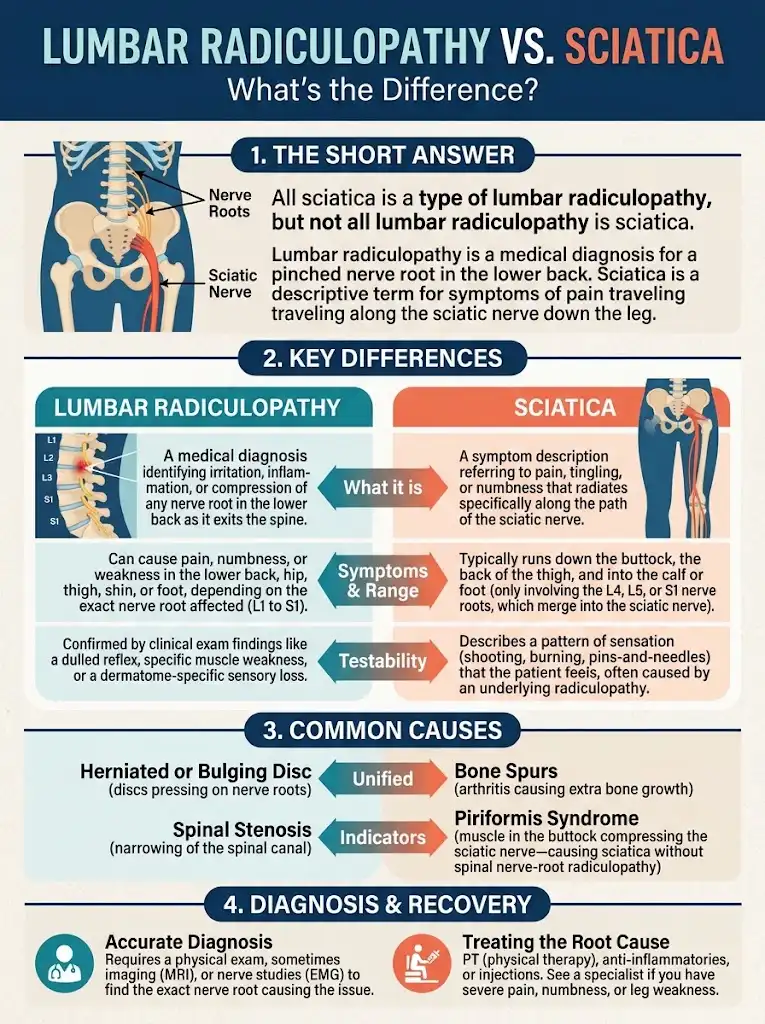
Lumbar radiculopathy and sciatica are closely related terms used to describe nerve-related pain in the lower back, buttocks, and legs. You might feel a sharp, burning, or electric-like sensation traveling down one leg, or experience tingling, numbness, or weakness that makes walking, sitting, or sleeping uncomfortable. Understanding what these symptoms mean can help you decide what to do next.
Although people often use lumbar radiculopathy and sciatica interchangeably, they are not exactly the same. Sciatica describes a pattern of symptoms along the sciatic nerve, while lumbar radiculopathy refers to dysfunction of a nerve root in the lower spine. The two can occur together, but their causes and symptoms vary.
This guide explains the differences between lumbar radiculopathy and sciatica, common causes, how clinicians evaluate these conditions, treatment options, recovery expectations, and warning signs that need medical attention.
What Is the Difference Between Lumbar Radiculopathy and Sciatica?
The main difference is that lumbar radiculopathy describes a nerve-root problem, while sciatica describes pain that travels along the sciatic nerve pathway. Lumbar radiculopathy may cause radiating pain, sensory changes, or muscle weakness. Sciatica usually refers to pain extending from the lower back or buttock down the back or side of the leg.
| Feature | Lumbar radiculopathy | Sciatica |
|---|---|---|
| Meaning | Dysfunction or irritation of a lumbar nerve root | Pain following the sciatic nerve pathway |
| Typical symptoms | Radiating pain, tingling, numbness, possible weakness | Shooting, burning, or electric pain down the leg |
| Common causes | Herniated disc, spinal narrowing, bone spurs | Often nerve-root irritation from a disc problem or spinal narrowing |
| Weakness | May occur, depending on the affected nerve | Can occur, but is not present in every case |
| Relationship | Can cause sciatica-like symptoms | May result from lumbar radiculopathy |
The terms overlap because lumbar nerve roots contribute to the sciatic nerve. However, not every case of leg pain is sciatica, and not every person with lumbar radiculopathy experiences the same symptoms.
What Does Lumbar Radiculopathy or Sciatica Feel Like?
Symptoms depend on which nerve is affected and how severely it is irritated or compressed. Common experiences include:
- Sharp, shooting, burning, or electric-like pain from the lower back or buttock into the leg.
- Tingling or numbness in part of the thigh, calf, foot, or toes.
- Pain that worsens with prolonged sitting, coughing, sneezing, or certain movements.
- Muscle weakness, difficulty lifting the front of the foot, or trouble pushing off while walking.
Some people have leg pain without significant back pain. Others experience mostly numbness or weakness rather than intense pain. The location of symptoms can help a clinician identify the affected nerve, but symptoms alone cannot confirm the cause.
If you are trying to understand what sciatica symptoms feel like and what causes them, pay attention to where the pain travels and whether sensation or strength changes.
What Causes Lumbar Radiculopathy and Sciatica?
Both conditions may occur when a lumbar nerve root becomes irritated, inflamed, or compressed. Common causes include:
- Herniated disc: Disc material presses against or irritates a nearby nerve root.
- Spinal stenosis: Narrowing of the spinal canal or nerve passageways puts pressure on nerves.
- Degenerative changes: Age-related changes in discs and joints may contribute to narrowing or nerve irritation.
- Bone spurs: Extra bone growth can reduce space around a nerve.
- Injury: Certain injuries may affect spinal structures and nearby nerves.
A herniated disc in the lower back is one possible cause, but imaging findings do not always explain a person’s symptoms. Lumbar spinal stenosis may cause leg discomfort or heaviness that worsens during standing and walking and improves when sitting or bending forward. Learn more about lumbar spinal stenosis symptoms and nonsurgical treatment.
How Do Doctors Diagnose Lumbar Radiculopathy vs. Sciatica?
Diagnosis starts with a medical history and physical examination. A clinician may ask where the pain travels, when it began, which movements aggravate it, and whether you have noticed weakness, numbness, or changes in walking.
The examination may include checking muscle strength, reflexes, sensation, walking, and leg movements that reproduce symptoms. These findings help distinguish nerve-root involvement from other causes of leg pain, including hip conditions and peripheral nerve problems.
| Evaluation | What it can help identify | Important limitation |
|---|---|---|
| Medical history and physical examination | Symptom patterns, weakness, sensory changes | Cannot always identify the precise structural cause |
| MRI | Disc herniation, nerve compression, spinal narrowing | Abnormal findings may exist without causing symptoms |
| X-ray | Bone alignment and some degenerative changes | Does not show nerve roots or discs in detail |
| Electromyography and nerve-conduction testing | Evidence of nerve dysfunction and help distinguishing some nerve disorders | Not necessary for everyone and may not detect every problem |
MRI is generally considered when symptoms are severe or persistent, when a serious cause is suspected, or when results could change treatment decisions. A clinician may recommend other tests depending on the examination and suspected diagnosis.
What Treatment Helps Lumbar Radiculopathy and Sciatica?
Treatment depends on the cause, symptom severity, duration, and presence of neurological changes. Many people improve with nonsurgical care, although recovery time varies.
Home care and activity adjustments
For mild symptoms without warning signs, practical measures may include:
- Staying gently active instead of spending prolonged periods in bed.
- Taking short walks and changing positions regularly as tolerated.
- Temporarily reducing heavy lifting, repeated bending, and movements that clearly worsen leg pain.
- Applying heat or cold, whichever feels more comfortable, with a protective layer to prevent skin injury.
If you need guidance on how to manage back pain with daily habits and home remedies, focus on tolerable movement and gradual return to normal activities rather than forcing painful exercises.
Physical therapy and medication
Physical therapy may help improve movement, strength, and activity tolerance. Exercises should be tailored to symptoms; stop and seek advice if an exercise causes increasing weakness, spreading numbness, or substantially worsening leg pain. General low-impact exercises for people with joint pain may be easier to tolerate, but they are not a substitute for an individualized rehabilitation plan.
Over-the-counter pain medicines may help some people, but they are not appropriate for everyone. Anti-inflammatory medicines can cause stomach bleeding, kidney problems, and cardiovascular risks, and may interact with other medications. Ask a clinician or pharmacist which options are safe for you.
When are injections or surgery considered?
A clinician may discuss an injection or surgical evaluation when pain remains disabling despite appropriate conservative treatment, or when examination and imaging show a problem that matches the symptoms. Surgery may be more urgent when significant or progressive neurological deficits occur. The choice depends on the underlying cause rather than whether the symptoms are labeled sciatica or radiculopathy.
How Long Does Recovery Take?
Recovery varies with the cause, severity, and whether nerve function is affected. Some episodes improve over several days to weeks, while persistent nerve compression may take longer and require additional treatment. Pain relief does not always mean that strength and sensation have fully recovered.
| Recovery pattern | What it may mean | Sensible next step |
|---|---|---|
| Symptoms gradually improve | Irritation may be settling | Continue comfortable activity and monitor changes |
| Symptoms persist or repeatedly return | The cause may need further evaluation | Arrange a clinical assessment |
| Weakness or numbness worsens | Nerve function may be deteriorating | Seek prompt medical evaluation |
| New bladder, bowel, or saddle-area symptoms develop | Possible serious nerve compression | Seek emergency care |
Warning Signs: When Should You Seek Medical Care?
Symptoms that may be monitored briefly
Mild, improving radiating pain without weakness, significant numbness, or other warning signs may be monitored while maintaining gentle activity. Arrange an appointment if symptoms do not improve, interfere with daily life, or keep returning.
Symptoms needing medical evaluation
Seek prompt medical advice for persistent numbness, new or worsening weakness, difficulty walking, severe pain, fever with back pain, or unexplained weight loss. A history of cancer, significant trauma, immune suppression, or recent serious infection may also change how urgently symptoms should be assessed.
Symptoms requiring emergency care
Go to an emergency department if you develop new difficulty starting or controlling urination, loss of bowel control, numbness around the groin or inner thighs, or rapidly worsening weakness in one or both legs. These can be signs of cauda equina syndrome or another serious condition requiring urgent assessment.
Frequently Asked Questions
1. Is lumbar radiculopathy more serious than sciatica?
Neither term automatically means a condition is more serious. Severity depends on the cause, pain level, and whether nerve function is affected.
2. Can you have lumbar radiculopathy without back pain?
Yes. Nerve-root irritation may cause symptoms mainly in the buttock or leg, sometimes with little or no lower-back pain.
3. Does sciatica always mean a herniated disc?
No. A herniated disc is a common cause, but spinal stenosis and other conditions can also irritate nerves and produce sciatic symptoms.
4. Can lumbar radiculopathy heal on its own?
Symptoms may improve without surgery, particularly when irritation settles and function is preserved. Persistent or worsening symptoms need medical evaluation.
5. Is walking good for sciatica?
Gentle walking may help maintain mobility if it does not significantly worsen symptoms. Shorter walks with breaks may be more comfortable than prolonged activity.
6. Should I stretch when my sciatic nerve hurts?
Some movements may help, but others can aggravate radiating pain. Avoid forcing stretches that increase leg symptoms, numbness, or weakness.
7. Can sitting make sciatica worse?
Yes. Prolonged sitting can aggravate symptoms for some people, particularly when a disc problem is involved. Changing positions regularly may help.
8. Does an MRI always show the cause of sciatica?
No. MRI can identify structural changes, but some findings occur in people without symptoms. Results need to be interpreted alongside the history and physical examination.
9. When does lumbar radiculopathy require surgery?
Surgery may be considered when symptoms remain disabling despite nonsurgical treatment or when a specific compressive problem matches the clinical findings. Progressive weakness or emergency warning signs require more urgent assessment.
10. Can sciatica cause permanent nerve damage?
Severe or prolonged nerve compression can sometimes cause lasting weakness or sensory changes, but this does not happen in every case. New or progressive neurological symptoms should be assessed promptly.
Conclusion
Lumbar radiculopathy describes a problem involving a nerve root in the lower spine, while sciatica describes a pattern of pain traveling along the sciatic nerve pathway. The conditions often overlap, but symptoms alone cannot establish the cause. Stay gently active when safe, seek medical guidance for persistent symptoms, and treat new weakness or bladder, bowel, or saddle-area changes as urgent warning signs.
Disclaimer: This article is provided for educational and informational purposes only.
This article is for education purpose only and is not a diagnosis or a substitute for medical advice.