
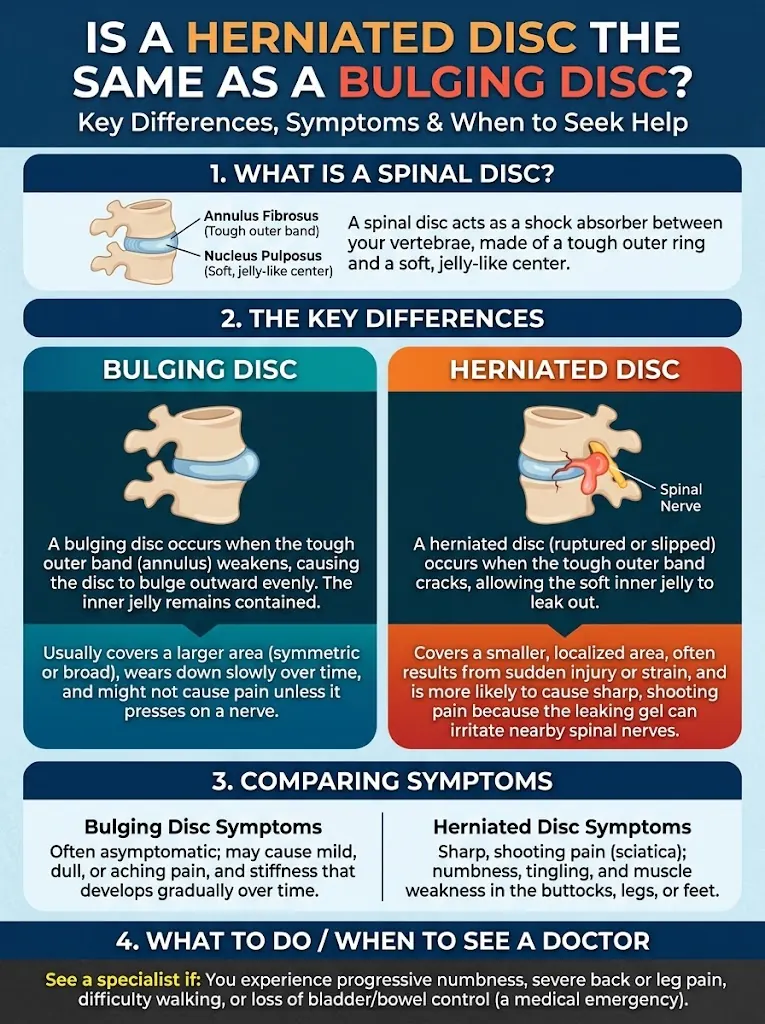
If you have back or neck pain and an MRI report mentions a bulging disc or herniated disc, you may wonder whether these terms describe the same problem. Both involve changes to the cushioning discs between the bones of your spine, and either finding can appear alongside pain, stiffness, or nerve-related symptoms.
However, a bulging disc and a herniated disc are not exactly the same. They describe different patterns of disc changes, and neither diagnosis automatically means you have a serious injury. Some people have these findings without noticeable symptoms, while others experience pain or weakness depending on whether nearby nerves are affected.
Understanding the difference between a herniated disc and a bulging disc can help you interpret imaging results, recognize symptoms that need medical attention, and understand which treatments may help. Here is how the conditions compare, how they are diagnosed, and what recovery may involve.
What Is the Difference Between a Bulging Disc and a Herniated Disc?
A bulging disc extends beyond its usual boundary over a broader area, while a herniated disc involves a more localized displacement of disc material. Both can occur in the neck or lower back.
Spinal discs contain a soft inner portion surrounded by a tougher outer layer. Age-related changes, repeated loading, and injury can affect their shape and structure. A bulge does not necessarily progress into a herniation, and the terms should not be treated as interchangeable.
| Feature | Bulging disc | Herniated disc |
|---|---|---|
| What happens | Disc extends outward over a broad area | Disc material moves outward through a more localized area |
| Outer disc layer | May remain intact, although disc structure can change | May stretch, crack, or tear |
| Nerve irritation | Possible | Possible, particularly if nearby nerve roots are compressed or irritated |
| Symptoms | May cause no symptoms or contribute to pain | May cause no symptoms or produce back pain and radiating nerve pain |
| Treatment | Often starts with conservative care when appropriate | Often starts with conservative care; some cases need additional treatment |
The appearance on an MRI is only one part of the assessment. The location of the disc change, the person’s symptoms, physical examination, and signs of nerve involvement all help determine whether the finding is clinically important.
What Symptoms Can Each Condition Cause?
Both conditions can be painless or cause similar symptoms. The symptoms depend more on the affected spinal level and whether nearby nerves are irritated than on the label alone.
Possible symptoms include:
- Localized neck or lower back pain
- Pain that travels into an arm or leg
- Tingling or numbness
- Muscle weakness
- Pain that worsens with certain movements, coughing, or straining
A lower-back disc problem may contribute to sciatica symptoms and causes, including pain that travels down the buttock and leg. When a disc affects nerves in the neck, symptoms may extend into the shoulder, arm, or hand.
Other spinal conditions can cause similar symptoms. For example, degenerative disc disease symptoms and treatment involve changes in disc structure over time and may coexist with bulging or herniation.
Why Do Bulging and Herniated Discs Develop?
Disc changes can develop gradually or become noticeable after an injury. Common contributing factors include aging, repetitive lifting, prolonged loading, smoking, and previous spinal injuries. Sometimes, no single cause can be identified.
A bulging disc does not always mean the spine is damaged in a way that requires treatment. Likewise, a herniated disc does not automatically require surgery. Imaging findings need to be interpreted alongside symptoms rather than treated as a diagnosis in isolation.
How Are Bulging and Herniated Discs Diagnosed?
Clinicians usually begin by reviewing symptoms, medical history, and movement, strength, sensation, and reflexes. MRI can show spinal discs and nearby nerves in detail, while X-rays primarily show bones and alignment rather than the disc itself.
Imaging may be recommended when symptoms are severe, persistent, or accompanied by concerning neurological findings, or when results would change treatment. A scan is not always necessary for uncomplicated back pain.
A report describing a disc abnormality does not prove that it is causing your symptoms. This is especially important because disc changes can occur in people who feel well.
What Treatment Helps a Bulging or Herniated Disc?
Treatment depends on symptom severity, functional limitations, and whether nerves are affected. Many people begin with nonsurgical care.
Conservative treatment
- Stay gently active: Adjust painful activities, but avoid prolonged bed rest when possible.
- Use appropriate pain relief: Ask a clinician or pharmacist which medicines are safe for you, particularly if you have other medical conditions or take other medications.
- Consider physical therapy: A tailored program may improve mobility, strength, and tolerance for everyday activities.
- Modify aggravating movements: Temporarily adjust heavy lifting or repeated bending if these worsen symptoms.
For persistent symptoms, a clinician may discuss other options, including selected injections or specialist referral. Surgery may be considered when significant nerve compression causes progressive weakness or when disabling symptoms do not improve with appropriate nonsurgical treatment.
If symptoms involve narrowing of the spinal canal, lumbar spinal stenosis causes and treatment may help explain how that separate condition can affect nerves and walking.
How Long Does Recovery Take?
Recovery varies according to the cause of symptoms, the amount of nerve irritation, overall health, and treatment. Some episodes improve over several weeks, while persistent nerve symptoms may take longer. MRI changes may remain even after pain improves.
| Recovery factor | What it may mean |
|---|---|
| Mild pain without weakness | Often managed initially with activity modification and conservative care |
| Radiating pain or tingling | May take longer to settle and may require clinical monitoring |
| Persistent or worsening weakness | Needs prompt medical assessment |
| Ongoing symptoms affecting daily life | May warrant reassessment and a more targeted treatment plan |
Progress should be judged by pain, strength, sensation, and daily function—not by assuming the disc must look normal on a follow-up scan.
When Should You Seek Medical Attention?
Arrange a medical assessment if back or neck pain persists, radiating pain worsens, or you develop new numbness or weakness.
Seek emergency care for new loss of bladder or bowel control, difficulty passing urine, numbness around the groin or saddle area, or rapidly worsening weakness—particularly when symptoms occur with back pain. These can indicate serious nerve compression requiring urgent treatment.
Frequently Asked Questions
1. Which is worse, a bulging disc or a herniated disc?
Neither is automatically worse. The seriousness depends on symptoms, nerve involvement, and how much the condition affects function.
2. Can a bulging disc turn into a herniated disc?
Disc changes can evolve over time, but a bulging disc does not inevitably become herniated. The two terms describe different patterns of disc displacement.
3. Can you have a bulging disc without pain?
Yes. Bulging discs can appear on imaging in people who have no symptoms. Treatment is generally guided by clinical findings rather than the scan alone.
4. Does a herniated disc always cause sciatica?
No. A herniated disc causes sciatica only when it affects nerves associated with the symptoms. Some herniations cause localized pain or no symptoms at all.
5. Can a herniated disc heal without surgery?
Many people improve without surgery as inflammation settles and symptoms change over time. The disc may not return completely to its original shape, even when symptoms improve.
6. Is walking good for a bulging disc?
Gentle walking may help maintain activity if it does not significantly worsen symptoms. Start at a comfortable pace and adjust the duration according to your response.
7. Can exercise make a herniated disc worse?
Some movements can aggravate symptoms, especially if they increase radiating pain or neurological symptoms. A physical therapist can help identify appropriate exercises and progress them safely.
8. Will an X-ray show a herniated disc?
An ordinary X-ray cannot directly show a herniated disc because it primarily displays bones. MRI is generally more useful when detailed assessment of discs and nerves is needed.
9. When is surgery necessary for a herniated disc?
Surgery may be considered for serious or progressive neurological problems or persistent, disabling symptoms that have not improved with appropriate nonsurgical treatment. The decision depends on examination findings, imaging, and individual circumstances.
10. Can a bulging or herniated disc cause permanent nerve damage?
Severe or prolonged nerve compression can sometimes cause lasting problems, but this is not the usual outcome for every disc abnormality. New or progressive weakness and changes in bladder or bowel function require urgent assessment.
Conclusion
A bulging disc and a herniated disc describe different forms of disc displacement, but either can occur with or without symptoms. Treatment should focus on your symptoms, physical examination, and nerve function rather than MRI terminology alone. Stay appropriately active, seek guidance if symptoms persist, and get urgent care for signs of serious nerve compression.
Disclaimer: This article is provided for educational and informational purposes only.
This article is for education purpose only and is not a diagnosis or a substitute for medical advice.