
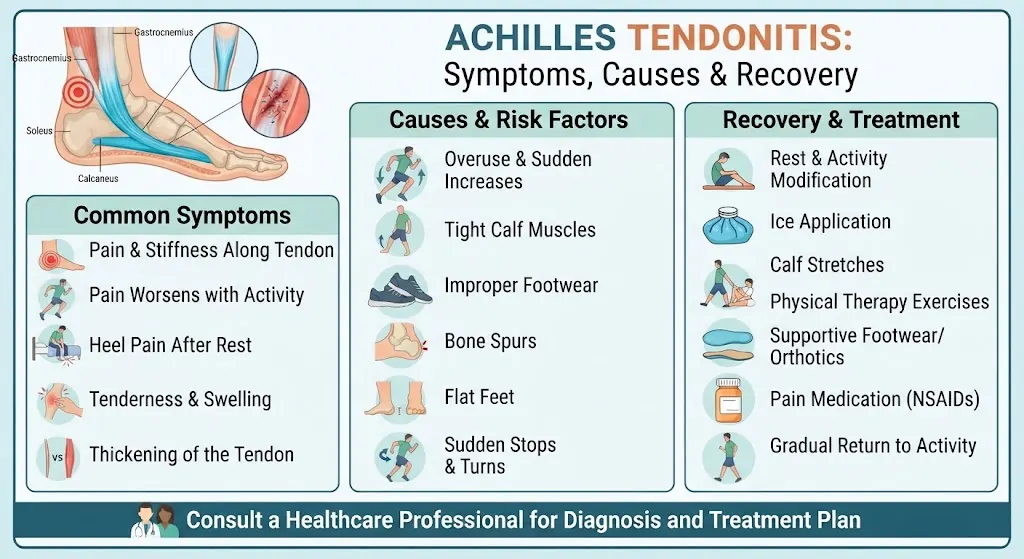
Achilles tendonitis can cause pain, stiffness, or tenderness at the back of your ankle, just above your heel. You may notice discomfort when taking your first steps in the morning, climbing stairs, walking uphill, or starting a workout. For runners and active adults, the pain can make exercise difficult and sometimes affect ordinary activities such as walking or standing.
Achilles tendon pain does not always mean tendonitis. Similar symptoms can occur with other tendon problems or an Achilles tendon tear, which may need urgent treatment. The location of the pain, how it started, and whether you can push off your foot normally can help determine the next step.
Achilles tendonitis is commonly used to describe irritation or overload of the Achilles tendon, the strong band connecting your calf muscles to your heel bone. This guide explains the symptoms, causes, treatment options, recovery timeline, and warning signs that should not be ignored.
What Are the Symptoms of Achilles Tendonitis?
Common symptoms include pain and stiffness along the tendon, tenderness when touching the area, and discomfort during activities that load the calf muscles. Symptoms may ease after gentle movement but return during or after exercise.
| Symptom | How it may feel |
|---|---|
| Morning stiffness | Tightness around the tendon after resting |
| Pain during activity | Discomfort while running, jumping, or climbing stairs |
| Local tenderness | Pain when pressing the tendon |
| Thickening or swelling | A visibly enlarged or swollen area around the tendon |
Pain near the heel can also come from other causes of heel pain when walking. Pain underneath the heel, for example, may be more consistent with plantar fasciitis symptoms and causes, although symptoms can overlap.
What Causes Achilles Tendonitis?
Achilles tendon symptoms often develop when the tendon is exposed to more repetitive loading than it can currently tolerate. Common triggers include suddenly increasing running distance, adding hill workouts or sprinting, jumping more frequently, or returning to exercise after a break.
Other contributing factors may include tight calf muscles, limited ankle movement, footwear changes, and previous tendon problems. People with flat feet and altered foot mechanics may experience different loading patterns, although foot shape alone does not determine whether someone will develop tendon pain.
Some medicines, including fluoroquinolone antibiotics and corticosteroids, have been associated with tendon injury in certain circumstances. Do not stop a prescribed medicine without medical advice; ask your clinician or pharmacist about your individual risks.
How Is Achilles Tendonitis Diagnosed?
A healthcare professional typically asks when the pain began, what activities worsen it, and whether there was a sudden injury. The examination may include checking tenderness, swelling, ankle movement, calf strength, and the ability to push off while walking.
Imaging is not always necessary. Ultrasound or MRI may be considered if the diagnosis is unclear, symptoms are not improving, or a partial or complete tendon tear is suspected.
What Is the Best Treatment for Achilles Tendonitis?
Treatment depends on symptom severity and whether the tendon has been irritated gradually or injured suddenly. Many cases improve with adjusted activity and a structured rehabilitation plan.
| Treatment | Potential benefit | Important caution |
|---|---|---|
| Relative rest | Reduces aggravating tendon loads | Avoid complete inactivity unless advised |
| Supportive footwear | May make walking more comfortable | Avoid sudden footwear changes that worsen pain |
| Progressive strengthening | Builds tendon and calf capacity | Increase resistance gradually |
| Physical therapy | Helps tailor rehabilitation | Exercises should match the injury and symptoms |
| Pain relief | May temporarily reduce discomfort | Medicines have individual risks and do not repair the tendon |
Temporarily reduce running, jumping, and uphill activity if they aggravate symptoms. You may be able to maintain fitness with comfortable alternatives such as swimming or cycling. See these low-impact exercises for people with joint pain for general activity ideas, but stop any movement that increases tendon pain.
Rehabilitation often includes progressive calf strengthening, sometimes using slow heel raises. However, heel drops off a step can aggravate pain near the heel insertion and are not appropriate for everyone. A physical therapist can help select the correct exercise and range of movement. Learn how physical therapy compares with chiropractic care when considering professional support.
How Long Does Achilles Tendonitis Take to Heal?
Recovery varies. Mild symptoms may improve over several weeks, while persistent tendon problems can take months of consistent rehabilitation. The timeline depends on symptom duration, tendon involvement, activity demands, and how gradually loading is reintroduced.
| Recovery stage | General approach |
|---|---|
| Early painful stage | Reduce aggravating activity and maintain comfortable movement |
| Improving symptoms | Begin or progress appropriate strengthening |
| Return to sport | Increase speed, distance, and jumping gradually |
| Persistent symptoms | Seek reassessment and review the rehabilitation plan |
For more context, read about how long tendonitis can last. Do not return to full-intensity sport simply because pain has eased; strength and tolerance for activity matter too.
When Should You Seek Medical Care?
Arrange a routine appointment if pain keeps returning, affects walking, or does not improve with sensible activity changes. Persistent symptoms may need a more specific rehabilitation plan or investigation for another condition.
Seek urgent medical assessment if you feel a sudden pop or snap in the back of your ankle, develop sudden severe pain or swelling, or cannot push off the foot or stand on tiptoe. These symptoms may indicate an Achilles tendon rupture. Seek prompt care after a significant injury or if the area becomes red and hot with fever.
Frequently Asked Questions
1. Can I walk with Achilles tendonitis?
Walking may be possible if discomfort remains mild and does not worsen afterward. Reduce distance and pace if you limp or experience increasing pain.
2. Should I keep running with Achilles tendonitis?
Avoid running that worsens symptoms, particularly sprinting and hills. Return gradually when walking and rehabilitation exercises are comfortable and your clinician agrees.
3. Is Achilles tendonitis worse in the morning?
Morning stiffness is common because the tendon has been relatively inactive during sleep. Persistent or worsening pain still deserves attention.
4. Should I use ice or heat?
Ice wrapped in a cloth may temporarily relieve soreness after activity. Gentle warmth may feel helpful for stiffness, but neither treatment addresses the underlying tendon-loading problem.
5. Do heel lifts help Achilles tendonitis?
Heel lifts may reduce tendon strain for some people temporarily. Their suitability depends on the location and cause of symptoms, so seek professional guidance if pain persists.
6. Can Achilles tendonitis heal without surgery?
Many cases improve with activity modification and progressive rehabilitation. Surgery is generally considered only for selected cases that do not respond to appropriate nonsurgical treatment or involve a significant tendon injury.
7. Are calf stretches recommended?
They can help some people, but aggressive stretching may aggravate pain where the tendon attaches to the heel. The safest approach depends on the location of symptoms.
8. Can Achilles tendonitis come back?
Yes. Symptoms may recur when training volume increases too quickly or the tendon has not regained enough strength and capacity. Gradual progression can help reduce the risk.
9. Does Achilles tendonitis always cause swelling?
No. Some people experience pain and stiffness without obvious swelling. A lack of swelling does not rule out a tendon problem.
10. When is Achilles tendon pain an emergency?
Sudden severe pain, a popping sensation, or difficulty pushing off the foot may indicate a tendon rupture and requires urgent assessment. Do not attempt strenuous exercise to test the tendon.
Conclusion
Achilles tendonitis commonly causes pain and stiffness behind the ankle, often after an increase in physical activity. Adjust aggravating activities, use a gradual rehabilitation plan, and seek assessment when symptoms persist. Sudden severe pain or loss of push-off strength requires urgent medical attention.
Disclaimer: This article is provided for educational and informational purposes only.
This article is for education purpose only and is not a diagnosis or a substitute for medical advice.