
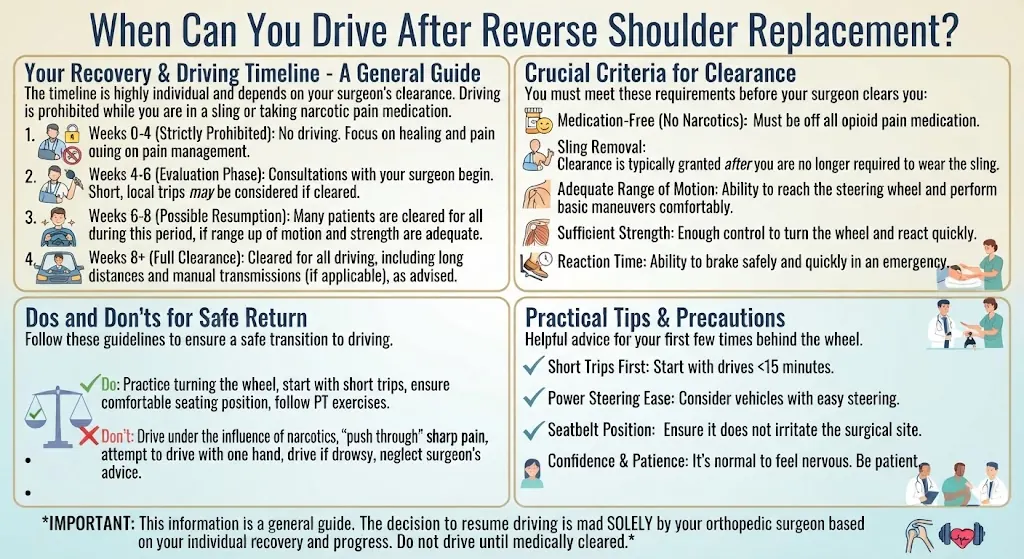
After reverse shoulder replacement, many people need about 4–6 weeks or longer before they can consider driving, but the timing varies with healing, pain, arm control, medication use, and the surgeon’s restrictions. This is a general estimate, not a guaranteed recovery milestone. You should not resume driving until your surgical team confirms it is appropriate and you can safely control the vehicle.
It can be frustrating to depend on others for transportation after surgery, especially when you need to attend follow-up appointments or return to work. However, being able to walk, dress yourself, or move your arm a little does not necessarily mean you can steer quickly or react safely in traffic.
Understanding how reverse shoulder replacement affects movement, what readiness looks like, and which restrictions matter can help you plan a safer return to driving.
## How Long After Reverse Shoulder Replacement Can You Drive?
There is no universal date for driving after reverse shoulder replacement. Some people regain the necessary function sooner than others, while pain, weakness, complications, or additional soft-tissue procedures can extend recovery.
| Recovery factor | How it affects driving |
| ——————— | ————————————————————————————————– |
| Sling use | A sling can restrict arm movement and interfere with steering. Follow your surgeon’s instructions. |
| Pain and stiffness | You need sufficient movement to steer and maneuver without significant pain or hesitation. |
| Strength and control | You must be able to respond to sudden hazards and maintain control of the vehicle. |
| Medication | Opioids and other sedating medicines can impair alertness, judgment, and reaction time. |
| Surgical restrictions | Your procedure and rehabilitation plan determine which movements are safe during recovery. |
The key is functional readiness and medical clearance, not simply reaching a certain week after surgery. For a broader overview, see the [reverse shoulder replacement recovery timeline](https://orthocareguide.com/how-long-does-shoulder-replacement-recovery-take/?utm_source=chatgpt.com).
## Why Is Driving Different After Reverse Shoulder Replacement?
Reverse shoulder replacement changes the normal mechanics of the shoulder. It is often used when the rotator cuff is severely damaged or cannot adequately support a conventional replacement. The deltoid muscle plays a greater role in raising the arm after this procedure, but recovery still depends on the individual’s condition and surgical plan.
Your surgeon may limit particular movements while the shoulder heals. These restrictions can affect how you steer, reach for controls, or respond to an unexpected situation. Learn more about [why a reverse shoulder replacement may be recommended](https://orthocareguide.com/why-would-you-need-a-reverse-shoulder-replacement/?utm_source=chatgpt.com) and [shoulder replacement when the rotator cuff is torn](https://orthocareguide.com/can-you-have-a-shoulder-replacement-with-a-torn-rotator-cuff/?utm_source=chatgpt.com).
## What Should Be True Before You Drive?
Before returning to the driver’s seat, confirm that your surgeon has cleared you. You should also be able to:
– Turn the steering wheel adequately and maintain control through ordinary maneuvers.
– React promptly to hazards without severe pain, weakness, or hesitation.
– Operate the vehicle without restrictions that make driving unsafe.
– Stay alert and free from impairment caused by pain medicines or other sedating drugs.
– Meet any applicable licensing and insurance requirements.
Do not remove your sling or stop prescribed medication simply to make driving possible. Ask your care team how long you need to use a [sling after shoulder replacement](https://orthocareguide.com/how-long-do-you-wear-a-sling-after-shoulder-replacement/?utm_source=chatgpt.com) and which [activities to avoid after shoulder replacement](https://orthocareguide.com/what-are-you-not-allowed-to-do-after-shoulder-replacement/?utm_source=chatgpt.com) during healing.
## What Can Delay Your Return to Driving?
| Problem | What to do |
| ——————————————— | ————————————————————————————– |
| You still need a sling | Ask your surgeon whether your current restrictions are compatible with driving. |
| You have significant pain or limited movement | Wait and discuss your symptoms with your surgical team. |
| You take opioid pain medicine or feel drowsy | Do not drive while impaired; ask your clinician or pharmacist about medication safety. |
| You experience new or worsening symptoms | Contact your surgical team before resuming driving. |
Recovery involves more than getting behind the wheel. Follow your prescribed rehabilitation plan, and do not start strengthening exercises or lifting weights earlier than advised. Your care team can guide you on [when you can lift weights after shoulder replacement](https://orthocareguide.com/can-you-lift-weights-after-shoulder-replacement/?utm_source=chatgpt.com) and what to expect from [shoulder replacement surgery and recovery](https://orthocareguide.com/how-long-does-shoulder-replacement-surgery-take/?utm_source=chatgpt.com).
If you are still preparing for surgery, reviewing [what to know before shoulder surgery](https://orthocareguide.com/things-i-wish-i-knew-before-shoulder-surgery/?utm_source=chatgpt.com) may help you plan transportation and home support. Understanding [pain after shoulder replacement surgery](https://orthocareguide.com/how-painful-is-shoulder-replacement-surgery/?utm_source=chatgpt.com) can also help you discuss pain control and medication effects with your care team.
Driving guidance after other shoulder procedures is not interchangeable with reverse replacement instructions. For comparison, read about [driving after conventional shoulder replacement](https://orthocareguide.com/when-can-you-drive-after-shoulder-replacement/?utm_source=chatgpt.com) or [driving after rotator cuff surgery](https://orthocareguide.com/when-can-you-drive-after-rotator-cuff-surgery/?utm_source=chatgpt.com). The restrictions may differ because the procedure and tissues involved are different.
## How to Prepare for Driving Again
Arrange rides for appointments, errands, and other essential trips while your shoulder heals. At your follow-up visit, ask your surgeon what movements you must perform safely, whether sling use affects driving, and whether your medication or surgical restrictions mean you should wait longer.
Do not test your readiness by driving in traffic or assuming that a short trip is safe. If your shoulder function remains limited, ask whether a professional driving assessment is appropriate. Also remember that returning to driving does not mean you are ready for every activity; your care team should guide your return to exercise and other daily tasks.
## Frequently Asked Questions
### 1. Can I drive two weeks after reverse shoulder replacement?
Two weeks is earlier than many people are ready to drive. Do not drive unless your surgeon has cleared you and you can safely control the vehicle without medication-related impairment.
### 2. Can I drive with my sling on?
A sling can restrict the movement needed for safe steering and emergency responses. Follow your surgeon’s instructions and do not remove it just to drive unless your care team specifically advises you.
### 3. Is driving an automatic car easier after reverse shoulder replacement?
An automatic transmission may reduce the need to change gears, but steering and reacting to hazards still require adequate arm control. An automatic car does not automatically make driving safe.
### 4. Can I drive using only my non-operated arm?
Not necessarily. You must be able to control the vehicle safely in realistic situations, and your surgical restrictions may still affect your ability to react.
### 5. Can pain medicine make driving unsafe?
Yes. Opioids and other medicines that cause drowsiness, dizziness, or slowed reactions can impair driving. Ask your clinician or pharmacist about your medication and never drive while impaired.
### 6. Does reverse shoulder replacement take longer to recover from than conventional replacement?
Recovery varies by individual, surgical technique, and rehabilitation needs. The type of replacement alone cannot determine when you will be safe to drive.
### 7. Do I need my surgeon’s permission before driving?
You should confirm with your surgeon when driving is appropriate for your recovery. You must also follow applicable local laws, licensing rules, and insurance requirements.
### 8. What if I can move my arm but still have pain?
Movement alone does not establish driving readiness. If pain affects steering, concentration, or quick reactions, wait and discuss your symptoms with your surgical team.
### 9. Should I practice driving in an empty parking lot first?
Do not use a self-directed driving test as a substitute for medical clearance. Ask your surgeon whether a supervised or professional driving assessment would be appropriate.
### 10. What symptoms mean I should contact my surgeon before driving?
Contact your surgical team about worsening pain, increasing redness or drainage from the incision, or fever. Sudden severe pain, new numbness or weakness, or a cold or pale hand needs urgent assessment; chest pain or shortness of breath requires emergency care.
## Conclusion
Many people need several weeks or longer before driving after reverse shoulder replacement. The safest return depends on adequate arm control, manageable pain, medication safety, and clearance from your surgical team. Plan alternative transportation, follow your rehabilitation instructions, and do not rush the process.
Disclaimer: This article is provided for educational and informational purposes only. It is not a substitute for professional medical advice, diagnosis, or treatment.
This article is for education purpose only and is not a diagnosis or a substitute for medical advice.