
Elbow pain can be frustrating, especially for athletes who rely on their arms for throwing, pitching, or repetitive overhead movements. A damaged ligament can affect strength, stability, throwing performance, and even everyday activities. One of the best-known procedures for serious elbow ligament injuries is Tommy John surgery.
If you have been diagnosed with a UCL injury, you may wonder whether surgery is necessary, what happens during the procedure, and how long recovery takes. Understanding the injury and available treatment options can help you have a more informed discussion with an orthopedic specialist.
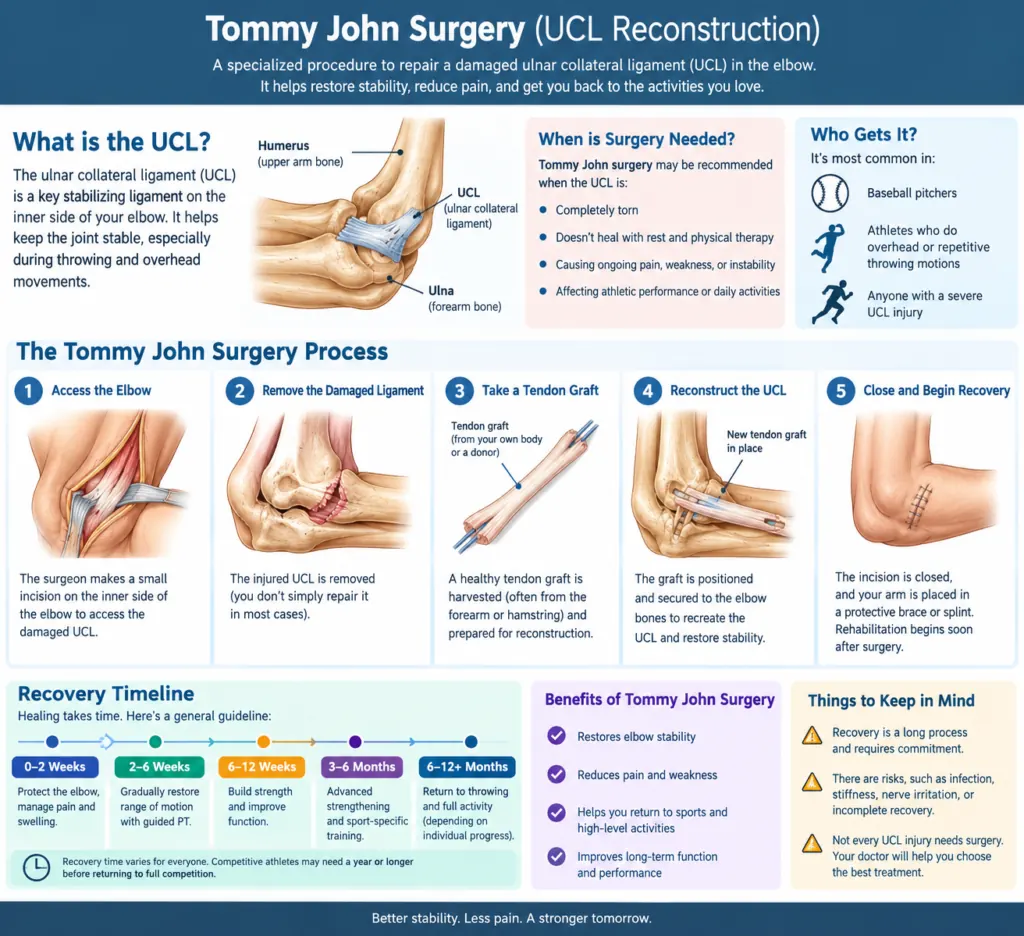
Tommy John surgery is a procedure used to reconstruct a damaged ulnar collateral ligament (UCL) in the elbow. During the procedure, the damaged ligament is reconstructed using a tendon graft to help restore elbow stability, particularly in athletes who perform repetitive throwing motions.
What Is Tommy John Surgery?
Tommy John surgery, medically known as ulnar collateral ligament reconstruction, is a procedure used to treat a significant UCL injury in the elbow.
The UCL is located on the inner side of the elbow and helps stabilize the joint. It is particularly important during throwing because it helps the elbow withstand the forces created by repetitive, high-speed movements.
The procedure became famous after professional baseball pitcher Tommy John underwent UCL reconstruction in 1974. Since then, the surgery has become closely associated with baseball pitchers and other throwing athletes.
However, not every person with a UCL injury needs Tommy John surgery. Treatment depends on the severity of the injury, symptoms, activity level, athletic goals, and response to nonsurgical treatment.
Why Is Tommy John Surgery Needed?
The UCL can become damaged because of repetitive stress, overuse, or an acute injury. Baseball pitchers and other overhead athletes can place substantial stress on the ligament through repeated throwing.
A UCL injury can range from a mild sprain to a partial or complete tear. Some injuries may respond to conservative treatment, while severe damage or ongoing instability may require reconstruction.
Tommy John surgery may be considered when:
- The UCL is severely or completely torn.
- Elbow pain continues despite appropriate nonsurgical treatment.
- The elbow feels unstable during throwing.
- An athlete cannot perform required sports activities.
- The injury significantly affects arm strength or function.
An accurate diagnosis is important because many different conditions can cause elbow pain.
What Are the Symptoms of a UCL Injury?
UCL injuries can develop gradually or occur suddenly. Throwing athletes may first notice discomfort on the inner side of the elbow that becomes worse with repeated activity.
In an acute injury, a person may experience a sudden pop followed by pain and difficulty continuing the activity.
Common UCL injury symptoms include:
- Pain on the inside of the elbow
- Weakness while throwing
- Reduced throwing speed or control
- A feeling of elbow instability
- Difficulty with overhead activities
- A popping sensation during an injury
- Pain that worsens with repetitive throwing
Persistent elbow pain should not simply be ignored, particularly when it affects athletic performance.
Athletes may also develop related shoulder problems because throwing involves the entire upper extremity. Maintaining appropriate conditioning with shoulder strengthening exercises for athletes can be an important part of an overall athletic conditioning program.
How Is a UCL Injury Diagnosed?
Diagnosis usually begins with a medical history and physical examination. Your doctor may ask when the pain began, whether it occurs during throwing, whether there was a specific injury, and whether you have experienced weakness or instability.
The physician may perform specific tests to evaluate elbow stability and determine whether the UCL is involved.
Imaging tests may also be used. Depending on the suspected injury, an MRI or other diagnostic examination may help evaluate the UCL and surrounding structures.
Because several conditions can cause pain in the elbow, shoulder, or arm, an accurate diagnosis is essential before deciding whether surgery is appropriate.
How Does Tommy John Surgery Work?
During Tommy John surgery, the surgeon reconstructs the damaged UCL using a tendon graft.
The graft may be taken from another part of the patient’s body. The surgeon prepares the graft and positions it around the elbow to recreate the stabilizing function of the injured ligament.
The general procedure involves:
- Accessing the elbow: The surgeon makes an incision to reach the damaged ligament.
- Preparing the injured area: Damaged tissue is addressed according to the surgical technique.
- Preparing the tendon graft: A suitable tendon is harvested or prepared for reconstruction.
- Reconstructing the UCL: The graft is positioned and secured to recreate elbow stability.
- Beginning recovery: The incision is closed and postoperative rehabilitation begins.
The exact surgical technique can vary depending on the patient’s injury, anatomy, activity level, and surgeon.
Is Tommy John Surgery Always Necessary?
No. Tommy John surgery is not automatically required for every UCL injury.
Some partial UCL injuries may improve with rest, activity modification, physical therapy, and other nonsurgical treatments. Surgery may be considered when the ligament is significantly damaged or when symptoms and instability continue despite conservative care.
Physical therapy can help improve movement, strength, stability, and function. Athletes should not assume that surgery is their only treatment option.
The appropriate treatment depends on the individual injury and the person’s goals.
What Is Tommy John Surgery Recovery Like?
Tommy John surgery recovery is a gradual process that can take many months. Rehabilitation is essential for protecting the reconstructed ligament and gradually restoring elbow function.
Early rehabilitation generally focuses on protecting the elbow and restoring appropriate movement. As healing progresses, physical therapy can introduce strengthening and functional exercises.
Throwing athletes eventually progress through a controlled throwing program rather than immediately returning to full-speed activity.
Recovery may involve:
- Protecting the elbow during early healing
- Gradually restoring range of motion
- Building arm and shoulder strength
- Improving stability and movement control
- Beginning controlled throwing when medically appropriate
- Progressing toward sport-specific activity
For general information about rehabilitation exercises, readers can also explore elbow pain exercises for recovery.
Athletes should follow their surgeon’s and physical therapist’s instructions closely. Returning to throwing too soon can place unnecessary stress on the healing reconstruction.
How Long Does Tommy John Surgery Recovery Take?
Recovery time varies between patients. Many people require several months of rehabilitation, while competitive throwing athletes may need a year or longer before returning to full competition.
The recovery timeline can depend on:
- Severity of the original UCL injury
- Surgical technique
- Healing progress
- Range of motion and strength
- Rehabilitation progress
- Type of sport
- Level of competition
A return-to-sport program should be individualized. Reaching a particular number of weeks or months after surgery does not automatically mean an athlete is ready for competition.
Throwing should progress gradually under professional supervision.
What Are the Risks of Tommy John Surgery?
Like any operation, Tommy John surgery has potential risks. These can include infection, elbow stiffness, nerve irritation or injury, persistent pain, weakness, graft problems, and failure to achieve the expected outcome.
Recovery can also be challenging because athletes may spend an extended period away from competitive sports.
Anyone considering surgery should discuss potential benefits, risks, alternatives, and expected recovery with an orthopedic surgeon.
Patients preparing for orthopedic procedures may also benefit from reading things to know before shoulder surgery for broader preparation and recovery considerations.
How Can UCL Injuries Be Prevented?
It is not possible to prevent every UCL injury, especially in athletes exposed to repetitive throwing. However, appropriate workload management, conditioning, recovery, and throwing mechanics may help reduce unnecessary stress on the elbow.
Helpful strategies include:
- Allow adequate recovery between intense throwing sessions.
- Follow appropriate throwing limits.
- Increase throwing intensity gradually.
- Maintain shoulder, arm, and core strength.
- Work on proper throwing mechanics.
- Avoid repeatedly playing through significant elbow pain.
- Seek medical evaluation when persistent symptoms develop.
The shoulder is an important part of throwing mechanics. Athletes can learn more about conditioning through shoulder strengthening exercises for athletes.
Tommy John Surgery and Other Upper-Extremity Injuries
A UCL injury does not always occur in isolation. Throwing athletes may also experience shoulder conditions, including rotator cuff injuries, labral tears, and shoulder impingement.
For example, rotator cuff tear symptoms and treatment explains another common cause of shoulder pain and weakness.
Likewise, shoulder impingement syndrome can cause pain during overhead movements and should be distinguished from elbow ligament problems.
Athletes experiencing shoulder discomfort can also learn about the top exercises for shoulder pain and review tips for shoulder pain relief.
Understanding the difference between these conditions is important because treatment should address the underlying diagnosis rather than simply the location of pain.
Physical Therapy vs. Surgery for UCL Problems
Physical therapy and surgery have different roles in treating orthopedic injuries.
Physical therapy may be recommended to improve strength, mobility, stability, and movement patterns. It can be used as part of nonsurgical treatment or during rehabilitation after surgery.
Surgery, on the other hand, may be considered when the UCL is significantly damaged and conservative treatment does not provide adequate stability or function.
The decision should not be based solely on an imaging result. Symptoms, physical examination findings, athletic demands, and treatment goals are all important.
Readers interested in understanding conservative versus surgical treatment can also explore physical therapy versus surgery for a shoulder labral tear.
10 Frequently Asked Questions About Tommy John Surgery
1. What is Tommy John surgery?
Tommy John surgery is a procedure used to reconstruct a damaged ulnar collateral ligament in the elbow. A tendon graft is used to recreate the stabilizing function of the injured ligament.
2. Why do baseball pitchers get Tommy John surgery?
Baseball pitchers repeatedly place substantial stress on the elbow during high-speed throwing. Repetitive stress can damage the UCL and, in severe cases, require reconstruction.
3. How long does Tommy John surgery recovery take?
Recovery can take many months. Competitive throwing athletes may need a year or longer before returning to full competition, depending on healing and rehabilitation progress.
4. Can a UCL tear heal without surgery?
Some partial UCL injuries may improve with nonsurgical treatment, including rest, activity modification, and physical therapy. Severe injuries or persistent instability may require reconstruction.
5. Is Tommy John surgery painful?
Pain and discomfort are expected after surgery and are managed as part of postoperative care. Your healthcare team can provide personalized instructions for pain management.
6. Can you throw again after Tommy John surgery?
Many athletes return to throwing following successful rehabilitation. The timing depends on healing, strength, symptoms, and sport-specific rehabilitation.
7. What tendon is used for Tommy John surgery?
A tendon graft may be taken from another part of the patient’s body. The exact graft and surgical technique can vary depending on the patient’s circumstances.
8. What happens if a UCL tear is not treated?
A significant UCL injury may cause ongoing pain, weakness, or elbow instability. The effects depend on the severity of the injury and the person’s activities.
9. Can physical therapy help a UCL injury?
Yes. Physical therapy may be used as nonsurgical treatment or during recovery after surgery. It can help restore movement, strength, stability, and functional control.
10. When should you see a doctor for elbow pain?
Persistent elbow pain, weakness, instability, or difficulty throwing should be evaluated by a healthcare professional. Sudden severe pain or a popping sensation during an injury also warrants medical assessment.
Conclusion
Tommy John surgery is a UCL reconstruction procedure used to restore elbow stability after significant damage to the ulnar collateral ligament. It is particularly associated with baseball pitchers and other throwing athletes, but not every UCL injury requires surgery.
Treatment depends on the severity of the injury, symptoms, activity level, and response to conservative care. When reconstruction is necessary, rehabilitation plays a major role in restoring movement, strength, and function.
If you experience persistent inner-elbow pain, throwing difficulties, weakness, or instability, consult an orthopedic specialist for an accurate diagnosis and personalized treatment plan.
Disclaimer: This article is intended for educational purposes only and should not be considered personalized medical advice.
This article is for education purpose only and is not a diagnosis or a substitute for medical advice.