
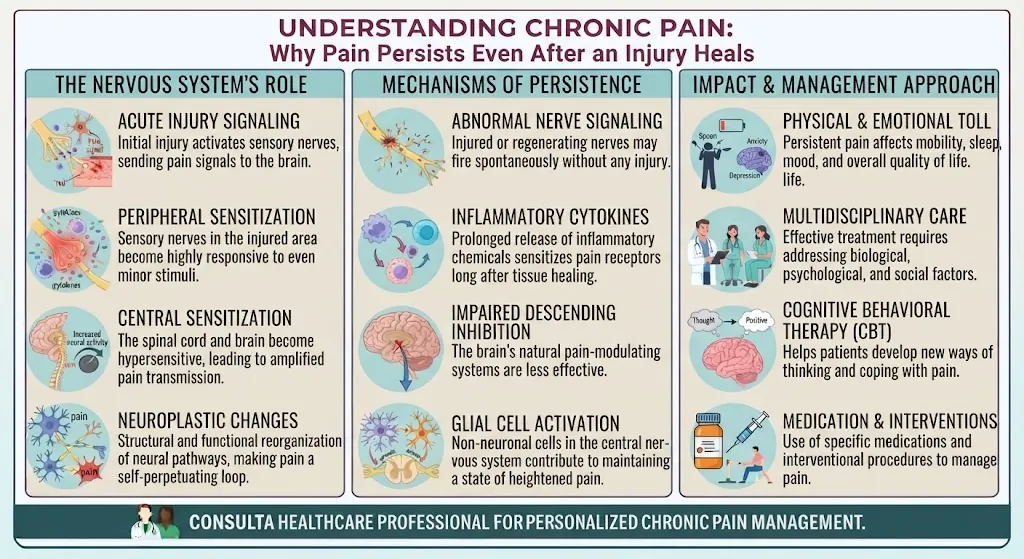
An old injury can seem fully healed, yet pain may return when you walk, exercise, sit for too long, or wake up in the morning. You might have regained your strength and mobility but still feel aching, burning, stiffness, or tenderness around the injured area. This can be frustrating, especially when medical tests no longer show an obvious problem.
Pain that persists after an injury heals does not automatically mean that the tissue is still damaged. Pain is influenced by more than the condition of muscles, joints, or bones. Nerve sensitivity, inflammation, movement patterns, sleep, and stress can also affect how pain is experienced.
Understanding why pain continues after an injury heals can help you recognize possible explanations, choose appropriate next steps, and know when to seek medical evaluation. Persistent pain is real, and it deserves attention even when the original injury appears to have recovered.

Why Can Pain Continue After an Injury Has Healed?
Pain can persist because tissue healing and the nervous system’s return to normal pain sensitivity do not always happen at the same pace. In some cases, the original injury has healed but the nervous system remains more responsive to signals from the affected area.
Other explanations include incomplete recovery, ongoing inflammation, nerve irritation, muscle weakness, or a separate condition that was not initially recognized. The likely cause depends on the injury, the symptoms, and how they change over time.
| Possible explanation | What may be happening | Common clues |
|---|---|---|
| Incomplete tissue recovery | The injured structure may still be healing or remain irritated | Pain with specific movements or loading |
| Ongoing inflammation | Inflammatory activity continues to irritate tissues | Swelling, warmth, stiffness, or tenderness |
| Nerve irritation or sensitivity | Nerves send stronger or unusual signals | Burning, tingling, shooting pain, or sensitivity to touch |
| Increased pain processing | The nervous system becomes more responsive to signals | Pain feels stronger than expected or spreads beyond the original area |
| Reduced strength or mobility | Muscles and movement patterns have not fully recovered | Discomfort with activity, stiffness, or reduced endurance |
These patterns can overlap. Symptoms alone cannot reliably determine whether an injury has completely healed or identify the exact cause of ongoing pain.
How Does the Nervous System Keep Pain Going?
Pain is a protective experience created through communication between nerves, the spinal cord, and the brain. During an injury, pain signals encourage you to protect the affected area while healing begins.
Sometimes, this protective system stays sensitive after the initial threat has reduced. The nervous system may respond more strongly to movement, pressure, or other signals that would ordinarily cause little discomfort.
One possible mechanism is central sensitization, which involves increased responsiveness in the central nervous system. It can contribute to persistent pain, but it does not explain every case and cannot be diagnosed from pain intensity alone. Learn more about how central sensitization can amplify pain.
This helps explain why pain does not always correspond directly to the amount of visible tissue damage. It does not mean the pain is imaginary, and it does not rule out a physical problem that needs treatment.
Can Inflammation or Nerve Damage Cause Persistent Pain?
Yes. Inflammation and nerve-related changes can both contribute to pain after an injury, although they produce different patterns.
Inflammation is part of normal healing, but it may continue if a tissue remains irritated or an underlying condition is present. Persistent swelling, warmth, or tenderness may suggest that further evaluation is needed.
Nerve-related pain may feel like burning, electric shocks, pins and needles, numbness, or pain that travels along an arm or leg. These symptoms can occur after a nerve injury or compression. New or progressive numbness or weakness should not be ignored.
An injury can also leave muscles weaker or joints stiffer because normal movement was limited during recovery. Gradually restoring strength and mobility may help, but exercises should match the injury and current abilities.
Can Stress and Poor Sleep Make Old Injuries Hurt Again?
Stress and poor sleep can make persistent pain harder to manage. Stress may increase muscle tension and affect how the nervous system responds to pain, while disrupted sleep can reduce pain tolerance and interfere with recovery.
This does not mean that stress caused the original injury or that symptoms are psychological. Physical and emotional processes interact, and addressing both may be useful. Read more about how stress can contribute to muscle and joint pain.
Pain may also become more noticeable when activity increases suddenly after a period of rest. That pattern can reflect reduced conditioning or sensitivity, but it should not automatically be attributed to either one without considering the injury and associated symptoms.
What Can You Do When an Old Injury Still Hurts?
The safest approach is to balance activity with recovery while avoiding movements that consistently cause significant worsening.
- Return to movement gradually. Start with activities you can tolerate and increase duration or intensity in small steps.
- Avoid prolonged inactivity when it is safe to move. Gentle movement may help maintain flexibility and strength, depending on the injury.
- Adjust painful activities. Reduce heavy lifting, repetitive movements, or high-impact exercise temporarily if they aggravate symptoms.
- Support sleep and recovery. Keep a consistent sleep routine and allow recovery time between demanding activities.
- Track meaningful changes. Note which movements trigger pain, whether symptoms are improving, and whether new symptoms appear.
- Seek individualized rehabilitation advice. A physical therapist or clinician can help adapt activity to your condition.
For example, low-impact exercises for people with joint pain may provide movement options when impact is uncomfortable. However, exercise is not appropriate for every injury at every stage. Follow any restrictions provided after surgery, a fracture, or a significant tendon or ligament injury.
Pain medication may help in some situations, but the appropriate choice depends on your health history and other medicines. Ask a healthcare professional or pharmacist about potential side effects and interactions before starting a new medication.
When Should You See a Doctor?
Pain that is not improving, repeatedly returns, or interferes with everyday activities deserves assessment. A clinician may review your injury history, examine movement and strength, assess nerve function, and decide whether imaging or other tests are needed.
| Symptom pattern | Recommended action |
|---|---|
| Mild discomfort that gradually improves and does not limit normal activity | Monitor the pattern and increase activity cautiously |
| Persistent or recurring pain, ongoing swelling, reduced movement, or pain that disrupts sleep | Arrange a medical appointment |
| New or progressive weakness, significant numbness, or rapidly worsening pain | Seek prompt medical assessment |
| Severe pain after major trauma, a visibly deformed limb, or a hot, swollen joint with fever | Seek urgent medical care |
| Back pain with new loss of bladder or bowel control or numbness around the groin | Seek emergency care immediately |
Do not assume that new symptoms are simply part of an old injury. A fresh injury, infection, nerve compression, or another medical condition may need separate treatment.
Frequently Asked Questions
1. Is it normal for an old injury to hurt months later?
Persistent discomfort can occur after an injury, but it should not automatically be considered normal. If pain continues, worsens, or limits activity, a healthcare professional can assess whether further treatment is needed.
2. Can an injury heal while pain remains?
Yes. Tissue healing and changes in pain sensitivity do not always progress together. However, ongoing pain can also reflect incomplete healing or another condition, so the cause should be considered rather than assumed.
3. Does pain always mean an injury has reopened?
No. Pain can occur without new tissue damage, particularly when the nervous system remains sensitive. Sudden pain after a new incident, loss of function, or new swelling still warrants appropriate assessment.
4. Why does my old injury hurt when the weather changes?
Some people report changes in pain with temperature, humidity, or barometric pressure, but responses vary and the mechanism is not fully understood. Weather-related discomfort alone cannot establish whether an injury has worsened.
5. Can exercise make persistent injury pain better?
Appropriately selected exercise may improve strength, mobility, and confidence with movement. The type and pace should be tailored to the injury, and significant or progressive pain should be assessed rather than pushed through.
6. Can stress make a healed injury painful again?
Stress can influence muscle tension, sleep, and pain processing, potentially making existing symptoms more noticeable. It does not prove that the pain is caused by stress or rule out a physical problem.
7. Should I rest until the pain completely disappears?
Not always. Extended inactivity can reduce strength and mobility, but some injuries require temporary protection or specific restrictions. Ask a clinician how much movement is appropriate for your situation.
8. Can an X-ray or MRI explain why an old injury still hurts?
Imaging may identify certain structural problems, but it cannot explain every type of persistent pain. Results need to be interpreted alongside your symptoms and physical examination.
9. How long can pain last after an injury heals?
There is no single timeline. Recovery depends on the injury, the tissues involved, nerve sensitivity, activity demands, and other health factors; persistent or worsening pain should be evaluated.
10. When should I worry about pain returning after recovery?
Arrange an assessment if pain repeatedly returns, interferes with sleep or daily activities, or is accompanied by swelling, weakness, or numbness. Seek emergency care for warning signs such as new bladder or bowel dysfunction with back pain or severe symptoms after major trauma.
The Bottom Line
Pain can persist after an injury heals because tissue recovery, nerve sensitivity, inflammation, strength, and movement do not always return to normal at the same time. Gradual activity, appropriate rehabilitation, and attention to sleep may help, but ongoing or changing pain deserves a careful assessment. The goal is to understand what is contributing to your symptoms and choose treatment that supports safe recovery.
Disclaimer: This article is provided for educational and informational purposes only.
This article is for education purpose only and is not a diagnosis or a substitute for medical advice.